

8. Ceramic Development in China
| 796 Page: 137 of 418 Go To Page: |  |
◁◁ First | ◁ Previous | Next ▷ | Last ▷▷ |
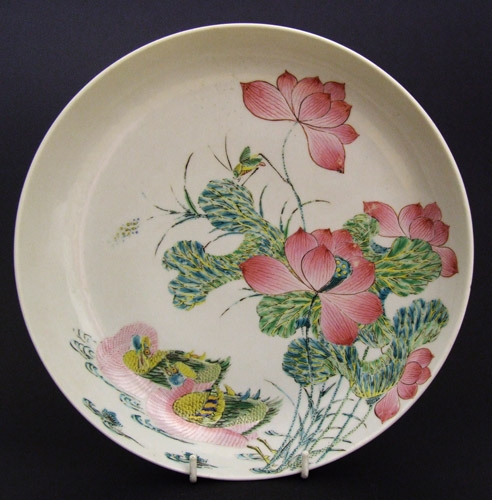
Yongzheng famille rose dish in the
Chinese taste - courtesy R&G
McPherson Antiques
During the short reign of Emperor Yongzheng (1723-35), the first Superintendent and second (Nein His-yao) strove for technical perfection.
The even more famous successor T’ang Ying, who was highly qualified and whose main interest was the chemistry of glazes, struggled with the balance between constant innovation and perfection of existing products, which caused foreign stimulation and experimentation to decrease and production to become more stable. “Famille rose” wares reached their peak at Jingdezhen between 1726 and 1736 under Nien His-yao, and the best material ended in 1753 with the death of T’ang Ying. However, very fine wares continued throughout the Qianlong period (1736-1795) and even into the 19th century (often with Kangxi Reign marks!).
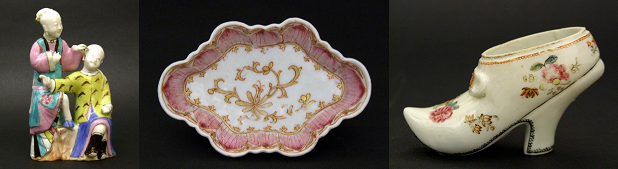
Qianlong export famille rose, figure group, spoon
tray and western shoe shaped snuff box
- courtesy R&G McPherson Antiques
Shapes and decoration were very varied. Motifs used for decoration were deities and auspicious emblems (bringing good fortune), landscapes and figure scenes – including tall elegant young ladies, together with flowers and birds, many taken from contemporary paintings.
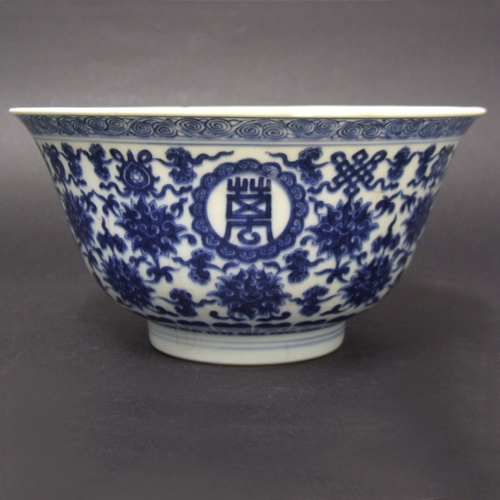
Qianlong imperial bowl with Buddhist
emblems - courtesy R&G McPherson
Antiques
These wares were mainly produced for export, and followed the requirements of the market, for example using Imari style decoration, but the following Qianlong Emperor also liked them.
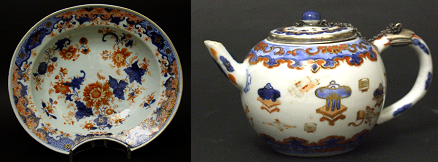
Qing Imari barber’s bowl and teapot
with 100 antiques design - courtesy
R&G McPherson Antiques
He also thought highly of the painter, Zou Yigui, whose depictions of flowers were no longer outlines but areas of solid colour and this style was copied by porcelain decorators of the day. The Emperor also had preferences for some motifs, particularly the cock and hen, used since the Ming period. The cock represents the five Han virtues – literary culture, warlike spirit, courage, unselfishness and trustworthiness.
However, Court demand for unrealistic imitation in porcelain of archaic bronze, gold and jade items, and, as extreme examples, porcelain musical instruments and perforated boxes, challenged the skills of potters at Jingdezhen.
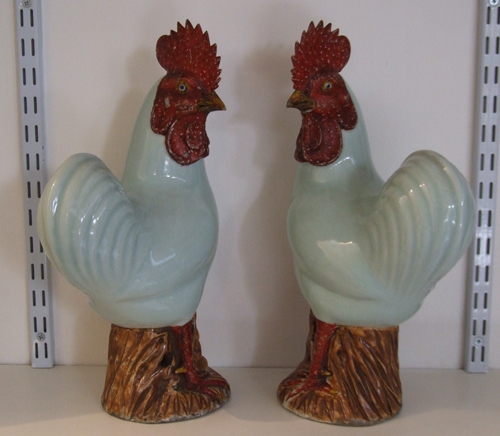
Qianlong cockerels, bases and beaks iron
glazed but combs and crops cold painted,
probably private trade by ship’s captain
- courtesy R&G McPherson Antiques
Particularly popular during the 18th century were the pure white wares. These were extremely high quality porcelain from Jingdezhen, so thin they were called “bodiless wares” incised in low relief with “an hua” decoration, sometimes pierced, and Dehua “Blanc de Chine” figures.
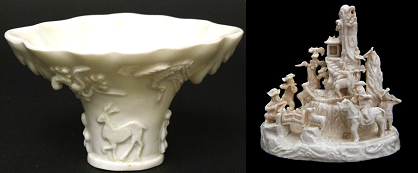
Kangxi Dehua blanc-de chine porcelain
libation cup and European hunting scene
- courtesy R&G McPherson Antiques
Much of the latter had been for religious use, and included Buddhist sculptures, but also represented the sculpture of the period. Europeans imported a great deal of “Blanc de Chine” as single figures or groups, but there were also some small cups, boxes and dishes.
| Page: 137 of 418 Go To Page: | |
◁◁ First | ◁ Previous | Next ▷ | Last ▷▷ |
Author: Dr. Stan Jones © Copyright 2010 -