

9. Ceramic Development in the Middle East
| 907 Page: 151 of 418 Go To Page: |  |
◁◁ First | ◁ Previous | Next ▷ | Last ▷▷ |
Uruk itself became a settlement around 5,000 BC as part of the Ubaid Culture. It developed as a trading centre that was, at that time, on the river Euphrates. It grew to be a large city covering some 6 sq km, with a city wall 9.5 km long, and by about 3,300 BC it had a population of around 40,000 people. As with most Sumerian cities many religious buildings were erected between 3,400 and 2,900 BC. A unique mosaic-like technique was used on buildings in Uruk and other cities, based on conical-shaped, ceramic “nails” some 3-8” long with 2-5” diameter heads embedded closely together in the mud-brick wall surface. The blunt outer ends were painted red, black and white, to produce patterns such as zigzag lines and lozenges on walls, columns and niches. These cones partially shielded the core of sun-dried bricks from the elements. This technique died out with the Uruk Culture. There were also similar foundation pegs with inscriptions relating to treaties and messages from kings to gods.
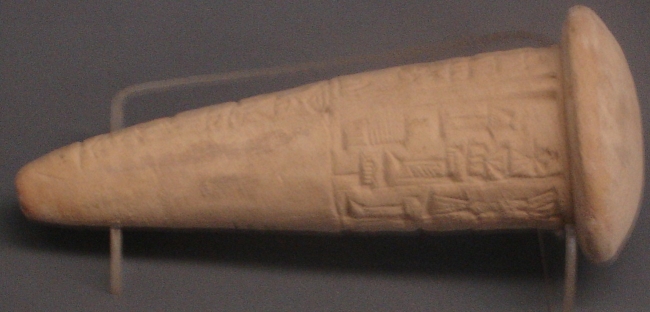
Akkad dynasty, Lagash, Sumeria, wall cone
22nd century BC - source museum
Istanbul
Lack of stone and other raw materials led to the early use of fired bricks for building, probably before 3,000 BC, a spin-off from the pottery industry. However, the shortage of fuel meant they were not used where mud bricks would suffice in the dry climate. They were used as the outer shell of the ziggurats, for underground facilities such as graves and cellars, for wall tops and pavements. The contrast with the massive elaborate Egyptian buildings made of readily available stone is obvious. The Rulers lived in large palaces with courtyards but most people lived in closely packed small houses. Artisans such as potters lived and worked in the same area, the frontage of the houses being shops forming a bazaar.
Trading by this time had become extensive, often using canals and the Euphrates River for transport, bringing great riches. Imports from Anatolia and Afghanistan included copper, gold, silver, obsidian, jewellery stones (some also from India), stone, wood and perishable goods such as spices, oil and textiles. Exports of pottery, cylinder seals and finished goods including silver, lapis and obsidian went to, for example, Susa, settlements in the Zagros Mountains and Egypt. They also invented early musical instruments such as the lyre around 4,000 BC.
Excavations again revealed several levels under the ziggurat. At the level dated to about 3,500 BC there was a temple made, surprisingly, out of limestone. Earlier levels revealed the remarkable pottery cone shapes with the brightly coloured ends, models of animals and red and black painted pottery urns. Another discovery at Uruk was a form of artificial stone, like concrete, dated to 3,000 BC. It appears that this technology was lost soon afterwards.
Coincident with this transition from Eridu to Uruk, (4,000 BC) another distinctive style of painted pottery developed and rapidly spread throughout Mesopotamia. This Uruk style pottery was made by the people we now describe as Sumerians, but they would have considered themselves part of their individual city-state rather than a single group or Culture. It began with buff pottery bodies tempered with chaff (wheat husks) and decorated with red and black painted pictures of animals. There was, however, a further move from “home” produced painted pottery made on a slow wheel, to a great variety of painted and unpainted pottery made by specialists using a faster wheel – an early example of the arrival of “mass production”. The decorative artistry of this period stands out and great quantities of painted pottery of high quality were produced that also show clear signs of specialized craftsmen from their styles and decoration as at Eridu. There were vases with a spouts and some vessels with eggshell thin walls dated between 4,000 and 3,500 BC.
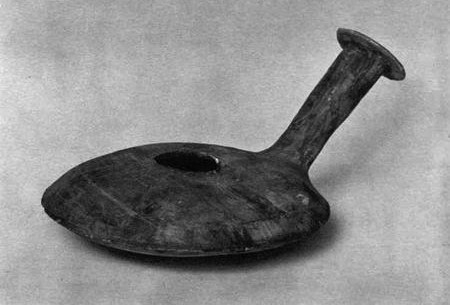
Eridu, early Uruk, vase with spout
4,000-3,500 BC - source National Museum of
Iraq, Baghdad
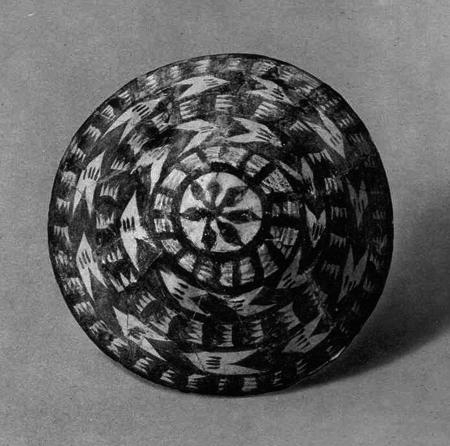
Eridu, early Uruk, conical painted
eggshell cup 4,000-3,500 BC - source
National Museum of Iraq, Baghdad
| Page: 151 of 418 Go To Page: | |
◁◁ First | ◁ Previous | Next ▷ | Last ▷▷ |
Author: Dr. Stan Jones © Copyright 2010 -