

9. Ceramic Development in the Middle East
| 905 Page: 152 of 418 Go To Page: |  |
◁◁ First | ◁ Previous | Next ▷ | Last ▷▷ |
Everyday pottery had a grey or red burnished body. A large number of coarse, bevelled-rim bowls were also produced, all made to various standard sizes, as measures, probably for allocating the State food ration. They were not made on a wheel, but appear to be made in crude moulds, perhaps shaped holes in the ground. The shape of this bowl served as the original for the sign meaning “litre”. Pottery animal heads were made around 3,300 BC probably to adorn buildings, the sheep being a popular subject probably due to its significance for clothing and food.
Another pottery style called after the name of the next period, Djemdet Nasr, took over around 3,250 BC in South Mesopotamia, between the Uruk period and the first Ur Dynasty. It was fairly thick-walled, wheel-turned, polychrome pottery with vertical bands of geometric decoration including hashes and triangles, often in black and plum on a buff pottery body, again indicating the influence of South West Persia. Jars and vases, some spouted, and bowls with four lugs with shapes often derived from metalware, have been found dated around 3,000 BC.
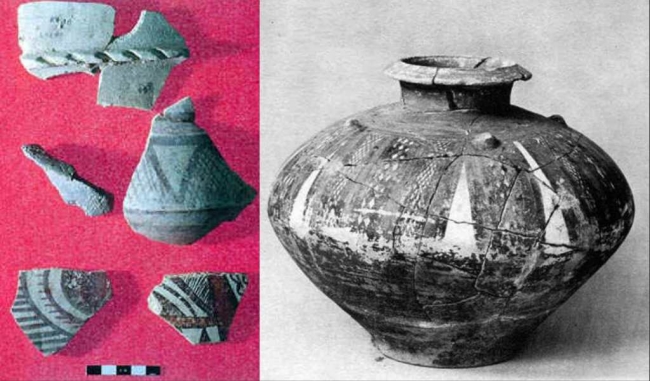
Djemdet Nasr painted sherds and pot,
3rd millennium BC - sources Dra
Ana Vasques Hoys and National Museum of
Iraq, Baghdad
Djemdet Nasr pottery, such as a flat-rimmed jar with red and black decoration, has been found in the United Arab Emirates, showing the link with the Oman peninsular, an important source of copper for Mesopotamia. At this time there was considerable trade between Sumer and the rest of the region, which spread its Culture and influence. Sumerian style seals were found at Byblos and numerous artefacts in Syria.
The first recognized written “language” began in Sumer around 3,500 BC, probably because the people were such avid record keepers, and it is likely to have been an evolution of the previous thousands of years of painted symbols on pottery and marks on seals and tokens. It seems to have been triggered by temple accounting for stored or exchanged goods using numbers and pictures of produce. Initially it was based on pictographs (similar to probably slightly later Egyptian hieroglyphics), consisting of pictures on clay tablets representing objects and concepts. For example a man’s head together with a bowl represents a ration. Excavations at Uruk revealed 5,000 tablets with inscribed pictographic writing dated to around 3,500 BC, together with small clay tokens of different shapes representing numbers. These were sealed in bullae (hollow fired clay balls/sacs used as “envelopes”) using cylinder seals. Examples of early pictographs on clay tablets have also been found in Tell Brak in Northern Mesopotamia (North-East Syria), clearly used for temple accounts. The depictions also possibly identified persons or groups. Tell Brak is just a 50m high mound now, but large numbers of “bevel rimmed bowls” have been found made from moulds that were shaped holes in the ground. They were of standard size hence thought to be rationing bowls.
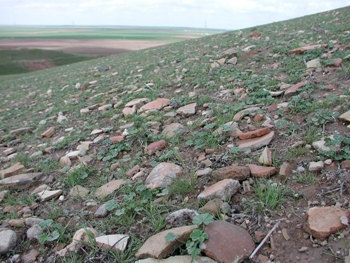
Tell Brak sherds
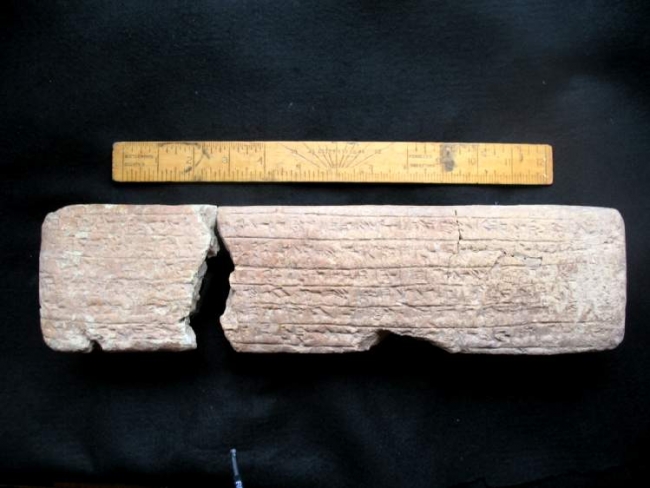
Elamite cuneiform brick - courtesy
Collector-Antiquities
The written language was subsequently elaborated to cover political propaganda, letters between the elite, myths, songs, poems and epics. The language developed towards the end of the 4th millennium so that pictographs gradually became simplified or representational, and presented as a series of small wedge-shaped marks impressed in soft clay with a stylus, which was then fired to harden. It is known as cuneiform writing after the (much later) Latin cuneus, meaning wedge.
| Page: 152 of 418 Go To Page: | |
◁◁ First | ◁ Previous | Next ▷ | Last ▷▷ |
Author: Dr. Stan Jones © Copyright 2010 -