

9. Ceramic Development in the Middle East
| 904 Page: 153 of 418 Go To Page: |  |
◁◁ First | ◁ Previous | Next ▷ | Last ▷▷ |
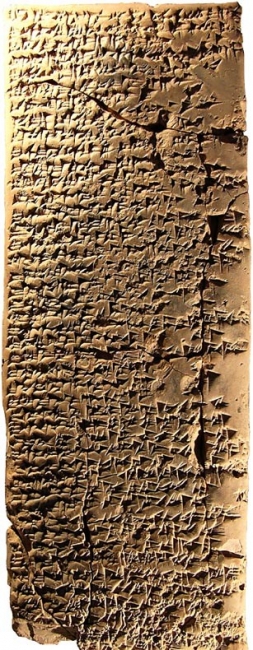
Cuneiform tablet
recounting the epic
of Gilgamesh
- source
Schoyen College
By 2,600 BC it had developed a formal grammar. Having a written language was a hugely significant breakthrough in terms of social interaction and organization, and was a major contribution towards the Sumerians being described as the “First Civilisation”. Also our knowledge of the succeeding development of the Sumerian Culture increased greatly with the discovery of well-preserved tablets containing this cuneiform writing recording day-to-day life in South Mesopotamia from that time. As an example, the long narrative poem “The Epic of Gilgamesh” is one of the oldest works of literature in the world, written around 2,000 BC in cuneiform on clay tablets.
Sumerian cuneiform literature is still not fully understood as tablets are often fragmentary and the grammar is so difficult. It is unlike any other language except perhaps Hungarian. However, Hungarian, Finnish and Estonian are derived from North Russia and distinct from Indo-European, so the link is tenuous. Reading and writing cuneiform Sumerian was always difficult as the alphabet is made up of 550 characters and scribes required years of training to master it.
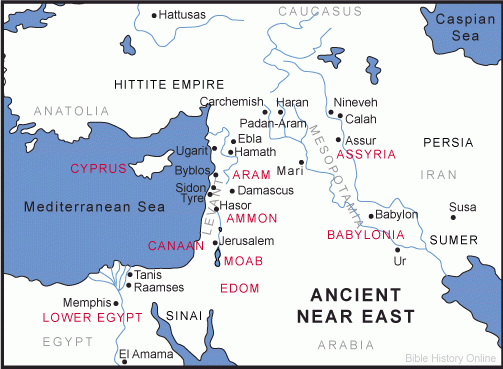
Map of Near East around 14th century BC
- source Bible History on-line
From 2,600 BC Mari (on the Syrian border) became the centre of cuneiform writing and some 17,500 tablets have been found there. Cuneiform spread, primarily by trade routes, to Susiana, Anatolia, the Levant and further east via Bahrain to the Indus. Although cuneiform writing was used subsequently for several languages, before the Akkadians took over in 2,334 BC documents were almost entirely in Sumerian. Another example of the spread of Sumerian Culture is in the city-state of Ebla in North Syria, which was settled before 3,000 BC. Some 15,000 clay tablets were discovered, containing cuneiform Sumerian text and another unknown language, dated to about 2,500 BC. There was also text found on hollow clay cylinders dated to 2,350 BC. The records show the inhabitants of Ebla owned 200,000 sheep, cattle and goats. Kilns were discovered near the cemetery, together with many pottery vessels including a spouted jar dated to 2,300 BC.
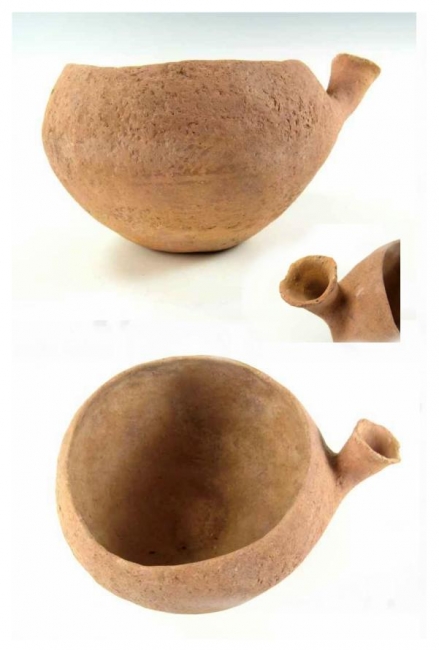
SyrioLevant spouted bowl 2,000 BC
- courtesy Collector-Antiquities
One pot contained the remains of a baby. Ebla was destroyed by the Akkadians in 2,240 BC.
The city of Uruk continued to grow, and round 2,700 BC the king was reputed to be the powerful ruler Gilgamesh referred to above. The famous stories of him led researchers to believe he was a legend, but he is now thought to have been genuine, thanks to an inscription found on a contemporary vase. Information on kings in this era has also been found as inscriptions on vase fragments.
Many thousands of people from Uruk moved to set up enclaves in neighbouring countries, again probably trading Uruk pottery and other finished goods for materials not available in Southern Mesopotamia. One provincial site was Tell Habuba Kabira, in North Levant, where ceramic cone wall mosaics and bullae with cylinder seal imprints were found. Uruk continued to flourish through the early Dynasties of Ur, but declined after 2,000 BC. However it continued to be an important religious centre and city for millennia. A Parthian plaque was found there dated to around 100 BC, probably depicting feasting at a funeral.
| Page: 153 of 418 Go To Page: | |
◁◁ First | ◁ Previous | Next ▷ | Last ▷▷ |
Author: Dr. Stan Jones © Copyright 2010 -