

9. Ceramic Development in the Middle East
| 903 Page: 154 of 418 Go To Page: |  |
◁◁ First | ◁ Previous | Next ▷ | Last ▷▷ |
9.12 Ur
Ur was another settlement that started around 6,000 BC, then near the outlet of the Euphrates, but now well inland, just west of Eridu. Handmade pottery has been found at Ur below the 3-metre thick clay/silt layer called the “Flood Deposit” likely to have occurred around 3,500 BC. Examples are an Ubaid style pottery female figure suckling a baby, detailed in black including possible tattoos, dated around 4,500 BC, and a pottery boat dated around 4,000 BC.
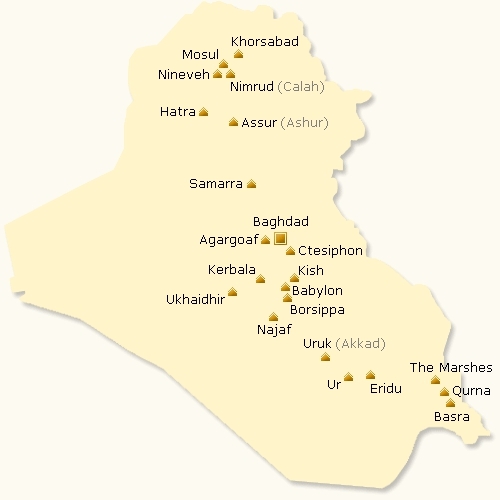
Map of ancient Mesopotamian cities
- source Atlastours.net
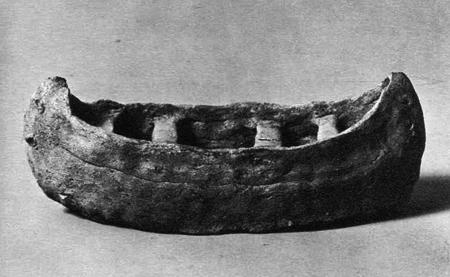
Ur, model of boat 4,000-3,500 BC
- source National Museum of Iraq, Baghdad
It is possible that this severe flooding gave rise to the story of Noah in the Old Testament, (although another source could have been the much bigger event around 6,400 BC when the water level had risen in the Mediterranean, assisted by the draining of a huge lake in Canada, to such a height that it was some 500 ft above the level of the modest lake that became the Black Sea. Probably starting as a trickle, no doubt assisted by earthquakes, the water broke through at the Bosporus and grew to a waterfall bigger than Niagara and a large area of the Ukraine disappeared under water in only 30 to 40 years. This tremendous event would have been passed on by word of mouth throughout the region). There is also an old Babylonian account of a flood in cuneiform writing dated to 1,635 BC from the royal library at Nineveh. Apparently the gods were fed up with the noise made by people so they arranged a flood to get rid of them, but Enki, the god of wisdom and water, gave a warning to a devotee Atrahasis who built a boat and was spared.
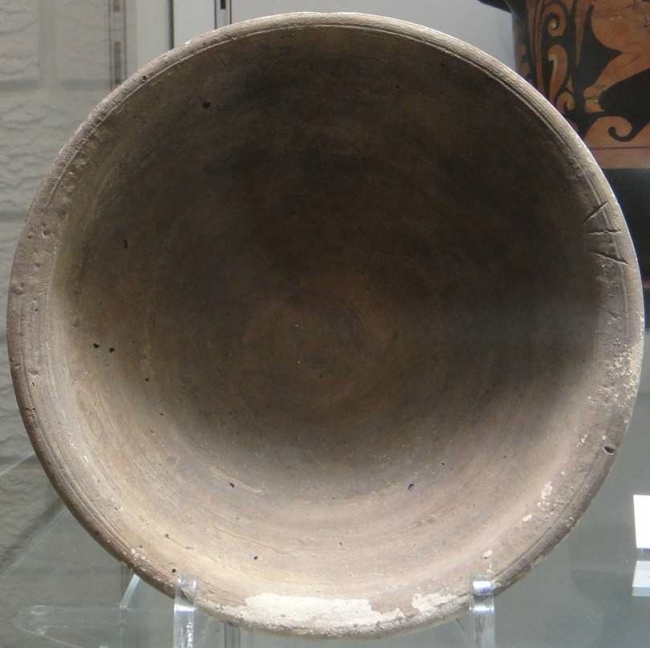
Mesopotamian wheel made dish, 3,000 BC -
Image courtesy of the Potteries Museum
& Art Gallery, Stoke-on-Trent
Wheel-made, Uruk-style, decorated pottery was found immediately above the flood layer, and Ur has revealed some particularly good examples of these painted designs. Vases, bowls (some with feet) and goblets have been found dating to about 3,200 BC, generally decorated in dark colours on a light ground. Earthenware statuettes have also been found around this date. A pottery vessel with long spout, based on a copper prototype, is an ancestor of many later variations from this region. After 3,000 BC decoration in the region reduced somewhat, but there are examples of large, buff pottery stands from graves with inscribed leaves and triangles filled with wavy lines dated around 2,500 BC. Utilitarian pottery was also wheel made.
By 3,000 BC there was a remarkable organization at Ur to administer the huge estates in the city-state. They counted everything – thousands of cattle and tens of thousands of bundles of reeds, using the numbering system the Sumerians devised based on 60. For example the hour was divided into 60 minutes, and the circle into 360 degrees, which of course has been passed down worldwide to today. They used multiplication tables and mathematics. Priests studied the skies, recording the movement of planets and stars so they could make calendars necessary for a farming society, and might well have developed the Zodiac and its signs.
| Page: 154 of 418 Go To Page: | |
◁◁ First | ◁ Previous | Next ▷ | Last ▷▷ |
Author: Dr. Stan Jones © Copyright 2010 -