

9. Ceramic Development in the Middle East
| 899 Page: 159 of 418 Go To Page: |  |
◁◁ First | ◁ Previous | Next ▷ | Last ▷▷ |
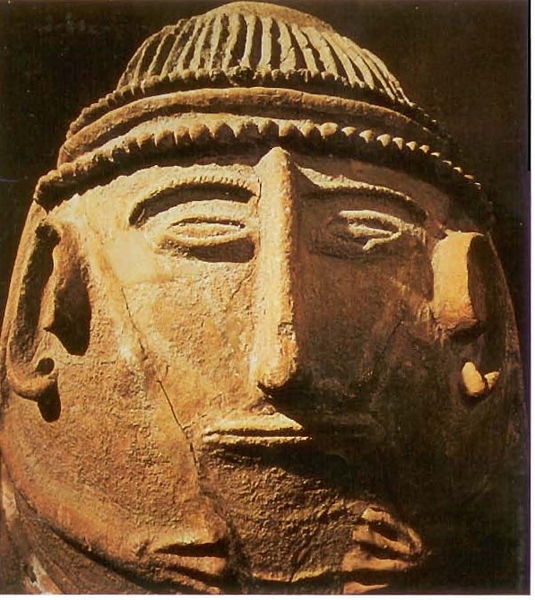
Lid of Philistine coffin - source Centre
of on-line Judaic Studies
Around the same time as some of the sea people started to settle in Phoenicia, the Philistines started to settle in the Levant. They appeared as early as 1,400 BC producing very characteristic “sea people” pottery coffins, some slipper shaped, with lids having a raised decoration of a face and arms. Some depicted their characteristic feathered headdress.
Somewhat similar coffins have been found in Egyptian controlled Levant dated to 1,300 BC. Their method of manufacture makes it likely ordinary potters made them as they started as large closed jars, using coiling and lots of straw temper. After drying, one side was cut out to form a lid. The face was modelled with clay and the whole was probably low-fired on an open bonfire. Colour was added as red or white slip and the face picked out in gold, black and red paint.
The Philistines expanded their boundaries around 1,100 BC, razing some neighbouring cities and building others. Although other cultural roots were broken, the early Philistine locally made pottery was distinctive and clearly traceable back to the late-Helladic-style Mycenaean, decorated in brown on black, initially imported from Cyprus. This developed into a distinctive Philistine pottery, mainly bowls and jugs, with black and red decoration on a white slip, having bold geometric borders containing birds, fish and sailing vessels or bold swirls.
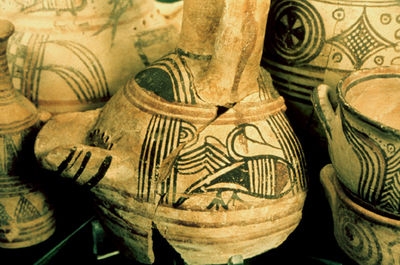
Philistine vessels - source, women in the
bible.net
There were other Cypriot influences such as vessels with long necks. Late period Philistine ware used very striking geometric and stylised animal and bird patterns in black and red on a cream slip. The Philistine Culture died out around 600 BC when overrun by the army of Nebuchadnezzar of Babylon.
Whilst the effect of the Sea People was huge, the Phoenician coastal towns of Tyre, Sidon, Byblos, Beirut and Arvad quickly recovered. The Phoenicians, encouraged by Mycenaean mariners, together with population pressures and external hostilities became ever more oriented towards the sea. So not long after 1,200 BC these rich commercial Phoenician cities started to establish trading colonies in many places along the Mediterranean trade routes, including Sardinia, Cyprus, Malta, Sicily and especially Carthage, on the coast of present-day Tunisia, notable from about 750 BC.
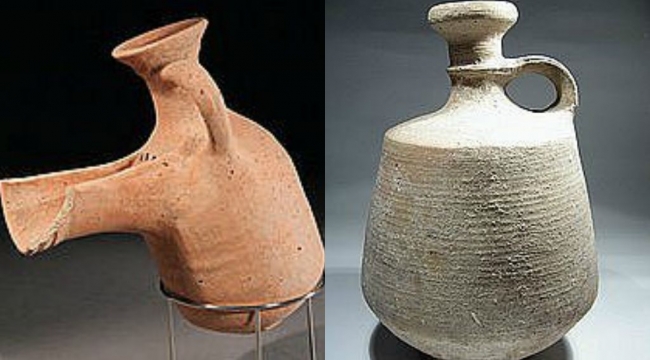
Israelite beer strainer and wine decanter,
800 BC
Between the withdrawal of Egyptian rule in Syria around 1,100 BC and the Assyrian demand for subservience and tribute around 800 BC, there were no lasting major military powers in West Asia, so smaller states such as Phoenicia and the Hebrew kingdom could prosper.
During these 300 years the Phoenician city-states remained relatively independent of each other. Byblos was the greatest Phoenician city while Sidon and Tyre were trade and business centres. During the 10th century BC, power moved from Byblos to Tyre, but Byblos remained the religious centre, and all the known early Phoenician literature was found there. It was particularly noted for its importation from Egypt of papyrus for writing, so much so that when the writing of the Hebrew Prophets was translated into Greek on papyrus, it was called the Bible after Byblos, its main source.
The Phoenicians are now also remembered for another major development, the “alphabet”, probably developed to assist in their expanding trade with Mediterranean peoples. By about 1,200 BC the Phoenicians had developed a series of written symbols, known as the Phoenician Script. It was probably based on simplified Sumerian cuneiform and the Egyptian hieroglyphic hybrid alphabet discovered in Sinai dated about 1,500 BC. Phoenician script had 22 consonants each representing a spoken sound. This script rapidly spread via the Phoenician merchants in their trade. Around 1,000 BC the Greeks took on this set of Phoenician symbols so aleph became alpha and beth became beta. The Greek “alphabet” was born, and passed on via the Romans to present day English. The Phoenicians provided the Greeks not only with the alphabet but also Phoenician designs for their pottery and standards for weights and measures.
Although the Phoenicians are said to have had a considerable library of written works on papyrus, it has all decayed and been lost. However, people they came in contact with, such as the Egyptians, had scribes record some of their works, and others were inscribed into stone by artists in Assyrian Nineveh. Otherwise all that remains are ruined cities and some tombs – those around 600 BC containing Greek pottery.
| Page: 159 of 418 Go To Page: | |
◁◁ First | ◁ Previous | Next ▷ | Last ▷▷ |
Author: Dr. Stan Jones © Copyright 2010 -