

9. Ceramic Development in the Middle East
| 898 Page: 160 of 418 Go To Page: |  |
◁◁ First | ◁ Previous | Next ▷ | Last ▷▷ |
The Phoenicians were united in their focus to trade throughout the Mediterranean, becoming its major maritime trading nation around 1,000 BC. They were masters of seamanship and developed sizeable galleys with rows of oarsmen and square sails, possibly using some Cretan technology. They also were the first to use the North Star for navigation, later picked up by the Greeks, as was their ship design and the benefits of marine trading. The Phoenicians reached Gibraltar and Cadiz (1,110 BC) and progressed up the Atlantic coast of Iberia. From the 11th century BC they were mining copper in Rio Tinto, Seville. Spain itself is a Phoenician word meaning “Land of Hydraxes”. The Phoenicians set up other settlements there such as at Malaga before 700 BC, and it had a substantial city wall by the 6th century BC. Although unproven, it is said they traded in tin from Cornwall. During this time the Phoenicians were powerful enough to monopolise trade throughout the Mediterranean, often using amphorae made locally.
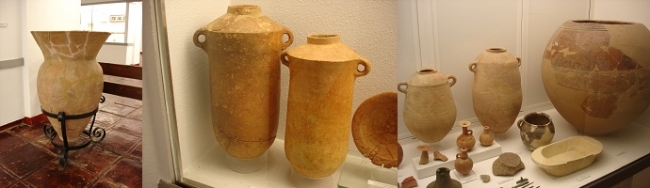
Vessels in Spain a) 2 ft tall amphorae 5th century BC,
b) containers for provisions 3.5 ft tall 7-6 century BC
and c) amphorae together with large storage vessel
9-6 century BC - source Archaeological
Museum, Seville
They traded in timber, metals, linen, foods, pottery, slaves and glass, (they were the first to “blow” glass vessels). They imported papyrus, ivory, ebony, silk, amber, spices, horses, precious metals and jewellery. Phoenicians were hired by the Egyptian Pharaoh Necho II to circumnavigate and map the coast of Africa around 600 BC becoming the first people to do so. It is possible that contact with the Phoenicians may well have sparked off the Greek cultural revival around 950 BC, after their Dark Ages. Certainly pottery from Canaan that was exported to Greece by the Phoenicians influenced Greek pottery decoration during the 8th and 7th centuries BC.
Carthage became the greatest port in the Western Mediterranean from the 7th century BC and the Phoenician’s most lasting colony. Although there were wars with the Greeks over Sicily, the two traded from the time of the earliest Phoenician colonisation. Pottery from Corinth, Athens, Ionia and Rhodes were found at Carthage and Utica (north west of Carthage) together with imports from Phoenicia and Egypt.
The real importance of the Phoenicians to Archaeologists is because the latter use pottery extensively to trace contacts between peoples. Since pots were widely distributed in the course of trade, particularly by the Phoenicians in the Mediterranean, they show clearly trade partners at various dates. This helps to explain times of war and peace, and who was allied to and traded with whom. Although the Greeks independently reached Spain in 575 BC, the Phoenicians carried much older fine Greek pottery there and past Gibraltar from 800 BC. The new style Greek pottery from around 760 BC, as well as Egyptian pottery, were carried to Iberia and Italy. A shipwreck off Majorca contained pots decorated with “Punic” writing. Punic was the name given to the Phoenicians, particularly from Carthage, by the Romans.
To hold off the Assyrian threat around 800 BC the Phoenicians paid them tribute for many years using silver imported from Spain. However, the Assyrians finally invaded in 732 BC, and controlled the area until their subsequent fall in 612 BC. Shortly afterwards, provoked by Egypt, Nebuchadnezzar II of Babylonia sacked Jerusalem, marched on Phoenicia and besieged Tyre. It held out for 13 years and then capitulated in 573 BC. Subsequently Phoenicia became subject to Persian control in 538 BC but they were left to carry on trading, and when the Persian leader, Xerxes, invaded Greece, the Phoenician fleet and its king were major participants.
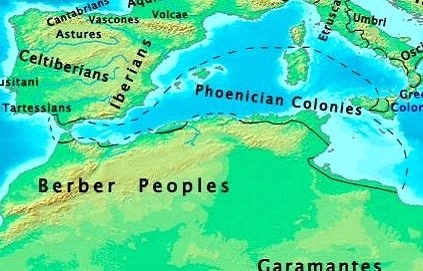
Map of Carthaginian Region 650 BC - source
Thomas Lessman
Continuous pressure by invaders caused native Phoenicians to emigrate to Carthage, so its importance grew and it became increasingly independent until it effectively became the centre of the “Carthaginian” Empire.
At its peak Carthage was probably the richest city-state in the world. However, there was serious trade rivalry with the Greeks in the 5th century BC and the Romans in the 3rd, which, in the case of the Romans, led to the Punic wars. Pottery found at Carthage was aligned with Phoenician Culture, for example urns that were used to contain the ashes of children who had died and small animals sacrificed to the gods dated to 5th century BC were similar to the Canaanite style around 1000 BC.
| Page: 160 of 418 Go To Page: | |
◁◁ First | ◁ Previous | Next ▷ | Last ▷▷ |
Author: Dr. Stan Jones © Copyright 2010 -