

9. Ceramic Development in the Middle East
| 914 Page: 167 of 418 Go To Page: |  |
◁◁ First | ◁ Previous | Next ▷ | Last ▷▷ |
Mud brick buildings started to be built at this time, alongside those made from reeds, and it is thought that the original concept of Egyptian town planning also began in this period. Egyptians developed early musical instruments, notably harps and flutes, and a very early board game called Senet. Another innovation that possibly dates back to the Tasian period was the cosmetic palette for preparing (grinding) and holding the materials (coloured stones such as malachite) used to decorate the eyes etc.

Naqada II siltstone palette UC4690 -
Copyright of the Petrie Museum of Egyptian
Archaeology, UCL
Early ones were simple, but by the Amratian period there were lozenge and oval shapes. The heavy make up round their eyes was first used as an insect repellent to protect them. Pottery models of buildings were included as grave offerings, and give much information on the architecture of the time.
The Gerzean Culture (Naqada II) developed from the Amratian but with marked differences, especially in pottery. As it started at the Nile delta, it included the influence of the northern peoples. The Culture moved through Upper Egypt but did not displace Amratian in Nubia. People’s lifestyle became even more sedentary and settlements became cities housing around 5,000 people. There was still occasional hunting of desert dwelling animals, but food production was almost entirely agricultural. The Gerzean society and economy became much more sophisticated, with evidence of leaders or elders and new social structures in the agriculturally-based cities. It was during this period that the foundations of Dynastic Egypt were laid. Interestingly, Dynastic leadership started in the relatively poorer stretch of the Nile valley from Aswan to Abydos in Upper Egypt, possibly because entrepreneurship was needed to make the region successful. The buildings in the cities were now predominantly mud-brick, and more elaborate. Superb relief carvings started to appear on stone or, less frequently, ceramic palettes giving hugely valuable informative details of political and other contemporary activities. They were now chiefly used as commemorative and ritual offerings. Copper weapons also started to appear. The earliest evidence of glass discovery in Egypt was around 3,500 BC, much the same date as in Mesopotamia.
Also by the Gerzean period classical Egyptian tombs began to be used, modelled on normal houses, some having multiple rooms. Although evidence is scarce, it is thought they also started in the Nile Delta region and spread into Upper Egypt. In these tombs the dead were surrounded by grave goods such as pottery vessels and figures, palettes and carved ivory. Pottery models such as an example of four cattle on a base probably represented food for the afterlife.
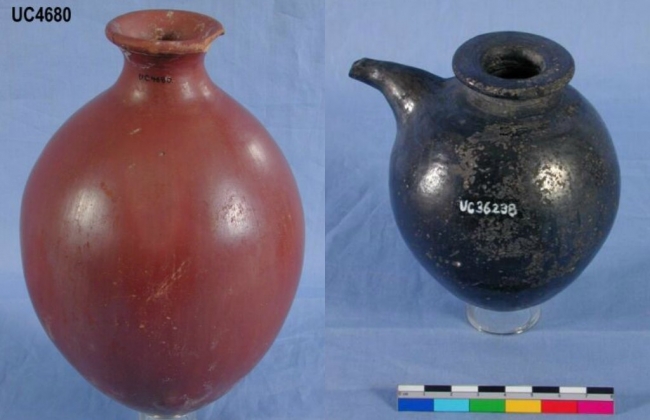
Naqada II polished red ware pot and black
polished jar with spout UC4680 and 36238 -
Copyright of the Petrie Museum of Egyptian
Archaeology, UCL
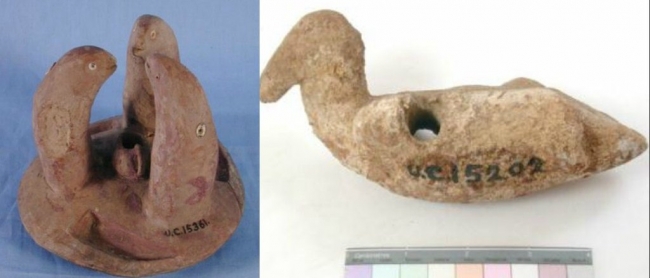
Naqada II, three snakes with ostrich egg
shell eyes and duck model UC15361 and
15202 - Copyright of the Petrie Museum of
Egyptian Archaeology, UCL
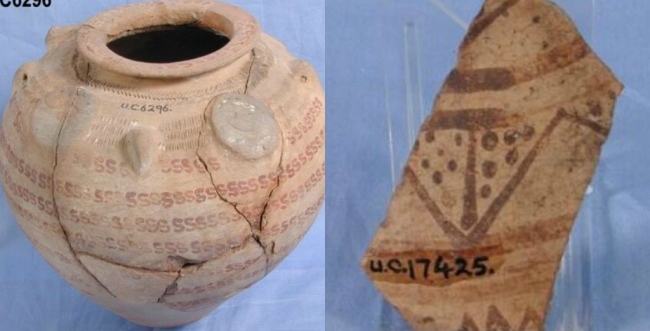
Naqada II, decorated jar possibly from
Iraq and sherd of Syrian jug UC6296 and
17425 - Copyright of the Petrie Museum of
Egyptian Archaeology, UCL
The influence of Mesopotamia was significant during this period, with both designs and artefacts entering Egypt. As examples, brick tomb construction and cylinder seals in the same style as the contemporary Uruk Culture have been discovered. This transfer of designs from Mesopotamia continued for some time, also showing up on carvings. Examples on pottery are depictions of the Djemdet-Nasr hero, with beard and kilt, fighting carnivores in Mesopotamia but modified to him fighting crocodiles in Egypt, together with depictions of predators tearing prey and captives being clubbed to death.
| Page: 167 of 418 Go To Page: | |
◁◁ First | ◁ Previous | Next ▷ | Last ▷▷ |
Author: Dr. Stan Jones © Copyright 2010 -