

9. Ceramic Development in the Middle East
| 915 Page: 168 of 418 Go To Page: |  |
◁◁ First | ◁ Previous | Next ▷ | Last ▷▷ |
The route of these contacts is most likely to have been by sea, either via Byblos or around the Arabian Peninsula, as the land route was so arduous. Uruk-style painted ceramic cones found in Buto in the Delta Region reinforce Byblos as one route. It is likely that some Mesopotamian craftsmen migrated as well, as so much transfer of technology is unlikely to have been only by trade. The Egyptians also picked up the production of beer from Mesopotamia and it became their national drink. It spread from Egypt around the Mediterranean Region.
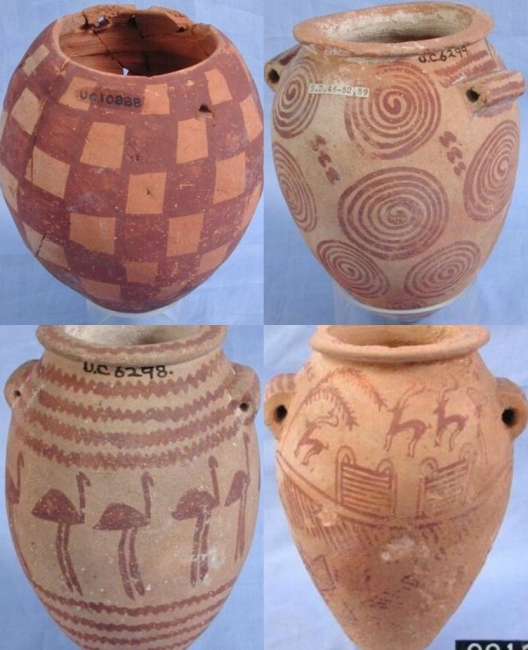
Gerzean vessels, pinkware with checker
board pattern, with spirals, with
ostriches and buffware with boats and
antelopes, UC10888, 6299, 6298 and
8812 - Copyright of the Petrie Museum
of Egyptian Archaeology, UCL
Gerzean pottery was a distinctive development, particularly its decoration and the first use of marl clay. The light pink or buff-bodied marl pots were often painted in dark red, brown and black ochre with depictions of animals such as ostriches in rows, crocodiles, birds in flight, people (marching men and dancing women), plants such as the aloe, many-oared boats with cabins possibly carrying gods with royal standards (flags), together with geometric symbols including wavy lines, dots and spirals. Some of these symbols appear to be the precursors of their earliest writing. Black slipped, engraved vessels are particularly striking. Not surprisingly the early symbol for a pottery vessel was a picture of a pot. One method used for making the Gerzean pots was “paddle and anvil”, with one hand holding a flat tool inside the vessel, pressing the clay against the other hand or tool outside, and this could produce the most elegant and thin-walled vessels.
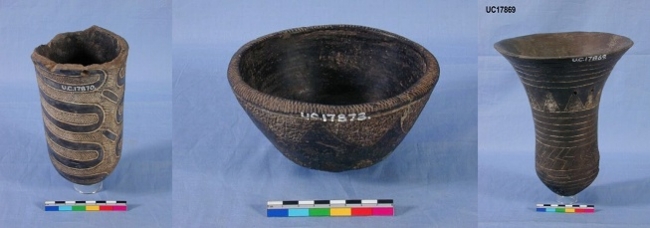
Gerzean black incised vessels, bowl with zigzag
rim, beaker with herringbone pattern and flared
beaker UC17873, 17870 and 17869 - Copyright of
the Petrie Museum of Egyptian Archaeology, UCL
Coiling was also used that was evident from the inside of the vessel but traces usually removed from the outside. It is possible that rotation was used on a mat or inside a large ceramic bowl. Kilns had a flat clay base on which a series of firebricks arranged vertically in graduated sizes were placed an equal distance apart to form supporting bars. A layer of clay and vegetable matter was put on these firebrick bars, onto which the pots were placed. The whole was surrounded with a circular mud brick wall, probably with a roof. The fire was placed on the kiln base between the firebricks.
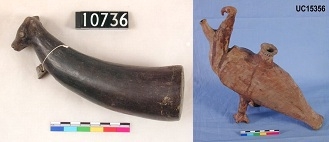
Gerzean pottery horn with cow’s head with beads
as eyes and bird shaped pot UC15356 and 10736
- Copyright of the Petrie Museum of Egyptian
Archaeology, UCL
The handles on Gerzean vessels became “wavy” nearly reaching a totally decorative phase. Further pots were developed shaped as animals, such as hippos, elephants, birds and fish, and many pots were made especially as grave goods. Some of the pots were coloured to imitate stone. In fact pottery from this period was sufficiently valued to be given as gifts to foreign leaders and found in their graves. A few pots had applied modelled figures such as crocodiles. Most early pottery with incised decoration round the world was incised or engraved before firing, as it is much more difficult to do after firing. However, Egyptian potters were so skilful at engraving that they carried out this process after firing before 3,100 BC.
| Page: 168 of 418 Go To Page: | |
◁◁ First | ◁ Previous | Next ▷ | Last ▷▷ |
Author: Dr. Stan Jones © Copyright 2010 -