

9. Ceramic Development in the Middle East
| 921 Page: 174 of 418 Go To Page: |  |
◁◁ First | ◁ Previous | Next ▷ | Last ▷▷ |
The earliest calendar in the first half of the 3rd Millennium BC was based on the Nile flood, with 365 days split as three lots of four months of 30 days plus 5 days, starting when Sirius (the dog star) rose above the horizon (a few weeks before the inundation). The first four-month period was the inundation, the second germination and growth and the third harvesting. The lack of the extra quarter of a day per annum led to serious problems over time as their year gained on the true solar year. At the time of the Ramesses it was clear from written records that the seasons had previously reversed. In the time of the Ptolemies it was put right by adding an extra festival day every four years (our leap year). However the native Egyptians did not accept this until Christian times. Unfortunately, other calendars were also used, some concentrating on the length of reign of a king. These are especially inconsistent in the various records available to us. Some kings were said to reign for over 100 years, making absolute dates of events and reigns difficult to work out. By the New Kingdom (1,552-1,070 BC) discrepancies are about 25 years, but there is general agreement on the number of years of each reign. However, some kings reigned for very short periods, and others on inscribed lists probably not at all!
Adding to the confusion, kings often had several names (one had six), and some were added during their reign. Together with the difficult Egyptian language, these make understanding of the names and sequence of Egyptian rulers often less than clear, and a great deal of guesswork is sometimes needed. Today “Egyptian” names may be used e.g. Khufu or the Greek version Cheops. Many place names are Arabic.
Narmer’s son Aha ruled for 20 years and probably founded Memphis, the new Capital in Lower Egypt. Djer, who was Aha’s son, is probably the earliest to be depicted as a mummy in Egypt.
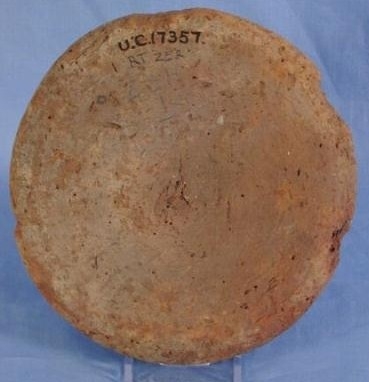
Dish from King Djer’s tomb, Abydos
UC17357 - Copyright of the Petrie Museum
of Egyptian Archaeology, UCL
Historically people had been buried in the desert where the natural chemicals were observed to preserve their bodies. Once tombs were introduced bodies decayed, so mummification was devised to artificially preserve their bodies, using similar dehydrating chemicals (natron – sodium carbonate and bicarbonate), but with complicated procedures and great ritual.
Den, the third king after Aha, had the first stone-built rather than mud-brick architecture in his tomb, including a granite pavement, at Abydos. At the beginning of the first Dynasty servants were killed and buried with their ruler (174 in Den’s tomb). This practice soon ended and they were replaced by the previously mentioned Ushabti figures, maybe 6”to 8” tall, usually modelled as mummies, in different materials including pottery, faience, stone and wood.
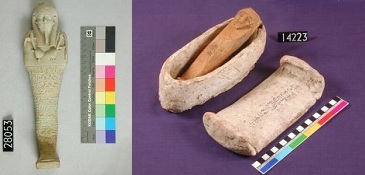
Mummy ushabtis, Dynasty 26 blue glaze on
pottery and a Dynasty 18 pottery coffin
for a wooden ushabti UC28053 and 14223 -
Copyright of the Petrie Museum of Egyptian
Archaeology, UCL
During the 18th Dynasty (reign of Thutmose IV) they stopped being mummies and became models of workers. On the ledges in some tombs there were again clay models of bulls with real horns. Poor people were still buried in the old way well after the introduction of mummification. In the Early Dynasties and later Old Kingdom large earthenware pots were also used for burials.
At this early time the people of Canaan had already come to view Egypt as the rich customer and protector, and geared their economy to supply its needs e.g. olive oil and wine. As an indication of trade at these times, Egyptian pottery was found in Palestine dated to the First Dynasty, with the Egyptian king’s name inscribed, together with Egyptian seal marks on jar stoppers. Storage jars would be sealed with a “blob” of unfired clay to prevent spillage in transport. There were ceramic lids used, but only if movement would not displace them. Similarly Canaanite amphorae were used for transport and have been found in Egypt.
| Page: 174 of 418 Go To Page: | |
◁◁ First | ◁ Previous | Next ▷ | Last ▷▷ |
Author: Dr. Stan Jones © Copyright 2010 -