

9. Ceramic Development in the Middle East
| 922 Page: 175 of 418 Go To Page: |  |
◁◁ First | ◁ Previous | Next ▷ | Last ▷▷ |
By the start of the second Dynasty (2,890 BC), Memphis had become the sole Capital City. The kings of the first two Dynasties ruling between 3,080 and 2,686 BC were buried in a similar manner to their predecessors. Their tombs are called “Mastaba” which is Arabic for “bench”. They were large, usually mud-brick rectangular buildings containing rooms. Early on the doors between rooms were only 6 inches high as it was only the spirits who were to use them. As this was to be their home in the afterlife the front façade was often decorated as if a palace entrance. This was later used as a device on sarcophagi. Within the Mastaba were stelae (upright stone slabs) with inscriptions containing the dead person’s details and gifts received. However, one of the kings of the First Dynasty, Anedjib, had a mud-brick stepped structure built inside his tomb, which was possibly the precursor to the pyramids. The tombs of the First Dynasty Rulers are also to be found at the necropolis of Um el-Qaab near Abydos. Abydos existed back in the Naqada period and had great religious significance, hence its location for a huge necropolis. There is some confusion whether the Second Dynasty tombs were at Abydos or Saqqara near Memphis, as some had a tomb at one and a cenotaph (empty tomb) at the other, as did, for example, king Aha.
The absence of rain in Egypt made it unnecessary to fire bricks, particularly since fuel was not plentiful. Sun dried bricks were made in standard (large) sizes, sometimes reinforced with straw. Today thousands of these retain their form and the stamps of the king’s reigns when they were made. Fired bricks were used very occasionally, particularly in areas likely to become wet, starting about the same time as in Mesopotamia, around 3,000 BC. As an example, in the later New Kingdom, the tomb of Pa-mer-kau (Merenptah’s son) at Nebesheh is built of fired red bricks, but this is very unusual.
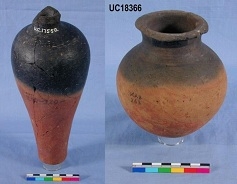
Dynasty I black topped red vessels, vase
and globular pot UC17550 and 18336 -
Copyright of the Petrie Museum of
Egyptian Archaeology, UCL
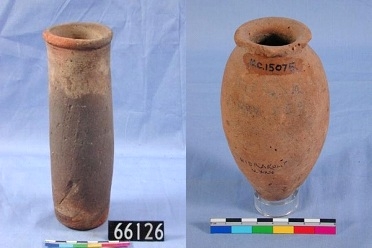
Dynasty I small jar and Early Dynasty pink
vase from Hierakonpolis UC66126 and 15075
- Copyright of the Petrie Museum of
Egyptian Archaeology, UCL
Ceramic vessels were the main component of tomb equipment, mainly containing food offerings. The elite had sacred wooden barges placed in nearby pits for travel in the afterworld. During the first and second Dynasty, pottery vessels were mainly based on pre-existing shapes, and painting was not as common as it became later. Some bowls and plates were produced by pressing a sheet of clay onto a shaped core, trimming, allowing to dry and then firing. Larger vessels had their bases made by coiling, with separate rims that exhibited horizontal parallel lines from rotation. Some cylindrical jars had a lattice design imitating the rope marks made by slings for carrying pots and others the marks of the bands of string used to support pots when drying. Undulating lines modelled into the upper part of cylindrical jars were the final manifestation of the influence on Egyptian potters of wavy-ledge handles on vessels imported from Palestine before 3,000 BC.
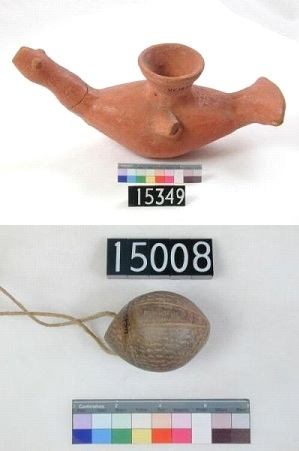
Dynasty I bird shaped vessel
and Early Dynasty incised
rattle UC15349 and 15008
- Copyright of the Petrie
Museum of Egyptian
Archaeology, UCL
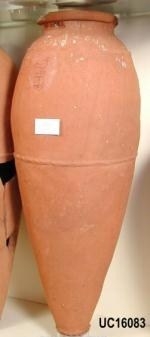
Large red ware jar with
Narmer incised on
shoulder UC16083 -
Copyright of the Petrie
Museum of Egyptian
Archaeology, UCL
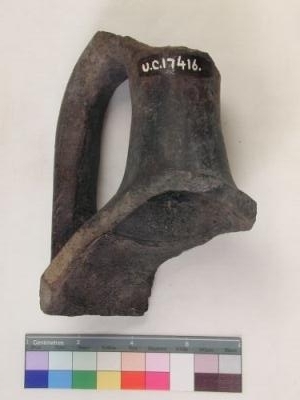
Neck and handle of Syrian vessel
Dynasty I Abydos UC17416
- Copyright of the Petrie
Museum of Egyptian
Archaeology, UCL
Large elongated storage jars (such as for wine) typify this period, and large tomb jars often have incised royal names. Vessels made from marl clay became more common and were sometimes burnished to imitate alabaster. Interestingly shaped vessels and toys were also produced.
| Page: 175 of 418 Go To Page: | |
◁◁ First | ◁ Previous | Next ▷ | Last ▷▷ |
Author: Dr. Stan Jones © Copyright 2010 -