

9. Ceramic Development in the Middle East
| 925 Page: 178 of 418 Go To Page: |  |
◁◁ First | ◁ Previous | Next ▷ | Last ▷▷ |
In the Old Kingdom there were basically two groups of pottery, the first were “fine” wares that were burnished or polished, slip coated (often red, sometimes black) on buff or brown bodies. These fine wares included carinated bowls, dishes, jars (some with spouts or perforated lids), large basins, pot stands and models of birds and animals. These burnished and polished wares were so shiny that they appeared to be glazed. Although incising was common, little was painted now except for some late Old Kingdom wares after firing. The second group was coarser undecorated domestic ware. To protect food from rodents smaller pots often had handles so they could be hung from the rafters.
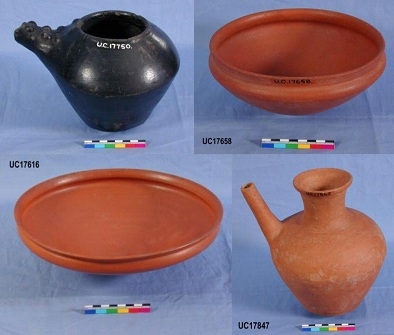
Dynasty 5 black ware spouted jar with studs
copying rivets, Dynasty 4 burnished red pottery bowl,
orange slipped spouted jar and bowl,
UC17750, 17658, 17847, 17616
- Copyright of the Petrie Museum
of Egyptian Archaeology, UCL
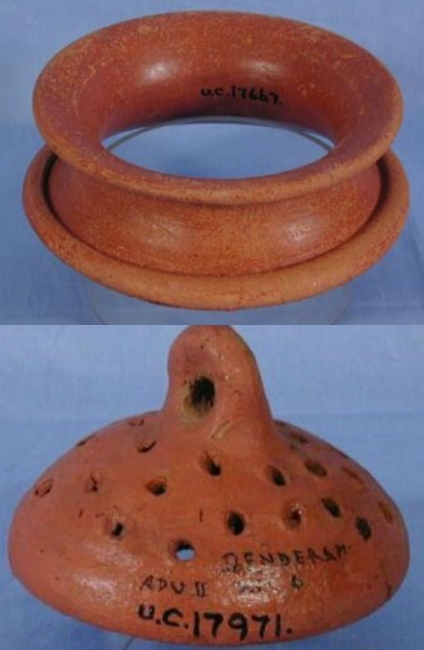
Dynasty 5 burnished red slipped pot
stand and perforated lid UC17667
and 17971 - Copyright of the Petrie
Museum of Egyptian
Archaeology, UCL
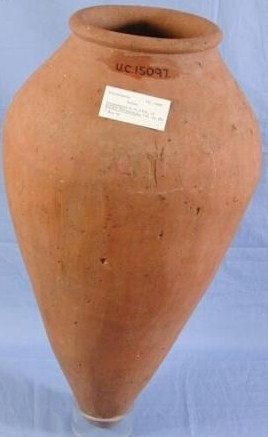
Large pointed-base vessel,
Hierakonpolis UC15097
- Copyright of the Petrie
Museum of Egyptian
Archaeology, UCL
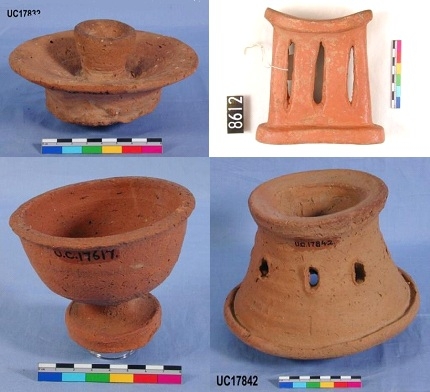
Dynasty 4/6 domestic ware, pink ware
candlestick, red ware stemmed cup,
headrest and brazier stand UC17832,
17617, 8612 and 17842 - Copyright
of the Petrie Museum of Egyptian
Archaeology, UCL
Larger pottery vessels were mostly used for storing water, beer, wine and milk. As their pottery was unglazed it was to some degree porous, so care had to be taken with more expensive liquids. The ground was often sandy or uneven so there were far more rounded or pointed bases than flat. Few had handles so the larger ones were moved with rope “baskets’ and there were pottery stands in the houses to support them. Sometimes they would be placed in holes in the ground or just leant against a wall. Richer people would have more highly decorated vessels, which might be concentrated on one side of the pot to be “shown off”.
Potters were not held in very high esteem in early Egypt, as it was not considered a very pleasant occupation for the usual reasons. The much later king Khety, who started the ninth Dynasty in 2160 BC, left some well-known “Instructions to His Son” that state “the potters trade was not enviable, potters were covered with earth, their breath from the oven”.
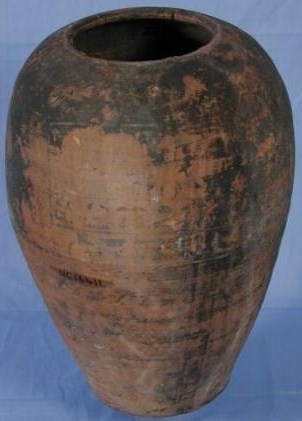
Dynasty 6, wheel-made canopic
jar with 4 lines of hieroglyphics
UC16411 - Copyright of
the Petrie Museum of Egyptian
Archaeology, UCL
Accordingly potters were usually located on the edges of the towns, sometimes grouped together to limit the effects of the smoke and smell. The majority produced general pots and pottery products that were given to employees as part of their pay, together with food, beer and clothing. Some potters were employed in manufacturing “factories” owned by the King and royal family, or by the elite (to supply the wealthy), government departments or in association with temples and cemeteries. Potters working for temples would have specialised in ritual vessels, as a large number of ceramic vessels were specially made to be used in religious services, both in the present and for the hereafter. Some were similar to domestic pots, such as to pour water for the god’s use, for burning incense and bread moulds for offerings. Others were unique to burials. For example, during mummification most of the body’s internal organs were removed and from the 4th Dynasty placed in pottery vessels called canopic jars. There were four different jars each containing different parts of the body, lungs, liver, intestines and stomach – the brain and heart were not considered important.
| Page: 178 of 418 Go To Page: | |
◁◁ First | ◁ Previous | Next ▷ | Last ▷▷ |
Author: Dr. Stan Jones © Copyright 2010 -