

9. Ceramic Development in the Middle East
| 926 Page: 179 of 418 Go To Page: |  |
◁◁ First | ◁ Previous | Next ▷ | Last ▷▷ |
A god protected each canopic jar and the four gods were known as the sons of Horus. Also large numbers of Ushabti figures were provided - one for each day of the year was recommended - so there were larger pots used to contain a number of these figures. Within tombs there were pottery vessels imitating stone, some vessels with messages for the dead inscribed in black ink and even miniature solid vessels that were to turn into real ones in the afterlife. These religious vessels were a significant part of the pottery industry. Some of the finer pottery was made solely for tomb offerings for those who could afford it, luckily for us, as many have been preserved for posterity. However, the less rich used poor quality copies.
In the third Dynasty, the tomb of King Djoser (2,667-2,648 BC) was the first stepped pyramid, and was also the first large-scale stone construction in the world. It started as a mastaba, the lower rooms carved from rock then covered by a 60m x 60m building 8m high. There were many rooms to hold gifts, the walls of some were decorated with blue faience tiles to imitate matting.
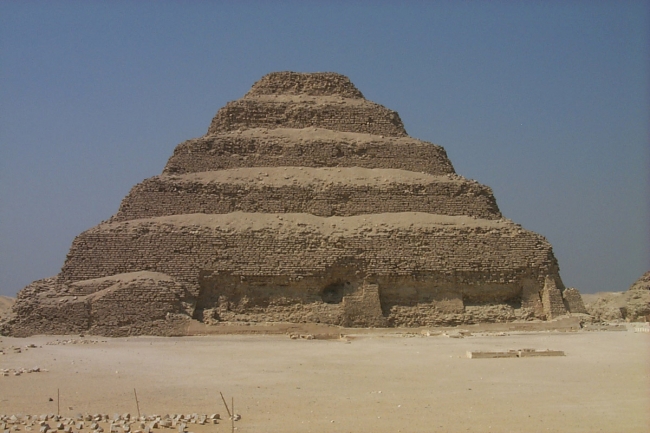
Djoser’s pyramid - source Paul
Mammic
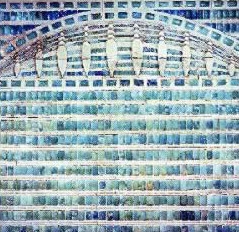
Faience tiles in King Djoser’s tomb,
Saqqara - source TourEgypt.net
Imhotep, probably the most renowned architect in Egypt, so much so he was later deified, made it more visible by building a stepped pyramid on top, 62m high. The word pyramid comes from the Greek for pyramid-shaped “wheaten cakes”. There are various theories to explain the pyramidal shape. One is that it represents the sun’s rays linking the King to the Sun God Ra who would protect him. They clearly also indicated the centrality and permanence of the king’s life and afterlife.
During Djoser’s reign the Provinces, most of which were ancient kingdoms having had their own dynasties, came to be recognised. Governors or “Nomarchs” were appointed and given significant power to represent the king in the ever-growing kingdom. There were 22 Provinces in Upper and 20 in Lower Egypt.
In the fourth Dynasty the King’s power reached a peak. The first king Snorfu (Sneferu) built no less than three pyramids. The first was stepped like Djoser’s, but this was abandoned in favour of two “perfect”, or smooth sided, pyramids. The first was called the “bent pyramid” that had a shallower slope at the top compared with the bottom.
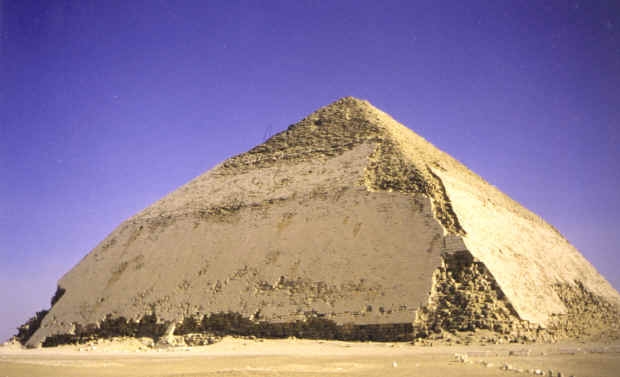
Bent pyramid - courtesy BelovedEgypt
This was probably to reduce the weight as it may have cracked during building, due to the angle of the initial slope being too great. His last pyramid was the precursor of “perfect” pyramids, with a sustainable slope angle. Snorfu built incessantly and records reveal he sent as many as 40 ships at a time to Byblos for timber.
The next king, Khufu (Cheops) (2,589-2,566 BC), fortified the kingdom and increased the power of the state. Raids were made into Libya and Nubia bringing back slaves and cattle. The slaves were needed, as there were labour shortages on farms in the Nile Delta and in the army. Foreign countries were intimidated by Egypt to provide people and goods. Some foreigners would not need much persuasion, as they would be well fed in Egypt and possibly starve back home. Trade continued to expand particularly through Byblos, to the north and Punt, to the south. It was because so much was traded through Byblos that the Egyptian word for a sea-going ship was a “Byblos ship”. Punt is now lost but probably was in present Eritrea or Somalia from where Egypt imported myrrh, incense, ivory, ebony, resins, gums and leopard skins.
| Page: 179 of 418 Go To Page: | |
◁◁ First | ◁ Previous | Next ▷ | Last ▷▷ |
Author: Dr. Stan Jones © Copyright 2010 -