

9. Ceramic Development in the Middle East
| 927 Page: 180 of 418 Go To Page: |  |
◁◁ First | ◁ Previous | Next ▷ | Last ▷▷ |
Khufu built the Giant Pyramid at Giza near Cairo. It was made of over 2 million limestone blocks, each weighing over 2.5 tonnes. It took 23 years to complete the 150m high structure, so one block had to be laid every 5 minutes, 24 hours every day. Not only the construction is mind boggling, but the quarrying resource must also have been colossal. Even today it is still not completely understood how the Egyptians managed to build Pyramids. For 4,000 years the pyramid of Khufu was the tallest man-made structure on earth. These early pyramids were made entirely of stone blocks, but some later pyramids, for example in the Middle Kingdom, had a stone outer shell with a rubble interior. The former could withstand the removal of some blocks for reuse, which was a common occurrence by later rulers, but the latter just collapsed and are now rough mounds.
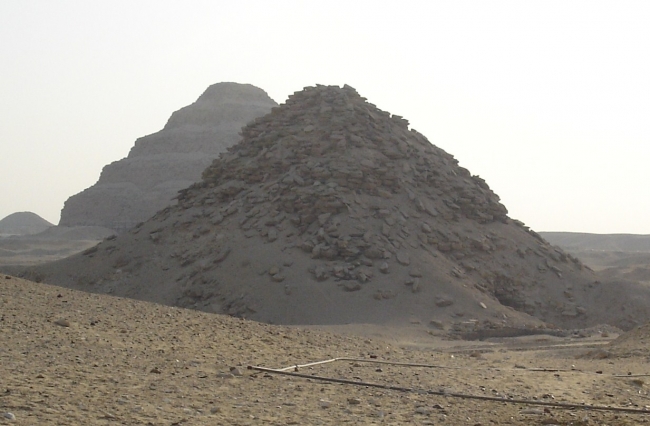
Collapsed pyramid in front of Djoser’s pyramid
Furthermore, not all ambitious building plans reached completion, and archaeological sites are littered with half-finished projects, grand schemes cut short when the ruler died and funds dried up.
Djedefra (2,566-2,558 BC), one of Khufu’s sons, seized power possibly after killing one of his brothers. He built his Pyramid at Abu Rawash near Heliopolis as part of a rock hill, rather than at Giza, and used much more expensive red granite in the lower cladding. The pyramid appears to have been dismantled, possibly by the Romans and later. Djedefra was in turn possibly killed by his brother Khafra (2,558-2,532 BC) who built his pyramid back in Giza, as well as building the Great Sphinx that could well depict the face of his elder brother Djedefra, or perhaps Djedefra built it with the face of Khufu.
Illustrations from tomb and temple walls from the 4th, 5th and 6th Dynasties give a clear picture of the variety and quantity of pottery containers used at this time. They were deep basins, ewers, carinated bowls, spouted bowls and squat spouted jars resembling teapots, including some made in Nubia, Upper Egypt such as the characteristic Ballas Ware. The fine carinated bowls of the Fifth Dynasty were probably made using a mould and then tool finished on a wheel – very time consuming. Around 2,500 BC there were mud brick kilns 1 to 3m diameter and 2m high, flared at the top. Pots were loaded from the top onto openwork platforms, and the top was sealed for each firing. There was a small firing chamber below and fuel was fed through a hole in the wall near the base. These kilns were able to reach 600 to 1,100 degrees centigrade, with 600 to 900 sufficient for Nile clay vessels and 700 to 1,100 for marl clay vessels.
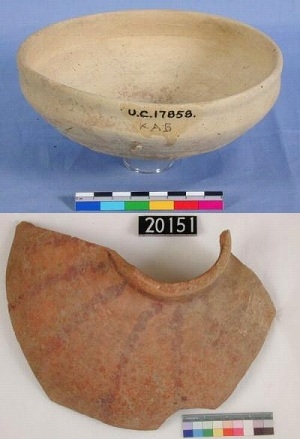
Dynasty 4, Nubian Ballas ware bowl,
and painted pink ware pot sherd
UC17858 and 20151 - Copyright
of the Petrie Museum of Egyptian
Archaeology, UCL
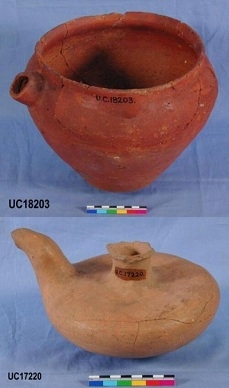
Dynasty 4 spouted bowl, and
an orange ware “teapot”
UC18203 and 17220 -
Copyright of the Petrie Museum
of Egyptian Archaeology, UCL
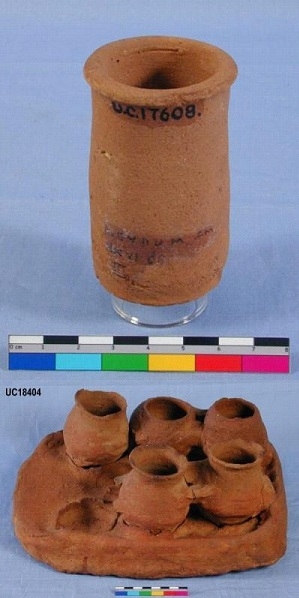
Red ware models of cylinder
jar and jars on tray UC17608
and 18404 - Copyright of
the Petrie Museum of
Egyptian Archaeology, UCL
By now mummification was well advanced, and pottery and stone canopic jars became increasingly decorated. The covers of the jars started as plain disc shapes, but later they became domed, often using painted faces as decoration. The Egyptians mummified many animals as well as humans, including sacred cats and crocodiles, even lizards. In the process papyrus was shredded, destroying vast amounts of historical records. Even so, much remains, and of the Egyptian papyri in one collection in Oxford University only a few percent of the fragments have yet been translated. Towards the end of the Old Kingdom, models of buildings, crafts and chattels, usually of pottery or wood, were placed in tombs as grave goods, replacing the previous custom of having paintings depicting craftsmen on tomb walls. Those people who could afford it were buried in wooden or stone sarcophagi representing a house as the eternal place for the dead person on earth. The incised or painted decoration of the front of the sarcophagus was still of a palace.
| Page: 180 of 418 Go To Page: | |
◁◁ First | ◁ Previous | Next ▷ | Last ▷▷ |
Author: Dr. Stan Jones © Copyright 2010 -