

9. Ceramic Development in the Middle East
| 932 Page: 185 of 418 Go To Page: |  |
◁◁ First | ◁ Previous | Next ▷ | Last ▷▷ |
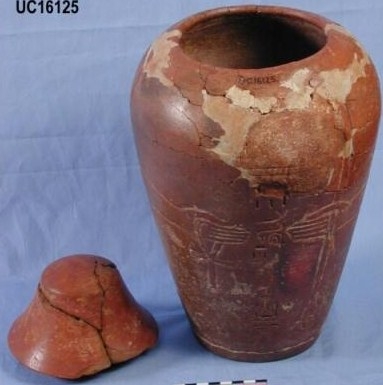
Dynasty 12, red burnished canopic jar
decorated in low relief UC16125 -
Copyright of the Petrie Museum of Egyptian
Archaeology, UCL
However, in common with the rest of the Middle East, it did not develop past high-fired earthenware and fritware, as the link with high temperature kaolin-based clays was not made. Fritware is a body containing quartz and clay with glass frit that has been added to reduce the fusing temperature. Huge quantities of domestic pottery were produced, as well as the other major application - to service religious and funerary activities with ritual pottery, such as the canopic jars, Ushabti figures and vessels for food and drink offerings.
Along with faience, pottery was used in personal decoration, and again much was as amulets and other devices to ward off evil spirits and promote good fortune. As scarab beetles were symbols of the solar cycle and rebirth and associated with the creator god Khepri, many amulets and much funerary jewellery were based on the scarab. A vast range of animal forms was used as inscribed decoration on the scarabs.
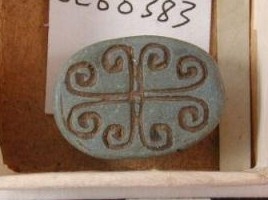
Middle Kingdom, “Egyptian
Blue”, scarab seal UC60383 -
Copyright of the Petrie Museum of Egyptian
Archaeology, UCL
The Middle Kingdom from 2,055 to 1,650 BC was founded by Mentuhotep II (2,055-2,004), based in Thebes as part of the 11th Dynasty, who reunited the whole of Egypt including Lower Nubia. In the Old Kingdom Thebes was a small village, but now became the Southern Capital, second only to Memphis. Initially the local god was Montu, the falcon-headed god, but in the 12th Dynasty he was replaced with Amun, later the “king of the gods”. Huge fortresses were built in the Eastern Delta Region and Nubia, south of Aswan, to defend the border and protect trade. The fortress at the second cataract had walls 11 metres high and 5 metres thick.
As mentioned earlier regarding Phoenicia, the Egyptians used pottery as part of a ritual to bring bad luck to anyone who might attack or offend them. To destroy their enemies by magic, they made a number of vases or figures with hieratic inscriptions listing princes and countries to be destroyed if they rebelled. They would be broken while a ritual spell (execration text) was being pronounced. A large number of such pieces have been found in and around the Nubian fortresses as well as in Libya and West Asia. The Egyptians also built “pylons”, which were large, often decorated, gateways. They were primarily to show their control of important trade routes.
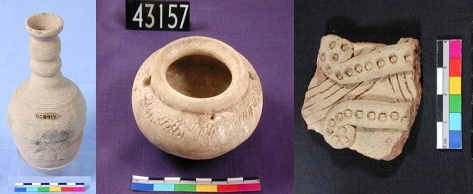
Middle Kingdom incised marl ware,
perforated bowl, Qena ware bottle and
highly decorated sherd UC43157, 8917 and
66655 - Copyright of the Petrie Museum of
Egyptian Archaeology, UCL
After the regional variations that occurred during the First Intermediate Period, ceramics became reunified. Dense bodied vessels made of fine marl clay were produced. The majority of vessels were “thrown” on the faster wheels, and ceramic wheel heads were used similar to those in Minoan Crete. When Mentuhotep II’s tomb was discovered, the funerary items included fine pottery bowls and stands coloured in blue/green and a faience figure of a field worker, covered with a thick blue/green glaze, detailed in black. Murals on his tomb walls show a variety of pottery bowls and spouted jars.
At this time the coffin within the tomb became made of wood moulded to the shape of the body, but the box-like sarcophagus was still used as an outer container, depending on the wealth of the deceased.
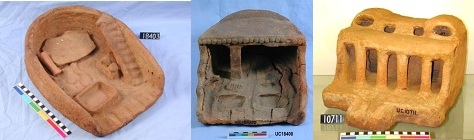
Middle Kingdom soul houses, with modelled
and relief offerings UC18403, 10711 and
18400 - Copyright of the Petrie Museum of
Egyptian Archaeology, UCL
Pottery “cones” similar to those in the Uruk and later period in Mesopotamia were used as decoration in tombs of the elite. Poorer people buried in simpler graves would have a pottery model of a chapel, known as a soul house, placed on their grave so that offerings could be left.
| Page: 185 of 418 Go To Page: | |
◁◁ First | ◁ Previous | Next ▷ | Last ▷▷ |
Author: Dr. Stan Jones © Copyright 2010 -