

9. Ceramic Development in the Middle East
| 933 Page: 186 of 418 Go To Page: |  |
◁◁ First | ◁ Previous | Next ▷ | Last ▷▷ |
Mentuhotep III (2,004-1,992 BC) rebuilt the administration and put in place new Nomarchs. He re-expanded the Empire, and as in the Old Kingdom they “exploited” the countries of West Asia, but were unable to control them for extended periods. However, Nubia was closely controlled with additional fortresses, as they feared a revolt might interrupt their supply of gold. This period became a golden age for Egyptian pictorial art and much more literature was produced than in the Old Kingdom.
The 12th Dynasty started in 1,985 BC with Amenemhat I, probably vizier to Mentuhotep IV. In this period sons often co-ruled with fathers, further complicating dating. Trading with the Aegean Islands and Byblos resumed, and some Egyptian pottery used in trade has been found in Crete dated to the reign of another great king Senusret III (1,874-1,855 BC). Although the Minoan culture on Crete shows unmistakable signs of Egyptian influence, not that many Egyptian objects were found there. However, a greater number of Minoan polychrome-decorated ceramics have been found in Egypt, for example, a collection at Howwra in the Fayum Oasis. Also a magnificent bowl was found in a tomb at Abydos that is now in the Ashmolean Museum, Oxford. Senusret III forged commercial links with Syria and Palestine as far north as Ugarit, and Egypt’s influence spread to North Anatolia. Considerable tribute was received.
Potter’s wheels now had a taller axis pole and even with a simple wheel this had more momentum, was faster, and could spin off stored energy. It is possible extra weight was added to the wheel head to increase the momentum.
Also in the 12th Dynasty they made many more burnished marl jars to imitate alabaster. Incised and applied decoration included straight and wavy lines together with lozenges and cross-hatching.
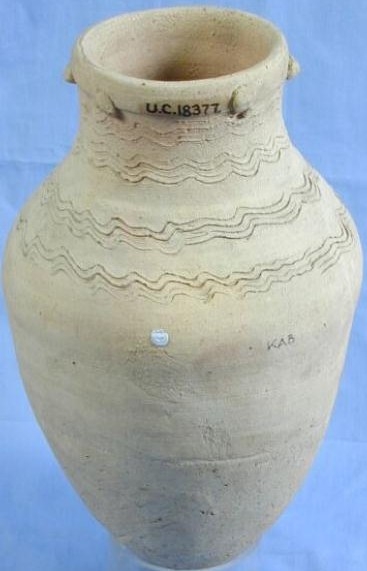
Dynasty 12, white slipped pot
with appliqué pellets and
incised lines UC18377 -
Copyright of the Petrie Museum
of Egyptian Archaeology, UCL
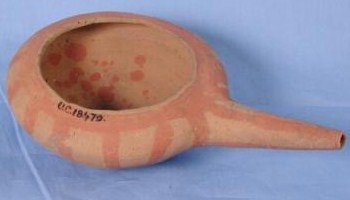
Dynasty 12, dish with long spout and red
slip decoration UC18470 - Copyright of the
Petrie Museum of Egyptian Archaeology, UCL
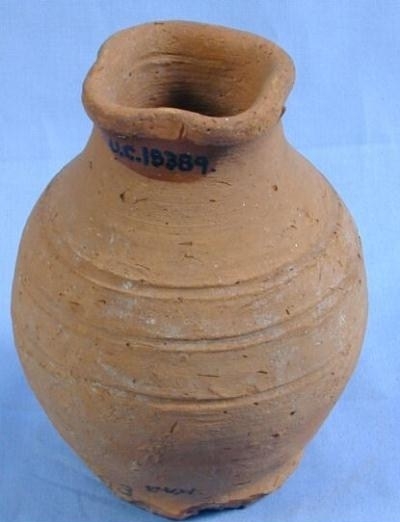
Dynasty 12, incised jar with 4 spouts
UC18389 - Copyright of the Petrie
Museum of Egyptian
Archaeology, UCL
Bands of red, black or white colour were applied to the body or rim. There were jars with four spouts, pedestalled cups and flared-necked vases.Some vessels were shaped as women with applied faces and arms.
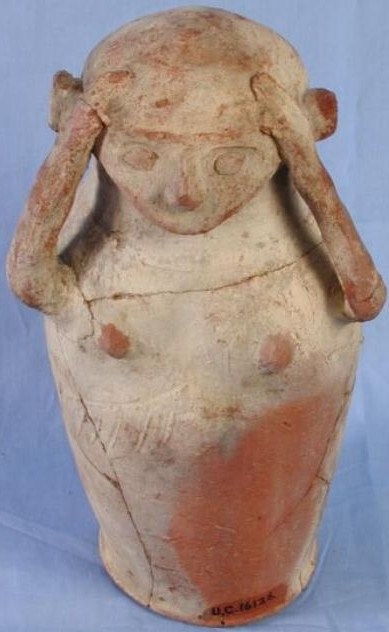
Dynasty 11, woman shaped
vessel in mourning UC16126
- Copyright of the Petrie
Museum of Egyptian
Archaeology, UCL
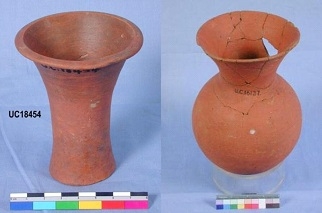
Dynasty 12, flared neck red ware, cylinder
vase and globular pot UC18454 and 16137 -
Copyright of the Petrie Museum of Egyptian
Archaeology, UCL
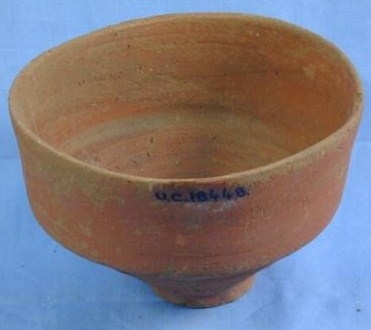
Dynasty 12, red slipped stemmed cup
UC18448 - Copyright of the Petrie Museum
of Egyptian Archaeology, UCL
| Page: 186 of 418 Go To Page: | |
◁◁ First | ◁ Previous | Next ▷ | Last ▷▷ |
Author: Dr. Stan Jones © Copyright 2010 -