

9. Ceramic Development in the Middle East
| 938 Page: 191 of 418 Go To Page: |  |
◁◁ First | ◁ Previous | Next ▷ | Last ▷▷ |
Although the next Pharaoh, Tutankhamun (1,336-1,327 BC), had a very short reign and achieved little, the treasures of his tomb are particularly well known. Fortunately Tutankhamun’s tomb had not been discovered by tomb robbers as it’s entrance had been obscured some 200 years after sealing by rubble from nearby building works for the tomb of Ramesses VI, preserving it for thousands of years.
Egypt’s fortunes changed again when another ex-general became Pharaoh Horemheb (1,323-1,295 BC). He re-established Egypt’s power against the Hittites, reconquering Canaan, and appointed another, rather short-lived general as his successor – Ramesses I (1,295-1,294 BC). This pharaoh started the 19th Dynasty and the famous Ramesside Period. He was followed by his son Sethos I (1,294-1,279 BC). To gain political support he restored many of the inscriptions previously damaged by Akhenaten. The next Ruler was Ramesses II, the Pharaoh known as ‘Ramesses the Great”, who ruled for 66 years from 1,279 to 1,213 BC. He is also known as the “Greatest Builder of Them All” as he built so many monuments over this time and still had time to father over 100 official children. His most noted buildings are his mortuary temple at Thebes that resembled a large city, his temple and the smaller but unique one for his favourite wife (of eight) Nefertari that were cut into the rock at Abu Simbel in Lower Nubia, the exquisitely decorated tomb for his wife at the Valley of Queens and a completely new Capital city called Pi-Ramesse (city of Ramesses) in the Delta probably on the site of Avaris, which had been razed after the Hyksos. The city was decorated with some splendid faience tiles.
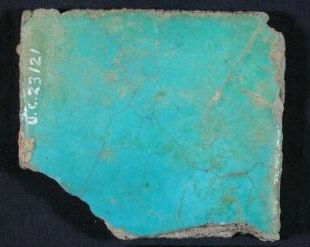
Dynasty 18, blue faience tile - Copyright
of the Petrie Museum of Egyptian
Archaeology, UCL
Illustrations on faience plaques in Ramesses tomb included Asiatic prisoners. In the 1960’s the two temples at Abu Simbel were moved to higher ground to prevent them being flooded by the rising waters of the Aswan High Dam.
Tombs of provincial officials were cut into rock, both vaults and chapels. They would typically be in cliff faces facing the Nile or a wadi.
Ramesses II is noted for his battles in West Asia. The Egyptians were good at improving technology if not devising it. They took the bow and the chariot from Mesopotamia and improved them so they were much superior to those used by their enemies. They had bows that could fire arrows lethally to 175m and exceptionally as far as the length of three football fields. His well-trained army moved back into Phoenicia and Syria where it confronted the Hittites moving south and in 1,274 BC fought them at the “Battle of Qadesh”. This city was fought over often, as it was an important centre on the trade route from the Euphrates to the Mediterranean. Both sides claimed victory, and there are many accounts as poems, epics and stelae glorifying the Egyptian success and the part Ramesses II played in it, but Akkadian cuneiform accounts found in the Hittite Capital make it clear that the Egyptians, and Ramesses himself, had a lucky escape. However, it stopped the previously inexorable expansion of the Hittite Empire, as it led to the “Peace Treaty of Qadesh” signed around 1,269 BC between Ramesses II and Hattusilis II that was the first recorded one in history.
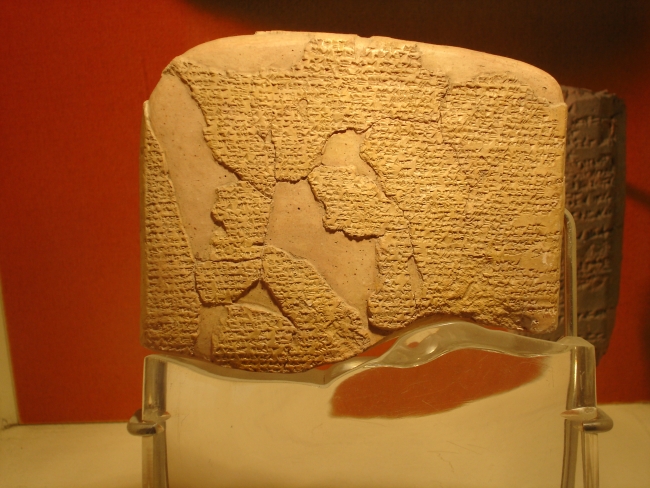
Akkadian cuneiform Treaty of Qadesh -
source Archaeological Museum, Istanbul
For this reason a copy is enshrined in the United Nations building in New York. The original treaty was apparently inscribed on silver tablets, but these are lost. Copies were written on clay tablets and stelae in the languages of both parties, and different parts have survived of both. However, the main reason for the treaty, which led to 80 years of peace, was to join against the growing threat from the Assyrians, who had already conquered the Mitanni, latterly a Hittite ally. The alliance was later consolidated by the marriages of Ramesses II to a Hittite Princess in the 33rd and another in the 44th year of his reign.
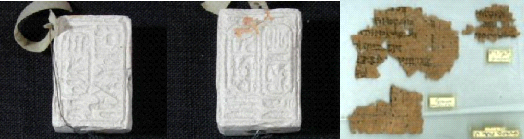
Scaraboid, one side with name of Ramesses
II, other with name of a Hittite princess,
daughter of ruler of Kheta UC61396 -
Copyright of the Petrie Museum of Egyptian
Archaeology, UCL, and a papyrus fragment
referring in hieratic to the same wife
Ramesses II reorganised the Canaanite cities and dispossessed many of the people, who Egyptians called the Hapiru (Hebrew). They were driven into the Judean hills, became pastoral and founded Israel. Tribute from Canaan included wood, silver, copper, tin, cattle, incense and wine. Ramesses II also extended the Empire to the 5th cataract in Nubia.
| Page: 191 of 418 Go To Page: | |
◁◁ First | ◁ Previous | Next ▷ | Last ▷▷ |
Author: Dr. Stan Jones © Copyright 2010 -