

9. Ceramic Development in the Middle East
| 937 Page: 190 of 418 Go To Page: |  |
◁◁ First | ◁ Previous | Next ▷ | Last ▷▷ |
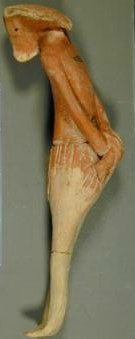
Figure of captive UC15816
- Copyright of the Petrie
Museum of Egyptian
Archaeology, UCL
He pushed the Egyptian boundary to the third cataract in Nubia, and then, via Byblos, to the banks of the Euphrates in West Asia, confronting the Mitanni and gaining control of much of Syria including the important trade routes. Thutmose I then withdrew, leading to constant erosion of the boundaries of the Empire as vassal states switched allegiances under pressure, allowing the Mitanni to expand for some 40 years.
Thutmose III (1,479-1,425 BC) ruled jointly with his aunt, Hatshepsut, but was well in her shadow until 1,458 BC when he took over. He had to win back all the West Asian territories, which he did by defeating the king of Qadesh and the Mitanni allies at the battle of Meggido in 1,457 BC (his 22nd year).
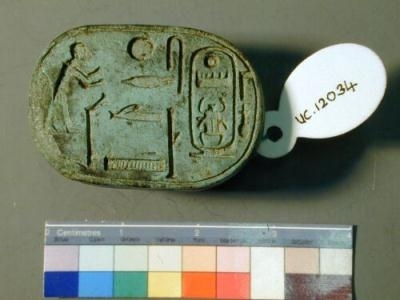
Green scarab referring to Pharaoh Thutmose
III’s battle at Qadesh UC12034 -
Copyright of the Petrie Museum of Egyptian
Archaeology, UCL
He re-captured the city of Qadesh 8 years later and he followed up with 15 more campaigns, including crossing the Euphrates and destroying many Mitanni cities, to retain control in West Asia. After each campaign his armies returned with large quantities of food and goods. Towards the end of his reign Thutmose III received tribute from several countries including Babylonia, Assur (Assyria) and Anatolia (the Hittites), as they all valued Egypt controlling the Mitanni. The Egyptian Empire in West Asia reached its greatest extent at this time. In particular, the conquest of Cyprus gave access to its pottery designs that had a significant effect on Egyptian potters.
Thutmose III was technically the first Pharaoh, as it was from his reign that the term regularly came into use, seldom before that, although now we often refer to earlier rulers as Pharaohs. The title Pharaoh is derived from the Egyptian for “Great Estate’ and refers to The Royal Palace as an institution. Thutmose III was a practised potter, botanist and writer.
The Hittites became a growing threat so the Mitanni sued for peace with Egypt and a fixed boundary was agreed, leading to peace for some 65 years. A little later Thutmose IV (1,401-1,390) married the daughter of a Mitanni prince reinforcing the agreement. So Pharaoh Amenhotep III (1,390-1,352) inherited a peaceful kingdom allowing him to build many sumptuous monuments. It also allowed time to be spent on technical developments such as the first water clock that was devised during his reign. However, within some 70 years of Thutmose III’s death, the latest superpower in West Asia, the Hittites, had systematically annexed all of Egypt’s vassal states in West Asia. The problem was exacerbated by Pharaoh Akhenaten (1,352-1,336 BC), who had little interest in foreign affairs, as he was preoccupied with internal religious turmoil. He tried to force Egyptians to worship one god, Aten - the sun god, rather than their chosen one (each city had its preferred god from the pantheon).
The relationships between the various countries at the time of Amenhotep III and Akhenaten were well illustrated by a cache of 380 clay tablets to and from the leaders of Byblos, Mitanni, Assyria, Babylonia and the Hittites. They were written in cuneiform script in the Babylonian language (Akkadian) that was the diplomatic language of the time. They were found in Tell el-Amarna, Akhenaten’s new capital 190 miles south of Cairo, which he built to honour Aten. It was huge, six miles long and three wide, with the temple to Aten half a mile long. At its height it housed at least 6 pottery kilns. The cuneiform correspondence is known as the Amarna Letters and covers several hundred years of records. Early ones between Amenhotep III and Tushratta, king of the Mitanni, were cordial and concerned the Pharaoh’s marriage to Tushratta’s sister and daughter. One recorded the Hittite king Suppiluliumas congratulating Akhenaten on his succession, politically putting pressure on the Mitanni. In later ones the Mitanni were pleading with the Egyptians to help them battle the Hittites
Because of the need to maintain proper succession (or the appearance of it), or to appease the high priests and population, Pharaohs erased some inscriptions relating to prior rulers and replaced them – some were even restored by even later Pharaohs. On Akhenaten’s death, Tell el-Amarna was abandoned as Capital and Royal Residence, and after a few years its population also left, making it a frozen time capsule for archaeologists. The high priests declared his reign heretic; accordingly following Pharaohs erased much of his legacy - images and stelae.
| Page: 190 of 418 Go To Page: | |
◁◁ First | ◁ Previous | Next ▷ | Last ▷▷ |
Author: Dr. Stan Jones © Copyright 2010 -