

9. Ceramic Development in the Middle East
| 936 Page: 189 of 418 Go To Page: |  |
◁◁ First | ◁ Previous | Next ▷ | Last ▷▷ |
Thus began the 18th Dynasty and the New Kingdom. The latter prospered for about 500 years, from 1,550 to 1069 BC. The New Kingdom was the last glorious period of ancient Egypt. Previously, in the Old and Middle Kingdoms, the Pharaohs were usually too aloof to have accounts written of their exploits, but this changed by the 18th Dynasty when much more material appeared. The information was often inscribed on stone stelae (the free-standing, inscribed, stone monuments) relating important happenings.
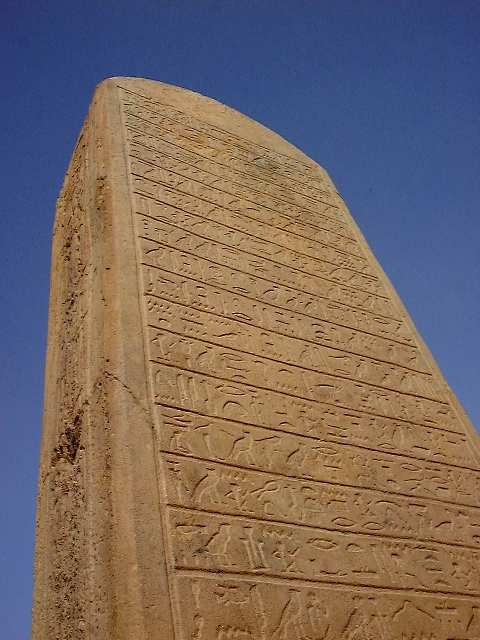
A stele
Ahmose (1,550-1,525 BC) kept the administration much as it had been in the Middle Kingdom, but replaced Nomarch families with his supporters. The priority of the first three kings was to conquer Nubia and carry out raids into East Asia to destabilise it. So within 50 years the Egyptians had extended their boundaries well into Nubia in the south and to Syria in the north. They were particularly keen to have a buffer to stop the Asiatics from returning, particularly the menacing Mitanni and Hittites. International trade grew via Byblos as Phoenicia again became part of the Egyptian Empire.
In the New Kingdom, Egyptians were able to procure considerable tribute from their vassal countries, as well as technology and culture. Examples of the tribute from Syria included fantastically shaped vases of Cretan origin. They also prized Hurrian ware and distinctive pottery from Cyprus.
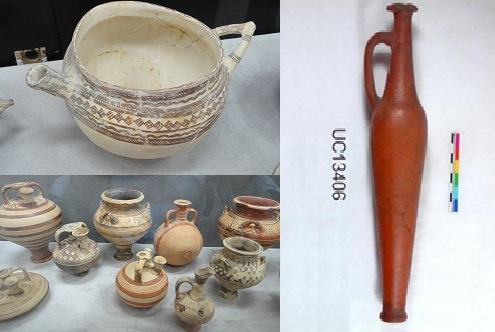
Cypriot white slipped spouted bowl
1,450-1,225 BC and 16th century
BC Syrian vessels - source St Barnabas
Archaeological museum, Cyprus and Dynasty
18 Cypriot wheelmade burnished
“spindle bottle” UC13406 - Copyright
of the Petrie Museum of Egyptian
Archaeology, UCL
Although there were peaks and troughs, this was in general a time of unprecedented luxury and refinement for kings, nobility and governing classes. During the New Kingdom more emphasis was put on building temples for the gods. They were usually made of carved stone and contained stone and wood statuary, inscribed stelae and included precious materials in the inner areas. From the start of the New Kingdom, Egyptian Kings had stopped building tombs in the shape of pyramids as they were constantly raided by tomb robbers. From this time they were buried in the foothills west of Thebes in elaborate tombs cut deep into solid rock accessed by a narrow sealed tunnel. There was usually a series of buildings, pylons and obelisks on the surface. However, private tombs of officials were now small but elaborate structures with a small steep-sided pyramid. Within it there would be a niche containing a stela. Officials who could not afford a fancy stone sarcophagus might use a pottery one. An example in plain red had a lid separated into two sections, the top section depicting a face in relief, coloured in yellow slip. On its reverse were found finger marks of the potter made as he modelled the face, probably using a mould. Pottery models of coffins and other funerary items were also found in these tombs.
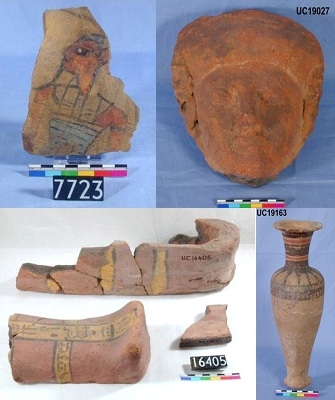
Dynasty 18, sherd from decorated coffin,
face from coffin, model coffin and Hes
vase UC7723, 19027, 16405 and 19163 -
Copyright of the Petrie Museum of Egyptian
Archaeology, UCL
As before, a large number of 6-10” long pottery “cones” might also appear as decoration on the façade of tombs at this time, not too dissimilar to the earlier Mesopotamian ones. However, now their blunt ends were covered in informative inscriptions including the names and titles of the buried officials.
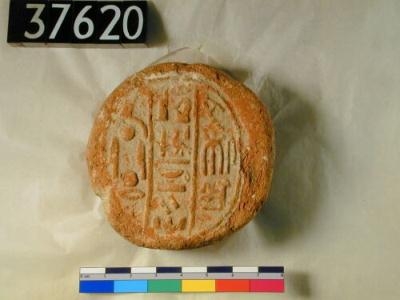
Dynasty 18 funerary cone UC37620 -
Copyright of the Petrie Museum of Egyptian
Archaeology, UCL
The 18th Dynasty itself lasted until 1,295 BC. King Thutmose I (1,504-1,492 BC) was a military commander and not of a royal family, however, by his marriage to a royal princess he was able to legitimise his position. He had a well-organised army that at this time contained many captive foreigners (they were also used in dangerous trades such as quarrying).
| Page: 189 of 418 Go To Page: | |
◁◁ First | ◁ Previous | Next ▷ | Last ▷▷ |
Author: Dr. Stan Jones © Copyright 2010 -