

9. Ceramic Development in the Middle East
| 935 Page: 188 of 418 Go To Page: |  |
◁◁ First | ◁ Previous | Next ▷ | Last ▷▷ |
In the 13th Dynasty Egyptian potters made shallow dishes inscribed at the centre with fish, and vessel shapes included fish and birds, as well as continuing to make beautiful cylinder seals and scarabs.
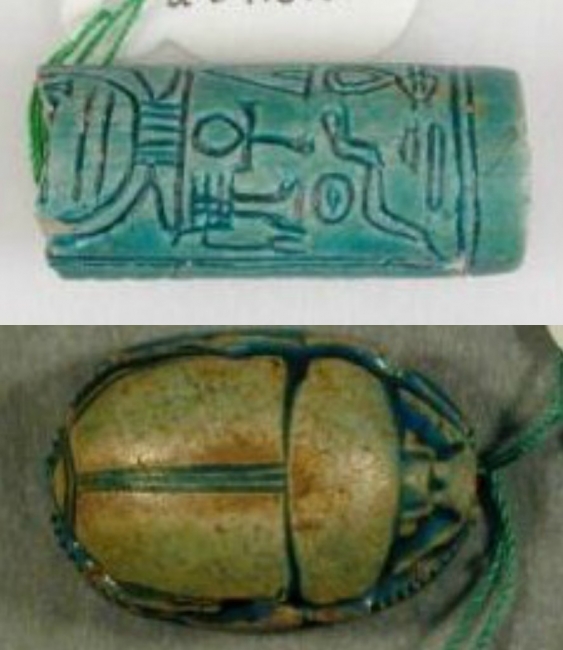
Middle Kingdom glazed steatite, cylinder
seal and scarab UC11527 and 11362 -
Copyright of the Petrie Museum of Egyptian
Archaeology, UCL
Pottery from Cyprus and The Levant continued to influence Egyptian designs. Imported pots have also been found and Petrie describes several discovered at Kahun that came from the Aegean Region, and other finds have been identified from Crete, Asia Minor, Syria and Canaan.
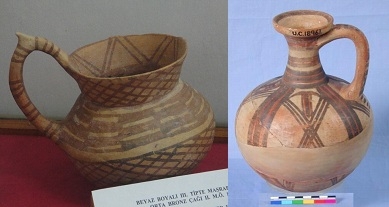
Cypriot painted white ware tankard
1,800-1,700 BC and bichrome jug UC18961 -
source Guzelyurt Archaeological Museum and
Copyright of the Petrie Museum of Egyptian
Archaeology, UCL
Towards the end of the 13th Dynasty, the people of the Eastern Delta broke away and were ruled separately by minor kings of the Fourteenth Dynasty. Many foreign workers had immigrated to Egypt to improve their lot, and the Asiatic Hyksos peoples from Syria, Palestinians, Hurrians and others slowly expanded their influence over the Delta Region after 1,770 BC. By about 1,730 BC the Hyksos started to occupy and develop a new city, Avaris, on the base of an old town in the Delta Region (located near Tanis, but nothing now remains). Around the time Egypt declined in the middle of the 17th century BC, the Middle East was very warlike with several large armies on the move.
The Middle Kingdom formally came to an end in 1,650 BC, followed by 100 years of disunity (the Second Intermediate Period). The Hyksos entered Egypt in large numbers and united with those already in the Delta Region. Much information has been found of this time from inscriptions on scarabs and paintings in mortuary temples. They brought with them much superior fighting equipment, such as improved bronze weaponry and compound bows, and the Mesopotamian two-wheeled chariot now drawn by a horse rather than a donkey. This was the first appearance of horses in Egypt and was first depicted in Egypt in the mortuary temple of Thutmose II. The Hyksos set up a capital at Avaris and then seized Memphis, and ruled as kings of the 15th and 16th Dynasties, while the Egyptian rulers of the 13th Dynasty returned to Thebes to rule there as the 17th Dynasty. The Nubians also revolted, set up their own kingdom and formed an alliance with the Hyksos. For several decades there was peace and the Hyksos took on much of the Egyptian Culture, taking Egyptian names, using Egyptian hieroglyphics, building temples, statues and supporting artisans, and trading internationally including with the Hittites in Anatolia.
The Hyksos brought their own style of pottery (Tell el-Yahudiyeh ware) that was produced in Egypt during the Second Intermediate Period. Typically small black/brown ware jugs were made with lustrous burnished surfaces incised with zigzag lines and dots filled with white (gypsum) paint. Although an imported technique, most of this ware was made in Egypt and exported to several countries including Cyprus.
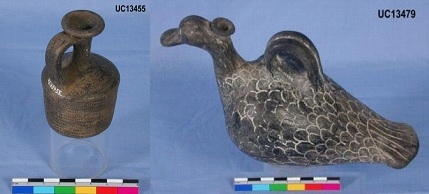
Tell el-Yahudiyeh ware Dynasty 15 juglet
and duck jug UC13455 and 13479 - Copyright
of the Petrie Museum of Egyptian
Archaeology, UCL
Peace did not last long and in 1,570 BC the Hyksos ruler picked a fight with the Thebans allegedly over the killing of sacred hippopotamuses. In the ensuing battle the Theban king, Ta’o, was killed, but, after a lull, his successors, brother Kamose and son Ahmose retaliated and drove the Hyksos out of Egypt and through to Southern Palestine. This period had shown a very similar pattern to the First Intermediate Period, with weak native rulers, intruders from Palestine into the Delta Region and Nile Valley, then Theban Princes pulling the natives together, expelling the foreigners and ushering in an epoch of immense power and prosperity. A recent theory suggests that the turmoil caused by the eruption of the volcano Thera also might have triggered a significant change in the balance of power between the Empires at this time.
| Page: 188 of 418 Go To Page: | |
◁◁ First | ◁ Previous | Next ▷ | Last ▷▷ |
Author: Dr. Stan Jones © Copyright 2010 -