

9. Ceramic Development in the Middle East
| 940 Page: 193 of 418 Go To Page: |  |
◁◁ First | ◁ Previous | Next ▷ | Last ▷▷ |
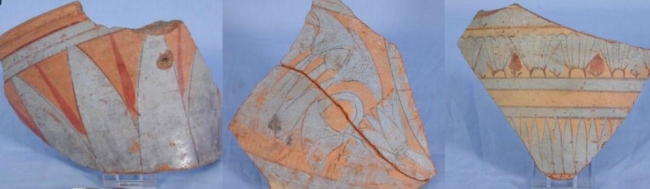
Dynasty 18 sherds, blue, red and black on
orange bodies, papyri and lotuses, and
petals and lotus flowers UC2300, 24634 and
24556 - Copyright of the Petrie Museum of
Egyptian Archaeology, UCL
Pottery with blue slipped ground also became popular. Pottery chalices representing half-closed lotus flowers, some rare ones having a square mouth, were used for cult purposes in funerary rites and are depicted in drawings on tomb panels.
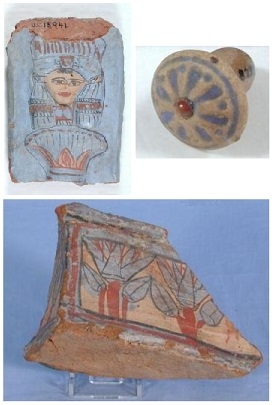
Dynasty 18, Painted blue, red,
pink and black, handle with head of
Hathor, ear stud and sherd from box
UC15941, 38280 and 2312
- Copyright of the Petrie Museum
of Egyptian Archaeology, UCL
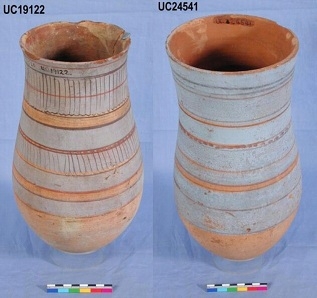
Dynasty 18, jars with cream grounds
painted in blue, red and black UC24541 and
19122 - Copyright of the Petrie Museum of
Egyptian Archaeology, UCL
This was the time when the dead were often wrapped in nets made from multi-coloured pottery and faience beads and bugles with amulets attached. Ushabtis, now often wearing long wigs, were sometimes inscribed with extracts from the ‘book of the dead”, which contained 190 chapters of instructions for the dead to avoid problems in the netherworld. The fantastic collars or pectorals were from this period, some formed from glazed pottery ushabtis.
In the New Kingdom, potter’s clay was often a mixture of Nile clay, limestone and straw, or other vegetable matter, and sand. The potters also used mixtures of Nile and marl clays. The manufacture of amphorae for storage and transport became specialised in terms of clay types, surface treatment and shapes. “Potmarks” were used that may have indicated contents, capacity or potter’s identity. With the stronger political and commercial connections abroad, large quantities of pottery vessels arrived in Egypt related to the trade in goods such as wine and oil with Cyprus, Crete, Greece, Levant and Sudan. This had a considerable influence on local potters, introducing many more forms and designs of decoration including white slip ware from Cyprus. In the 18th Dynasty Egyptian potters made amphorae imitating those from the Levant including their style of handles.
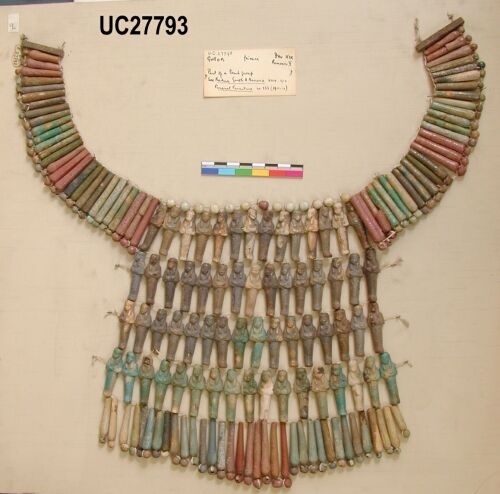
Magnificent glazed pottery pectoral
featuring ushabtis UC27793
- Copyright of the Petrie Museum of
Egyptian Archaeology, UCL
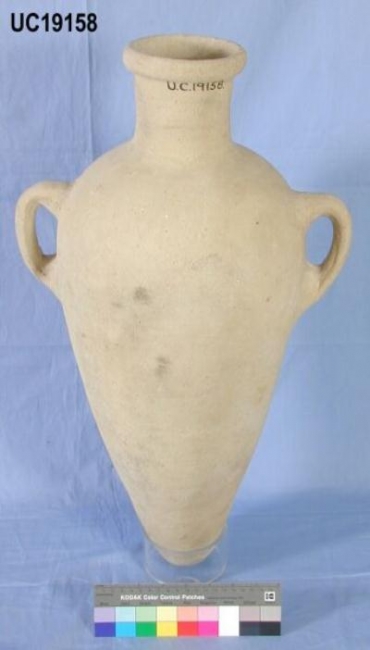
Dynasty 18 Ballas ware
amphora UC19158
- Copyright of the
Petrie Museum of
Egyptian Archaeology,
UCL
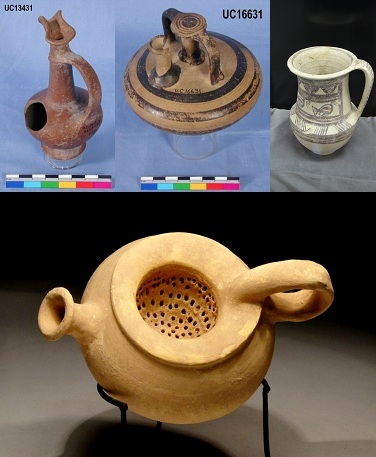
Dynasty 18 Cypriot juglet and
Mycenaean stirrup vase UC13431
and 16631, (Copyright of the Petrie
Museum of Egyptian Archaeology,
UCL), Mycenaean beaker
1,400-1190 BC, source St Barnabas
Antiquities Museum and wine strainer
from N Israel 1,550-1,200 BC
courtesy Aweidah Gallery
| Page: 193 of 418 Go To Page: | |
◁◁ First | ◁ Previous | Next ▷ | Last ▷▷ |
Author: Dr. Stan Jones © Copyright 2010 -