

9. Ceramic Development in the Middle East
| 941 Page: 194 of 418 Go To Page: |  |
◁◁ First | ◁ Previous | Next ▷ | Last ▷▷ |
Fine New Kingdom pottery, usually of marl clay, was decorated before firing with elaborate designs in red, brown and black. Manufacture was restricted to the main administrative and palace centres of Amarna, Luxor, Memphis and Qantir (Pi-Ramesse) from where it was distributed. Geometric bands separated scenes that included flowers and horses. Red, black and blue paint was also used on a light reddish or cream slip before firing using both types of clay. Decoration of the vessels included human figures, birds, cattle, fish, gazelles, ibexes, horses, cats, flowers and hieroglyphics. The animals were usually depicted in lively postures. From the second half of the 18th Dynasty very large jars were produced together with slender amphorae, tall one-handled bottles and pilgrim flasks using polished/burnished cream-bodied marl clay.
The light coloured surface layers of marl clay are a firing feature, not produced by slip. Large pots were often made in two parts, the base and middle, and the top and rim. In use, the necks of vessels such as amphorae were sealed with blobs of raw clay to prevent spillage, evaporation and fermentation. These “bungs” were often stamped to identify ownership, contents or a phrase seeking good fortune.
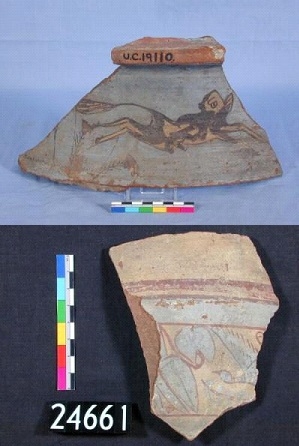
Dynasty 18 sherds, running calf
and birds UC19110 and 24661
- Copyright of the Petrie
Museum of Egyptian
Archaeology, UCL
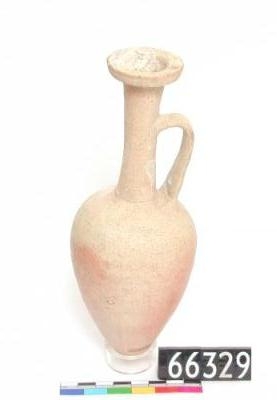
New Kingdom marl clay juglet,
cream slip and burnished
UC66329 - Copyright of the
Petrie Museum of Egyptian
Archaeology, UCL
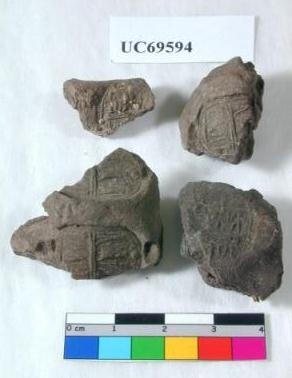
Dynasty 19, four fragments of
sealing clay with message
“Ramses beloved of Amun”
UC69594 - Copyright of the
Petrie Museum of Egyptian
Archaeology, UCL
In the 19th and 20thDynasties polychrome became more popular with the paint applied before and/or after firing. Some jars and handled vessels were coloured after firing with polychrome on their exteriors over a white gypsum coating adding greens from copper and yellows from iron. As it did not wear well they were less popular and were reserved for festive occasions and as tomb furniture. Very complex decorative vessels were produced using a combination of many techniques.
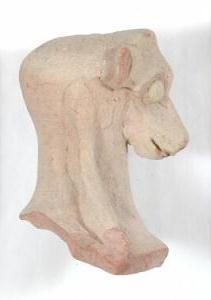
New Kingdom, animal head from
marl vessel, probably a spout
UC60041 - Copyright of the
Petrie Museum of
Egyptian Archaeology, UCL
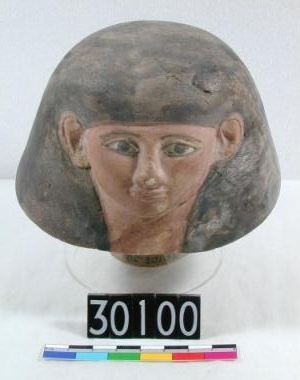
Dynasty 18, lid of a canopic jar
UC30100 - Copyright of the
Petrie Museum of Egyptian
Archaeology, UCL
They made some very fine quality marl-bodied, decoratively shaped items including figure vases modelled as gods, women (nurses), musicians, animals and birds using a very high level of technical ability. They were mainly made in two or more parts in moulds, although some were by hand, and then joined together and usually covered in a polished red slip. Some are considered to be the finest pottery from ancient Egypt. The same techniques were used for the human, animal and bird-headed jar lids.
| Page: 194 of 418 Go To Page: | |
◁◁ First | ◁ Previous | Next ▷ | Last ▷▷ |
Author: Dr. Stan Jones © Copyright 2010 -