

9. Ceramic Development in the Middle East
| 942 Page: 195 of 418 Go To Page: |  |
◁◁ First | ◁ Previous | Next ▷ | Last ▷▷ |
Some shallow bowls were decorated to resemble ducks, modelled with a head one side and tail the other. Garlands of flowers used during festivities probably inspired floral motives painted around pots. They also started to model the vessel wall, manipulating it while wet to achieve faces and other depictions both outward and inward. Ceramic moulds were used to make pottery and faience amulets and necklace pieces.
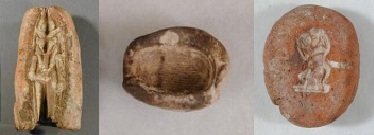
New Kingdom moulds, standing figure of
Bes, a scarab and Sekhmet UC46210, 7388
and 26078 - Copyright of the Petrie Museum
of Egyptian Archaeology, UCL
They were decorated with one of the many gods to give divine protection in life but also after death by being placed within the bandages of a mummy. At this time amulets were often placed in graves in place of other offerings. Pottery was used in very diverse applications, from coffins to earplugs.
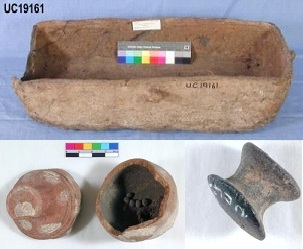
New Kingdom, child’s coffin, broken
rattle with pellets and ear plug UC19161,
59266 and 42890 - Copyright of the Petrie
Museum of Egyptian Archaeology, UCL
Papyrus remained expensive, so alternatives were still used to write on instead – particularly potsherds. Thousands have been found in places such as the workmen’s camp for Ramesses II’s tomb, many of which have not yet been published. Their initial purpose was as draughts of hieroglyphics to be inscribed in stone, but they also contained information on literary, magical and religious topics; barter; payment of wages; bills for corn or copper; lawsuits and even the hire of donkeys.
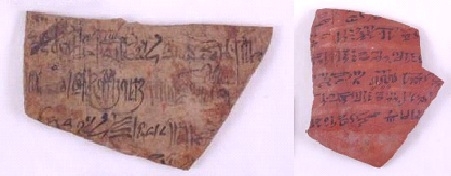
Hieratic on sherds, 6 lines part of story
of Isis and Ra, and 4 line letter from an
army scribe UC39610 and 39646 - Copyright
of the Petrie Museum of Egyptian
Archaeology, UCL
Merneptah, the ruler who followed Ramesses II from 1,213 to 1,203 BC, also had to defend the Delta Region from the Lebu and Sea People. Ramesses III (1,184-1,153 BC) was the second Pharaoh of the 20th Dynasty and the last really strong Pharaoh. He was able to drive off two major, direct attacks of the “Sea People” by land in Palestine and one by sea off the Delta Region, so they were forced to retreat and settled further north in Palestine, Lebanon and Syria. He also took many prisoners for the army and construction, and although they were branded, they were absorbed into the populace. Later they were to accelerate Egypt’s decline.
The government was still responsible for supplying people with provisions from the temple storerooms, but towards the end of Ramesses III’s reign this proved very difficult. A great deal of information of this period was contained in “Papyrus Harris No I” in the British Museum. It is the most magnificent of all Egyptian State Archives, being 133 ft long, 16.5 inches wide containing 117 columns of hieratic writing. At this time the tombs of ordinary villagers contained little jewellery, but quantities of faience and local pottery including vessels based on imported techniques or having Mediterranean-style decoration.
After the death of Ramesses III in 1153 BC there followed a number of weak Pharaohs with short reigns, who had become less powerful than the Theban High Priests. Subsequent opportunistic attacks from the Sea People in the Levant and from the Libyans sapped Egypt’s strength and its power over Syria faded, cutting off sources of many previous imports. Nubia had already emerged as an independent kingdom, led by Nubian Kushite priests, who were to start a Royal Dynasty in the early 9th century BC. They established a capital at Napata near the 4th cataract. With the death of Ramesses XI in 1,069 BC the New Kingdom ended and Egypt split up again, starting the Third Intermediate Period that lasted until 747 BC.
Undoubtedly, many king’s tombs would have been as rich or richer than Tutankhamun’s, but for the enterprise of grave robbers, and efforts were made to guard the necropolises from early times. However, grave robbing became prevalent after the death of Ramesses III, and after 1,069 BC it became an industry, so much so that the residual effects of many tombs, mainly coffins and mummies, were gathered together by the Theban High Priests for safety in secret burial chambers. One such was a shaft tomb at Dier el-Bahri containing the mummies of 12 Theban kings and over 100 queens and princes, together with high priests and priests of Amun, as well as funerary equipment. Another nearby cache contained 153 coffins, boxes of Ushabti figures including Osirian statuettes enclosing papyri (Osiris was a very early god of the afterlife)
| Page: 195 of 418 Go To Page: | |
◁◁ First | ◁ Previous | Next ▷ | Last ▷▷ |
Author: Dr. Stan Jones © Copyright 2010 -