

9. Ceramic Development in the Middle East
| 943 Page: 196 of 418 Go To Page: |  |
◁◁ First | ◁ Previous | Next ▷ | Last ▷▷ |
During this period of disunity, kings of the 21st Dynasty ruled North Egypt from Tanis in the Delta Region from 1,069 to 945 BC. Previously Pi-Ramesses had been abandoned as the river changed course, so Tanis was built using Pi-Ramesses as a quarry providing worked stone, hence its disappearance. In parallel, High Priests of Amun in Thebes held sway in South Egypt. However, a Libyan general called Herihor took control as High Priest there in 1,080 BC and adopted all the trappings of a Pharaoh. There was a period of peace between North and South helped by intermarriage between the rulers’ families. However, in 945 BC the powerful Libyans in the Delta Region seized power and their Meshwesh leader Sheshonq I founded the 22nd Dynasty. He appointed his son, Osorkon I, Governor of Upper Egypt, so Egypt again became unified. There is not a lot of information on the 22nd Dynasty rulers apart from that in the Tombs of the Apis Bulls, where there were huge sarcophagi containing the mummies of 64 sacred bulls. (Apis or Hapis was a bull god).
Trade links were re-established with Byblos and campaigns waged in Canaan, including in 930 BC the looting of Jerusalem - the spoils and tribute swelling their coffers. The Libyans happily adopted the culture and clothing of the Egyptians. Their rule did not last long, as the various relatives of the Pharaoh who were in control of the cities vied for independence so around 820 BC the State broke up again, with separate rulers north and south, with the 23rd Dynasty ruling Upper Egypt. The 24th Dynasty was brief and ruled the West Nile delta from 732 to 720 BC.
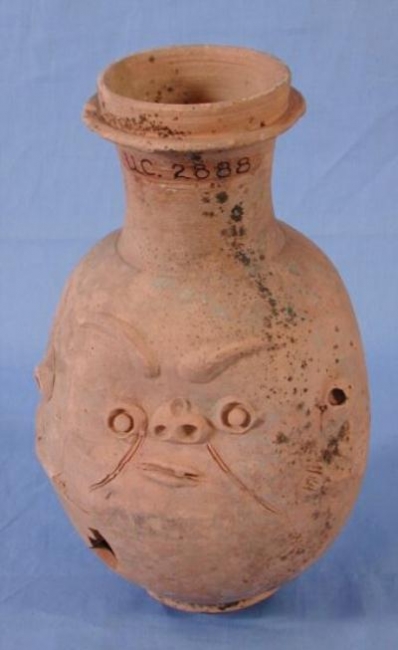
Dynasty 22 Bes vessel UC2888
- Copyright of the Petrie
Museum of Egyptian
Archaeology, UCL
In the period following the demise of the New Kingdom, decoration on pottery became scarcer, sometimes just a roughly applied white spiral. Jars with simple images of the god Bes (a grotesque and ferocious dwarf) appeared in the Third Intermediate Period. Other pottery vessels were relatively well made if plain.
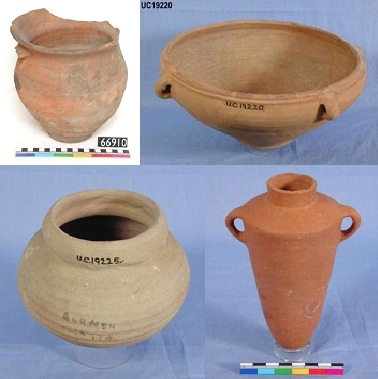
Third Intermediate, chamber pot, bowl with
four loop handles, small amphora and
Ballas ware jar, UC66910, 19220, 42271 and
19225 - Copyright of the Petrie Museum of
Egyptian Archaeology, UCL
Funerary pottery continued unabated and included fertility figures lying on beds as well as amulets.
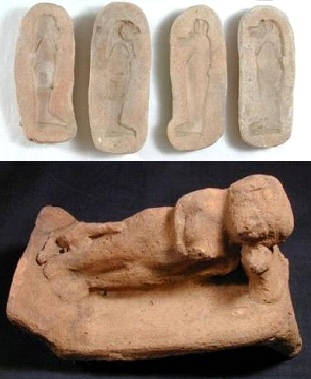
Third Intermediate, fertility figure and
moulds of sons of Horus – human,
falcon, jackal and baboon UC8649
and 55207 - Copyright of the Petrie
Museum of Egyptian Archaeology, UCL
From about 860 BC the Nubians started to expand Napata and use it as a rallying point. Their long interaction with Egypt had caused them to develop a very Theban Culture and they were unhappy that Libyans were ruling Egypt. This period of disunity in Egypt allowed the Kushite ruler, Piankhy (747-716 BC), king of Napata, to move north, capturing Thebes, Memphis and Heliopolis in 726 BC. Having gained control he returned to Napata. Throughout the first millennium BC, the priesthood built up power so their hierarchical administration survived each wave of invaders, and the Egyptians got used to self-administration with overlords. Usually the invader maintained the Culture of Egypt, appointed traditional Pharaohs and life for the majority went on as normal. Following this pattern, Piankhy’s brother, Shabako, went on to overpower all the Northern forces by 711 BC, and reunified Egypt under the 25th Dynasty as Pharaoh. The Nubian Kushites ruled Egypt until around 670 BC. The start of the 25th Dynasty also started the Egyptian “Late Period” (747 BC to the Romans in 30 BC). During this “Late Period” tombs for officials changed again and were vaults cut into rock with brick superstructures.
| Page: 196 of 418 Go To Page: | |
◁◁ First | ◁ Previous | Next ▷ | Last ▷▷ |
Author: Dr. Stan Jones © Copyright 2010 -