

9. Ceramic Development in the Middle East
| 944 Page: 197 of 418 Go To Page: |  |
◁◁ First | ◁ Previous | Next ▷ | Last ▷▷ |
While Egypt had been looking inward, Assyria had grown in power and by 732 BC its leader, Tiglath-Pileser III, was threatening Egypt. However, Egypt had become strong enough around 703-701 BC to join a coalition with Canaanite countries and drove the Assyrians out of Palestine and Syria. In the reign of the Assyrian leader Sennacherib (705-681 BC) Assyria attacked Egypt’s vassal states in Lebanon, particularly the Phoenician coastal towns. The Philistines asked Egypt for help, but it was inadequate. However, Sennacherib was murdered, causing a civil war in Assyria, giving Egypt a breathing space.
However, it did not last long and in 674 BC Esarhaddon (681- 669 BC), son of Sennacherib, attacked Egypt, but was driven back. He tried again in 671 BC and successfully reached Memphis where he set up the new ruling class (26thDynasty), with Necho 1 (672-664 BC) as Satrap (Governor), but the Egyptians quickly drove these rulers out. Esarhaddon returned to Egypt but died suddenly in 669 BC. His son Ashurbanipal (669-627 BC) took up the reins and started hostilities against Egypt in 667 BC, and after several battles re-took Memphis in 666 BC. He reinstalled the rulers in the Delta Region (based in Sais) and drove the Nubians back to Aswan, ending the Nubian’s 25th Dynasty. Ashurbanipal then left the Saite king in charge and returned to Nineveh. Again the Egyptians rebelled, so in 663 BC Ashurbanipal returned, crushed the Egyptian forces and sacked Thebes, carrying away vast booty. He had some of the ruling class killed and set up a powerful garrison of troops in Memphis and another Satrap, Necho I’s son Psammetichus 1 (664-610 BC), in Athribis, the new capital, 65km north of Cairo. A cuneiform clay cylinder relates these battles from an Assyrian point of view, and a stele at Gebel Barkal from Egypt’s.
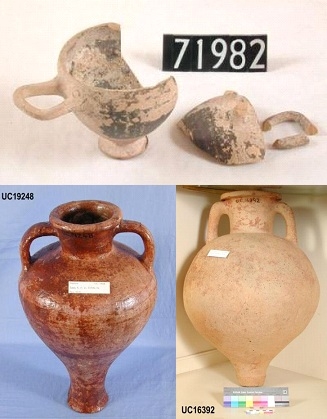
Late Period double handled drinking cup or
Kantharos and two Dynasty 26, Greek
amphorae found in Egypt UC71982, 16392
and 19248 - Copyright of the Petrie
Museum of Egyptian Archaeology, UCL
Psammetichus I moved the capital back to Sais as the local leaders in Athribis were hostile to him. The Saite king was very “Egyptian” in culture even though he had Libyan ancestry, so he was always looking for an opportunity to regain Egyptian control. Psammetichus I attacked the Assyrian garrison in 657 BC, after which the Saite leaders in the Delta were able to resume control, as the Assyrians had greater problems with a civil war at home and a war with Elam. He negotiated with the Theban high priest and by 652 BC obtained agreement to rule all Egypt, starting the 26th Dynasty (672-525 BC). His rule spread from the Mediterranean to the first cataract.
The Saite kings encouraged a huge influx of immigrants from the northeast, including Syrians, Jews and Carians, as well as from the Greek colony of Ionia, to help quell their local enemies. In particular, Greek colonists arrived in numbers and were particularly used as mariners and ship designers in the Egyptian navy. In 654 BC the Lydians asked Egypt for help against a Cimmerian threat in exchange for Greek soldiers from that part of Ionia under Lydian control, further increasing the Greek population in Egypt. Those Greek troops used by Egypt in the Levant between 625 and 600 BC brought their own pottery that has been found in coastal towns such as Ashdod (one of the five major Phoenician cities) and in the Negev, as well as in Egypt itself.
| Page: 197 of 418 Go To Page: | |
◁◁ First | ◁ Previous | Next ▷ | Last ▷▷ |
Author: Dr. Stan Jones © Copyright 2010 -