

9. Ceramic Development in the Middle East
| 946 Page: 199 of 418 Go To Page: |  |
◁◁ First | ◁ Previous | Next ▷ | Last ▷▷ |
In 404 BC Darius II the Persian king died, ending the 27th Dynasty. This gave the Egyptians the opportunity to set up the last period of Egyptian native rule from 404 to 343 BC (Dynasties 28-30). During this period Persians viewed Egypt as a “rebellious province” rather than an independent country. Later, when the Persians were ready, Ochus (ArtaxerxesIII), the then Persian leader, returned with his army and re-established control of Egypt from 343 BC, setting up the 31st Dynasty. He left a Satrap and returned to Babylon. He, his son and others were poisoned in 338 BC, and by 332 BC Alexander the Great had swept the Persians out of the Levant and Egypt. The Egyptian Culture survived well under the Persians, but the Greeks were to become more intrusive.
Domestic pottery continued with various functional vessels and funerary/religious pottery items.
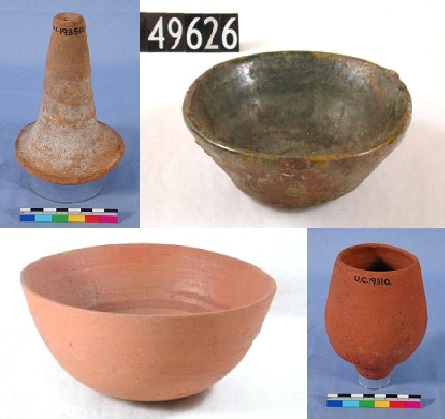
Late Period, pink ware funnel, glazed dark
green measuring bowl, red slipped pedestal
cup and bowl UC19350, 49626, 19310 and
66393 - Copyright of the Petrie Museum of
Egyptian Archaeology, UCL
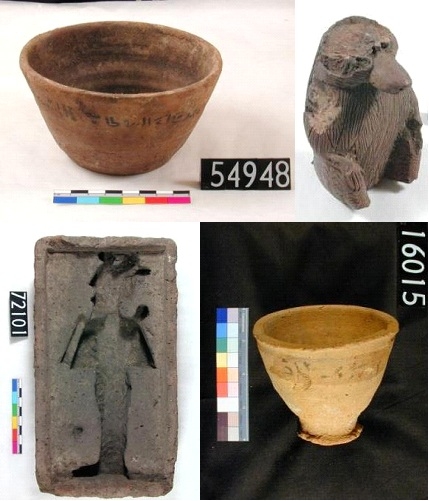
Late Period, embalming bowl, Thoth baboon,
dish “god’s offering of Netheb” and mould of
Osiris used for ritual germination of seeds
UC54948, 60050, 16015 and 72101
- Copyright of the Petrie Museum of
Egyptian Archaeology, UCL
However, during this period there was also considerable influence on the pottery from outside, particularly from Persia and Greece. In the Saite Period (625-550 BC) Bes jars were still common.
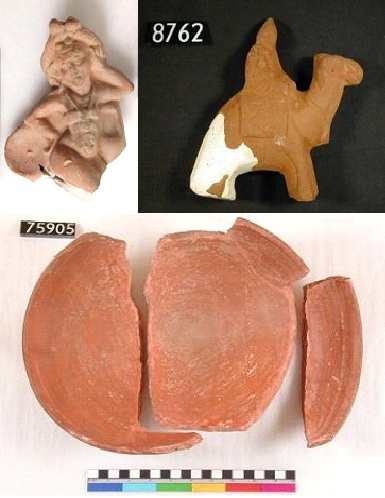
Dynasty 27, reclining man in
“Eastern style”, man on camel
– probably Scythian, and Syrian bowl
UC8788, 8762 and 7590 - Copyright of the
Petrie Museum of Egyptian Archaeology, UCL
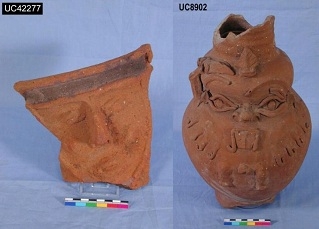
Third Intermediate Period Bes decoration
UC42277 and 8902 - Copyright of the Petrie
Museum of Egyptian Archaeology, UCL
Also many Phoenician storage jars and barrel-shaped kegs appeared. In the 4th century BC Greek red and black decorated ware was imported, but the Egyptians also copied large amounts of Greek wares and shapes, now using clays richer in kaolin from the Aswan Region. Bag shaped vessels having simpler designs were common. Also in this Late Period the inside of vessels containing wine were coated with resin or wax to prevent seepage. Large bottles and shouldered jars appeared using these kaolinic clays. They then started to have more comprehensive decoration than previously, carried out before firing, with broad bands of bushes, trees and lotus flowers and oblique cross lining. Colours used were dark brown, purple and black on an orange surface.
Alexander was accepted as Pharaoh in Memphis, and in 331 BC started to build Alexandria on the Mediterranean coast that was to become the new “very Greek” Capital. Greek Culture was imported into Egypt via Alexandria and the city became a centre for Greek learning. It was also one of the destinations of the caravans bringing in luxury goods along the Silk Road. Now the Greek part of Alexandria is under the sea after an earthquake caused the area to sink. Alexander set up his Greek friend and general Ptolemy with a small army to rule Egypt and set off to crush the Persian army and capture its territories east as far as India. He died in Babylon aged 32 in 323 BC. Ptolemy became Pharaoh in about 311 BC, starting the Ptolemaic Period.
To appease the various factions Ptolemy encouraged composite gods that could be venerated by all. Isis, the Egyptian god who was first recorded in the 5th Dynasty, became so universally successful that she was taken by the later Romans throughout their Empire and was worshipped until the 6th century AD. Serapis was equally popular, but he was a Ptolemaic invention, a combination of Osiris and Apis, whose main Temple was at Alexandria.
| Page: 199 of 418 Go To Page: | |
◁◁ First | ◁ Previous | Next ▷ | Last ▷▷ |
Author: Dr. Stan Jones © Copyright 2010 -