

9. Ceramic Development in the Middle East
| 947 Page: 200 of 418 Go To Page: |  |
◁◁ First | ◁ Previous | Next ▷ | Last ▷▷ |
Ptolemy II set up the first university in Alexandria in about 300 BC. Archimedes is said to have invented the screw pump there, Eratosthenes measured the diameter of the earth, Euclid invented geometry, Hero is supposed to have invented the steam engine, but only as a toy, and Ptolemy wrote about the nature of the universe. Ptolemy I and II also founded the Royal Library, which became the largest in the world with some 700,000 papyrus scrolls including authors such as Pythagoras. Although the Ptolemys ruled for almost 300 years, generally the Egyptians tried to maintain their own Culture that reflected in pottery such as offering tables.
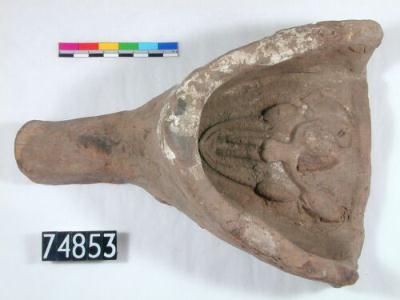
Ptolemaic period, offering table for
liquids UC74853 - Copyright of the Petrie
Museum of Egyptian Archaeology, UCL
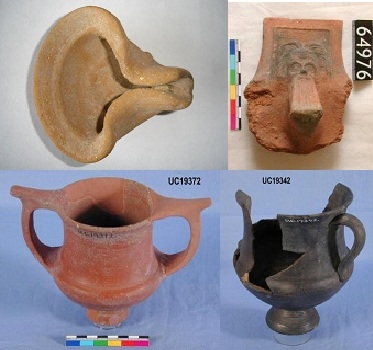
Ptolemaic period, Greek lamp, Greek style
bearded and horned head, burnished black
ware and red ware Kantharoi, UC19342,
19372 and 64976 - Copyright of the Petrie
Museum of Egyptian Archaeology, UCL
However, considerable Greek and Greek-style pottery has been found. The Egyptian priests managed to hold on to their power and even regained their estates in 118 BC, and for the next 100 years they continued as before under the Pharaonic period.
The Greeks introduced cremation to the Egyptians, so special pottery vessels were produced to hold the ashes. Much pottery now was red coloured, again with little decoration other than a few black lines.
Some painted and mould-made impressed pottery was also produced.
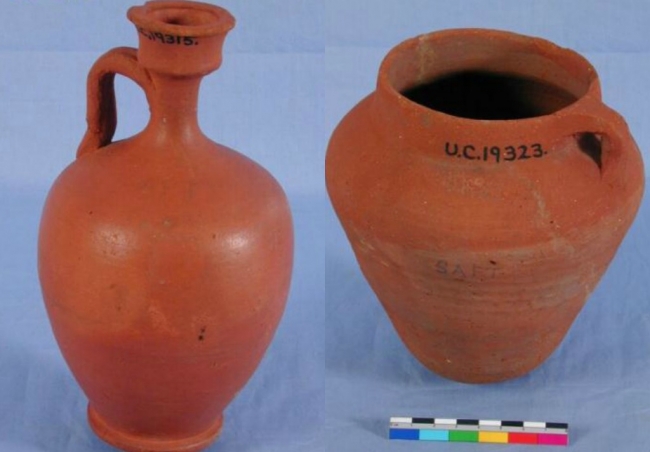
Ptolemaic Period red/orange burnished
ware, jug with Palestinian style handle
and jug wheelmade below the shoulder
UC19315 and 19323 - Copyright of the
Petrie Museum of Egyptian Archaeology, UCL
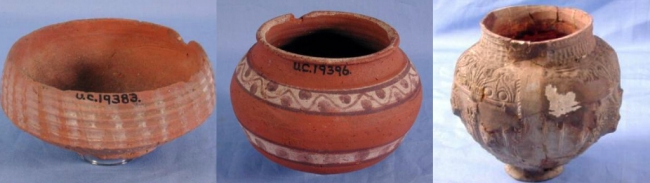
Ptolemaic Period, pink ware ribbed cup,
decorated jar and mould made vessel
depicting Queen Sarapis and others
UC19383, 19396 and 66969 - Copyright of
the Petrie Museum of Egyptian Archaeology,
UCL
Pottery female figures and animals with grotesque features were common. The vessels decorated with fairly crude faces and arms of the god Bes (called Besa by the Greeks and following Romans) continued to be produced. They were very popular with the Egyptians as they were thought to ward off snakes and generally protect the family. To give an indication of the considerable amount of pottery evidence that can be found in Egypt, a well that was filled with rubbish of this period was found to contain 5,000 inscribed and decorated ostraca.
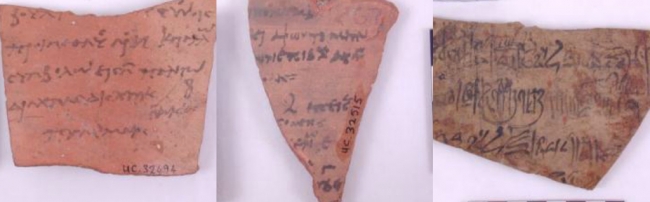
Ptolemaic Period ostraca, seven lines of
Greek referring to 2,000 bronze drachmae,
Greek accounts and Demotic referring to a
Greek named Arion UC32494, 32515 and 71104
- Copyright of the Petrie Museum of
Egyptian Archaeology, UCL
Faience remained popular and from about 300 BC was covered with a lead-alkali glaze to improve its appearance – it improved viscosity in firing and colours were more brilliant. Lead appeared in faience glaze before this time but could have been associated with the antimony compound used as yellow pigment. Also as time went on clay was added to the faience body to make it workable and harder, so by the Ptolemaic period and the following Roman, the body technology was very different to the earlier faience. Towards the end of the Late Period, lead-based glazing was introduced on earthenware pottery, probably from Syria and Babylonia in Mesopotamia. It was used by the Romans from 100 BC where it became popular for green (copper) and brown (iron) glaze colours.
| Page: 200 of 418 Go To Page: | |
◁◁ First | ◁ Previous | Next ▷ | Last ▷▷ |
Author: Dr. Stan Jones © Copyright 2010 -