

9. Ceramic Development in the Middle East
| 949 Page: 202 of 418 Go To Page: |  |
◁◁ First | ◁ Previous | Next ▷ | Last ▷▷ |
This First Babylonian Dynasty started relatively insignificantly, until around 1,766 BC, when the Babylonians were ruled by its sixth king, Hammurabi, who reigned from about 1,792 to 1,750 BC. He started an opportunistic expansion, capturing a number of other city-states including Yamkhad in North Syria, Hazor in Galilee, Larsa and Mari forming the first Babylonian Empire.
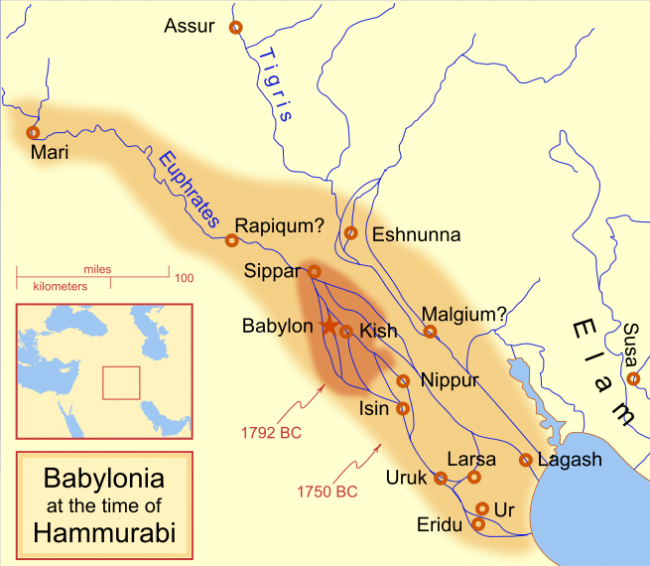
Map of Hammurabi’s Babylonian
Empire-1750 and 1792 BC - source Wikipedia
mapmaster
In some cases battles were fierce but in others it was sufficient for the “captured” city-state to agree to be subservient. The latter was probably the case with the kingdom of Amorite Mari. Its ruler Zimri-Lim (1,779-1,761 BC) is noted for his palace that was the largest in Mesopotamia at the time with 200 rooms covering some 5 acres (25,000 sq m), and his 5 month trip of 1000 miles with 4000 courtiers to the Mediterranean port of Ugarit to see the sea! Hammurabi’s control stretched further into Syria compared with the Ur III Empire, but not into Iran. It covered around half the overall area of Ur III and even included Ashur and Nineveh, albeit for a relatively short period. The Babylonians adopted and built on the prevailing Sumerian Culture. Hammurabi organised a well-trained army, built roads, reconstructed buildings and even set up a postal service The very south of Mesopotamia had suffered badly from the decline in central organisation, particularly the irrigation system, so he started to rebuild this and repaired temples. Around 1800 BC the architects in Mesopotamia were applying “Pythagoras’s” theorem in the construction of buildings over 1,000 years before Pythagoras was born, although it was never written down.
Pottery from the Old Babylonian period included earthenware relief plaques that were mass-produced using moulds, often depicting gods and domestic scenes probably used in house shrines. A good example is the “Queen of the Night” in the British Museum dated to 1,800 BC and made from straw-tempered pottery 0.5m high depicting a naked female god with wings and claw feet. Another depicts a man on horseback and a third example is a 12cms tall Amorite musician found in Diyala that is now in a Chicago museum.
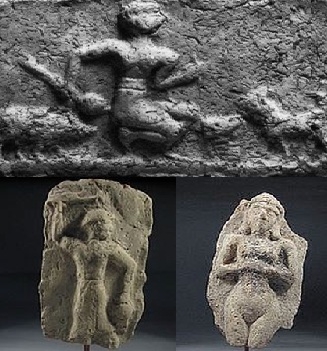
Old Babylonian Period plaques, a man
with musical instrument, source National
Museum of Iraq, Baghdad;
a man, and the goddess Astarte
courtesy Ifergan Collection
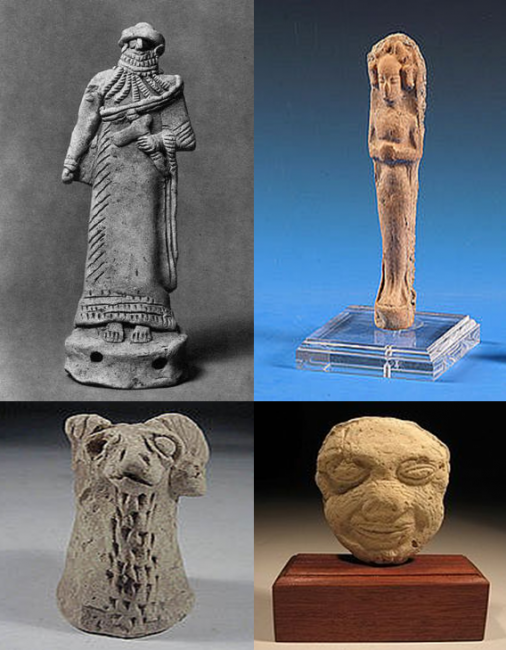
Old Babylonian Period models,
warrior - source National Museum
of Iraq Baghdad, figure, mask of
Humbaba and head of ram
- courtesy Ifergan Collection
They also produced earthenware votive offerings, such as the two-wheeled chariot decorated with seated gods now in the Louvre. Also an approximately half life-size, originally painted pottery model of a woman from the waist up is in the British Museum, possibly from a temple. At this time women could hold senior positions in the ruling hierarchy.
| Page: 202 of 418 Go To Page: | |
◁◁ First | ◁ Previous | Next ▷ | Last ▷▷ |
Author: Dr. Stan Jones © Copyright 2010 -