

9. Ceramic Development in the Middle East
| 950 Page: 203 of 418 Go To Page: |  |
◁◁ First | ◁ Previous | Next ▷ | Last ▷▷ |
Hammurabi is famous for his Laws and Customs produced around 1,750 BC called “The Code of Hammurabi” that was the first recorded comprehensive collection of laws in history, going into much greater detail than Ur Nammu’s laws 350 years earlier. Hammurabi’s laws were rather more “Amorite” than “Sumerian”, and their purpose was to support the centralisation of government and covered fairly harsh punishments for crimes, the division of classes, relationships between man, wife and children and regulations for business. Cuneiform accounts of both “laws” on terracotta can be seen in the Archaeological Museum, Istanbul.
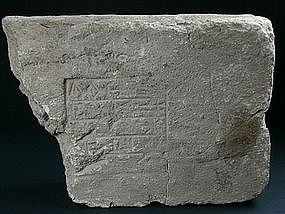
Old Babylonian Period tablet referring to
Hammurabi
In the reign of Hammurabi’s son (1,749-1,712 BC), the horseback riding, Kassites from the Zagros Mountains in Western Iran attacked Babylonia. They were driven off but the power of Babylonia started to decline, the Empire shrank causing a power vacuum impacting on the region for some time. The Kassites were an ancient, possibly Elamite, tribe. Over the next few decades the Kassites built up their population and influence in Babylonia, as did other ethnic groups including the Hurrians from present Armenia and a fresh influx of Indo-Europeans from Central Asia. From around 1,595 BC the Kassites took over most of Mesopotamia almost reaching Ashur. Apart from the skirmish with the Hittites around 1,600 BC, they ruled Babylonia for some 400 years, from 1,570 to 1,153 BC, although the Kassite upper classes were always a ruling minority. They continued to repair the irrigation system and rebuild and refortify the southern cities such as Ur and Uruk. They introduced “boundary stones” to delineate the boundaries between properties.
The Kassites started to use un-glazed, moulded, ceramic panels with figures in shallow relief to decorate the faces of buildings, the precursor to the later decorative tiled facades that were a feature of subsequent Middle East architecture. As an example, in 1,420 BC their leader Karaindash built a temple in Uruk that was decorated in such bas-relief pottery tiles. The Kassites produced very realistic pottery figures of animals such as a beautiful lioness, as well as some large faience objects such as masks, all now in the Baghdad Museum.
Although the craftsmen in this region were well versed in glazing faience and steatite from before 4,000 BC, its regular use on earthenware vessels seems to have been delayed by some 2,000 years to the 2nd millennium. The alkali glaze was almost certainly derived from the ancient faience technology. Whether this development was made before or during the Kassite rule is not clear as yet, but it is very likely that the Kassites were responsible for passing this glazing technology from Babylon to Persia around 1,500 BC. The Babylonian potters also appear to have been the first to recognise the importance of (small quantities) of lead in glaze as an alternative flux to lower the melting temperature of the glaze, (although for us to discriminate between the craftsmen deliberately adding an ingredient or it being a secondary component of an ore is difficult).
Not a great deal is known today about the obscure Kassite language, or for their first 100 years, much about their activities at all. However, they collected and preserved many of the Sumerian epics, prayers, royal inscriptions and works of literature making them available to us today. In fact the great Sumerian poems from the 26th century BC were copied many times on clay tablets in languages such as Akkadian, giving us a greater understanding of the Sumerian language. The Kassite leaders between 1,400 and 1,333 BC were in contact with Egyptian leaders concerning trade in, for example, lapis lazuli for gold, and to arrange political marriages.
The Kassites were under attack for decades from the Assyrians, and from the Elamites who regained their independence around this time. Again marriage was used to help, but the details are conflicting. The most probable account was that the Assyrian King Ashur-uballit’s daughter married the Kassite ruler, but in 1,320 BC, the Kassite elite killed his son-in-law and put another king on the throne in Babylon. This so infuriated the Assyrian ruler that he turned his army south and sacked Babylon, replacing the king, and there followed a period of relative peace.
| Page: 203 of 418 Go To Page: | |
◁◁ First | ◁ Previous | Next ▷ | Last ▷▷ |
Author: Dr. Stan Jones © Copyright 2010 -