

9. Ceramic Development in the Middle East
| 965 Page: 218 of 418 Go To Page: |  |
◁◁ First | ◁ Previous | Next ▷ | Last ▷▷ |
At around 5,000 BC Persian potters were painting geometric designs such as zig-zag lines and hashes in brown and red on pots covered with a thick cream or white slip. In subsequent centuries pottery became more and more refined, with finely ground sand temper added and better-controlled kilns, allowing much thinner bodies. There was a larger selection of vessel shapes and bodies were decorated with animals and stylised floral designs. Immigrants from the north also introduced red and grey monochromatic pottery.
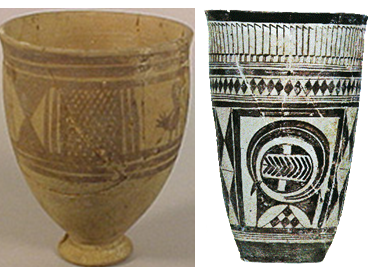
Persian Susa decorated cup, 4,000 BC -
courtesy Milwaukee Public Museum and
beaker, 3,800 BC source Victor Bryan
In the 5th Millennium BC in South Persia the potters had developed sophisticated two-stage kilns having a grate and firebricks. The potters of Susa, the major city in South Persia on the south eastern fringe of Mesopotamia, produced many large thin-walled drinking vessels and open bowls from high quality clay at the height of the Ubaid period from around 4,500 to 3,500 BC. They also made small pottery figures of humans and animals. Over 1,000 graves were found in Susa containing three or four items of fine handmade ritual pottery, usually a beaker, dish and small jar. The most richly decorated pottery from this area, remarkable for its fine painting, also came from Susa. The body was grey or buff coloured, coated in greenish slip and decorated in dark colours, often red, with geometric shapes, plants, waterfowl and other partly stylised but easily recognised animals including running dogs, horses, ibex, goats and snakes, as well as stick-like people, usually in friezes. Examples are a very attractive funeral beaker decorated with diamond shapes, zigzags and leaves using black paint on a cream ground, 20cms high, another with buff ground is decorated with stylised ibex having elongated horns forming a sweeping design, together with long-necked water birds near the rim (rare ones have a hunter with bow), both dated to 4,000 BC. A later bowl had dark brown birds, zigzags and triangles on a buff ground. There was a reasonable link with Northern Iran as shown in similar pottery decoration, but there would also have been a link between Susa and Ur at this time. Pottery from Bakun, a simple cattle ranching village but with highly developed crafts located near Persepolis, was influenced by Susa and around 4,000 BC produced vessels with geometric designs and dramatic human figures.
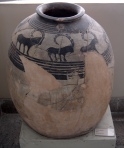
Persian Sialk vessel
4th millennium BC
- source Iran Museum
Tehran via Zereshk
The potter’s wheel in Persia followed closely its development in Mesopotamia, arriving in the 4th millennium BC producing better quality symmetrical bodies. At this time throughout Persia there was a lot of black painted, red-bodied pottery that changed to a buff body towards the end of the 4th millennium. In Tepe Sialk they also produced fine, delicate vessels and graceful beakers with well-fired buff bodies decorated with bands of sheep, goats and bulls. In Western Iran in the 3rd millennium they were making wares including large handmade jars from coiled clay. They impressed them with their fingers in horizontal bands in the wet clay and decorated them after drying with iron pigments that turned brown on firing. The potters used various geometric designs, including a band of eagles with outstretched wings. In Nineveh around 3,000 BC they made vessels with a foot, pottery jars with overall white paint decorated with red bands and geometric shapes, and bowls painted with animal decoration. Around 2,750 BC they made fine indented and incised grey ware.
| Page: 218 of 418 Go To Page: | |
◁◁ First | ◁ Previous | Next ▷ | Last ▷▷ |
Author: Dr. Stan Jones © Copyright 2010 -