

9. Ceramic Development in the Middle East
| 966 Page: 219 of 418 Go To Page: |  |
◁◁ First | ◁ Previous | Next ▷ | Last ▷▷ |
Iran is a large country and various Dynasties and tribes have ruled parts of it across the ages, and developed different regional cultures. One of these tribes was the previously mentioned Elamites who were neither Semitic nor Indo-European and had a unique language. Their Empire was centred on Susa, and flourished in the 4th and 3rd millennium BC. There was a very interesting development there around 3,500 BC as their potters produced a glossy black surface covering on the buff body. It is likely to be the first glaze specifically on earthenware anywhere, and its preparation was quite sophisticated. Clay was fired to 1,000 degrees C then ground, made into a paste and brushed on to the vessel and fired again at 800 degrees C. This particular glaze technique was short lived and soon lost. In the 3rd millennium they produced large round carinated vessels with lug handles, typically decorated with the spread-eagle motif and stick figures in red wash.
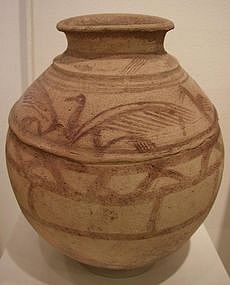
Persian vessel decorated with spread
eagle, 2,400-2,000 BC - courtesy Griffin
Gallery of Ancient Art
There were large, painted storage jars, 50 cm high and 40 cm diameter. Unpainted wares now had a finely burnished grey body (sometimes red), with distinctive shapes. Vessels had closed rather than open tops with long spouts, similar to metal wares, but decorated with inscribed patterns. There were shallow bowls with curved ridges inside called “worm bowls” and one-handed, splayfooted goblets. The fine burnished grey wares continued for the next 2,000 years.
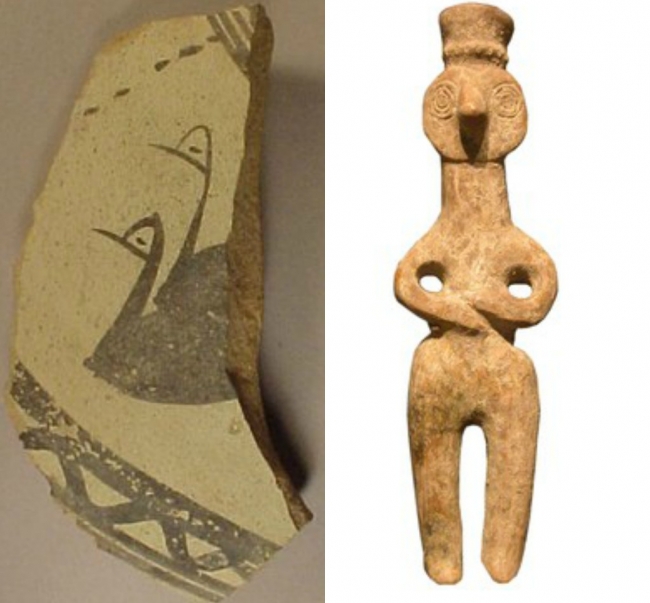
Persian, sherd slipped cream and decorated
with birds, 2,000 BC and Amlash (NW of
Tehran) human figure, 1,500 BC - courtesy
Milwaukee Public Museum
Throughout Persia the variety of vessel shapes increased further and decoration was very carefully applied. The technology spread widely indicating the good communications between the settlements, and by the 2nd millennium BC local potters were widespread, producing bowls, pitchers, jugs and jars, mainly undecorated with grey, red or buff bodies, but some were burnished and others painted with geometric patterns. Chequerboard patterns were popular.
During the 2nd millennium BC the eagle motif changed to ones of plump water birds, and mould-made figures became popular, some even larger than life-size. However, the most interesting vessels in the period from 1,500 to 500 BC were probably vessels with animal handles and zoomorphic vessels, the latter notably from the Marlik Region of North West Iran. These depicted humped bulls, camels, rams, horses, leopards and human figures, some with considerably exaggerated proportions.
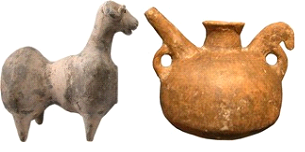
Persian Amlash ram figure 900 BC and
Khurvin vessel with horse head handle 9/8
century BC - courtesy Milwaukee Public
Museum
A number of these vessels were utilitarian while others were used in ceremonies or burials. Some, such as the hollow figures of women, are in red burnished clay, and others in grey polished ware. Various strange pottery items have also been found.
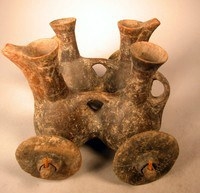
Persian Amlash four jugs conjoined
on wheels, 1,000 BC - courtesy
Milwaukee Public Museum
Although craftsmen in Mesopotamia were well versed in glazing faience and steatite from before the 4th millennium, its general use on earthenware pottery seems to have been delayed by some 2,000 years to the 2nd millennium. This glaze was alkali and almost certainly based on faience technology. It was probably first used in Babylonia before the Kassite period, and the technology was transferred to the Iranian Highlands by the Kassites around 1,500 BC. Although pottery styles were different, there were evidently links between the potters of Susa and Babylon at various times, and much experimentation. It is possible, but speculative, that the technology of adding imported tin oxide to their alkali glaze was first discovered in Mesopotamia, as early as 1,450 BC around Susa. However this glazing technology appears to have been lost after 1,200 BC. It seems to have reappeared around 900 BC in Assyrian Iraq.
| Page: 219 of 418 Go To Page: | |
◁◁ First | ◁ Previous | Next ▷ | Last ▷▷ |
Author: Dr. Stan Jones © Copyright 2010 -