

9. Ceramic Development in the Middle East
| 974 Page: 227 of 418 Go To Page: |  |
◁◁ First | ◁ Previous | Next ▷ | Last ▷▷ |
They also had to invent new Arabic words, but construct them in such a way that the reader could work out the meaning. Part of the motivation for the very expensive translation process was to show their rivals/enemies, the Byzantines, that the Arabs were as sophisticated as they were. Persian books that had been translated into Greek in Alexander’s time, together with Roman texts, were also translated into Arabic, and Abbasid Persians paid huge sums to have the knowledge returned to Persia. As time went on, this technology was further developed by the Muslims, who added it to their growing body of knowledge. For example Islamic medical knowledge was amongst the most advanced at the time. In particular the medical text “Qanun” by Ibn Sina (980-1,037 AD) was still utilised round the world until relatively recently, some 1,000 years later. Also arithmetic from India and Euclidian geometry were considerably expanded. By the 10th century many significant libraries existed in larger cities, and paper was so abundant it was provided free to readers. Salons were set up for philosophical debates, and all religions were included – Jews, Christians, Zeroasters etc., so long as they could make their point in fluent Arabic. The Abbasids were great educators and set up Madrasahs (schools/universities) throughout their Empire from 859 AD. By the reign of Caliph Harun al-Rashid (786-809 AD), the early Islamic Empire was at its greatest as well as being cosmopolitan and wealthy thanks to very successful trading.
The Abbasid’s very beautiful and sophisticated art tradition spread widely. It caused a great revival of ceramics in Egypt, possibly using migrant potters from Mesopotamia and Persia. New discoveries produced new effects that triggered further developments and new wares. For example, from as early as 700 AD the Iraqi potters had been producing “Basra blue-painted ware” in Basra, but it became associated with Abbasid Samarra. It comprised a buff/yellow fired body, a rediscovered white tin-opacified glaze and a further glaze layer containing cobalt blue.
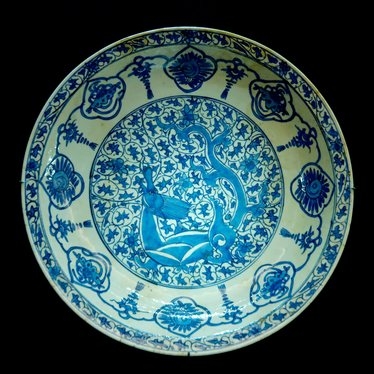
Basra blue ware dish
Also in Basra they produced lustre ware from 800 to 975 AD. The earliest evidence of the rediscovery of tin glaze technology is from an area near the city of Seleucia, just south of Baghdad.
Throughout the Abbasid period there was considerable interplay eastwards and westwards. The Arabic language spread as far as India. Chinese potters significantly influenced those of Islam, and Islamic potters greatly influenced Europeans, and they both passed some innovations back to China. Around 800 AD, a profound change took place in Islamic pottery when Caliph al-Rashid was presented with a group of Chinese Tang bowls and he realised just how beautiful their porcelain was. The perception that pottery should be viewed as highly artistic spread throughout the Empire. Caliph al-Rashid had local potters imitate imported Tang stoneware using local clay and glazes, and the first of this new fine pottery was produced in Baghdad shortly thereafter. They used the white tin opacified glaze they had developed to smooth and prepare the surface of the vessel. This glaze contained around 10% lead as a flux. Although the Abbasid potters initially used it to imitate the surface of Tang porcelain wares, it soon came to characterise Islamic wares. Initially Islamic potters focussed on decoration and colour, rather than beautiful shapes and textures. Because of this interest, the importation of Tang wares increased significantly. From the 8th century the Arabs had settlements in Canton, China, which were used to import porcelain and pottery. The Chinese honoured these foreign traders with Chinese names, and a common Muslim one was Liu.
| Page: 227 of 418 Go To Page: | |
◁◁ First | ◁ Previous | Next ▷ | Last ▷▷ |
Author: Dr. Stan Jones © Copyright 2010 -