

9. Ceramic Development in the Middle East
| 975 Page: 228 of 418 Go To Page: |  |
◁◁ First | ◁ Previous | Next ▷ | Last ▷▷ |
Early Islamic imitations, especially of dappled Tang glazes, have been found in Mesopotamia, Egypt and Eastern Persia. Some wares had a buff body decorated with monochrome green, white or yellow glazes, while others were in relief under a green glaze. Some were the very early examples of underglaze cobalt blue decoration. The technology to use cobalt blue colourant under alkali glazes that appeared in Iran in the 8th century AD was exported to Tang China for use with lead glaze. It was then improved by the Yuan Dynasty to create the famous Chinese blue-and-white ware, but declined in popularity in Iran. (It was reintroduced from 13th to 18th centuries because of the popularity of blue-and-white ware with European and Chinese customers).
Although the depiction of animal designs, particularly human, was banned as it was thought to encourage idolatry, against the teachings of the Qur’an, in practice this was often disregarded, especially in Persia, except in the decoration of mosques. Where they were depicted, animal figures are lively, but human ones tend to be stiff. From the 8th to the 10th century AD the potters in Eastern Iran made very simple and striking glazed earthenware bowls with calligraphy around the edge in black on a white or cream body. Arabic calligraphy was very effective as decoration, and was often used.
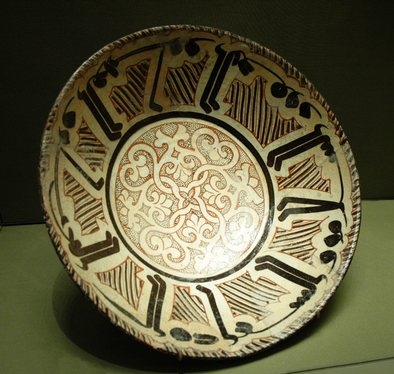
Plate with Arabic Calligraphy
During the 9th century AD, the Abbasid Caliphs brought a large number of non-Muslim Turkic slaves mainly from the Caucasus Region to form their army. They were young men who converted to Islam and lived in their master’s household and were very loyal. They were also very well trained, often as cavalrymen, and rose to the highest levels in the army. They became a warrior caste known as the Mamluks (Mamelukes). After less than 100 years the Abbasid Caliphs started to lose power to the Mamluks although they were left as titular heads for centuries.
Although the Culture of the Abbasid Empire flourished during the 8th to the 11th centuries, making it the golden age, its geographic control did not fare so well. Parts of Northern Persia had become independent under Turkic tribes from 819 AD. Because of this the Abbasid Caliph was even forced by the Mamluks to move his Capital temporarily from Baghdad to Samarra from 836 to 892 AD. Also as early as 787 AD the Abbasids started to lose their power west of Egypt, which ultimately led to the rise of the Caliphate of the Fatimids (909-1171 AD). The Fatimids had their origins as Berbers, but based their claim on a link to Fatima, Muhammad’s daughter. They were centred in Tunisia, North Africa until 969 AD when they moved their Capital to Cairo. The Fatimid Empire grew to cover North Africa, Egypt, the Levant and part of Arabia. Accordingly the Islamic Empire was no longer unified, but was ruled by these different Caliphates, some more powerful than others.
| Page: 228 of 418 Go To Page: | |
◁◁ First | ◁ Previous | Next ▷ | Last ▷▷ |
Author: Dr. Stan Jones © Copyright 2010 -