

9. Ceramic Development in the Middle East
| 976 Page: 229 of 418 Go To Page: |  |
◁◁ First | ◁ Previous | Next ▷ | Last ▷▷ |
Islamic pottery was perhaps at its best between the 9th and 13th centuries. The quality of pottery from Syria, Egypt, Mesopotamia, Persia, Afghanistan and Anatolia, although different in body, shape and decoration, even rivalled the wares from China.
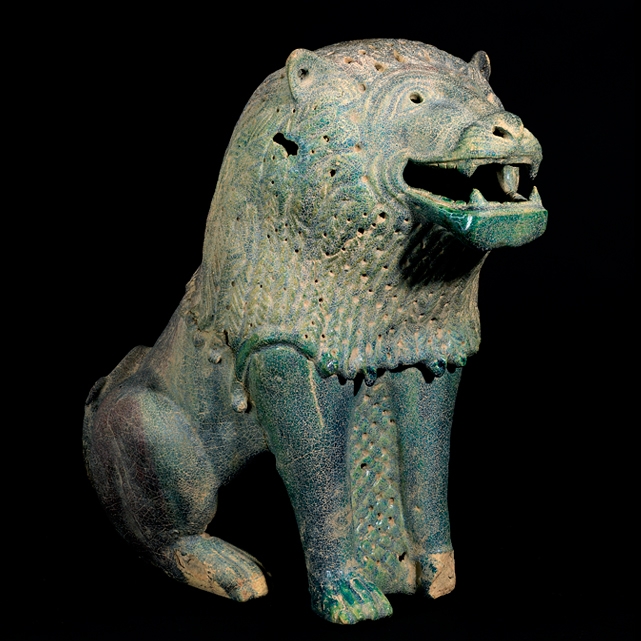
Islamic green glazed lion - courtesy Barakat
The development of pottery was closely linked to the Caliphate in power at the time. The Capital of each Caliph contained the rich and powerful court that wished to surround itself with beautiful objects, so they patronised the artists and potters. When a Caliphate declined, the most skilled potters would move to the Capital of another Caliph, taking their technology with them. Early centres at Baghdad, Old Cairo and Samarkand moved to Al Raqqah on the Euphrates, Rayy (Rhagae) and Kashan, both in Northern Iran – Rayy near Tehran. Unfortunately for us, Muslims did not believe in grave goods, so most of the pottery before 14th century has been excavated from ruins and is in pieces, as well as iridescent once it has been in the ground for a number of years. A few significant discoveries have been made, such as the presumed stock of a merchant who put his fine pottery in larger pots and buried them in the ground at Jorjan before fleeing the invading Mongols. However, Kashan and other centres were famous for decorated lustre tiles that were produced from before the 9th century AD predominantly for the walls of mosques and public buildings, and many of these have survived in good condition.
Lustre painting may have started in Mesopotamia or Egypt - Egyptian Coptic artists in the 7th century AD used it on glass, and metallic colouring of glass went back to Roman times there – however its first use on pottery was probably in Abbasid Iraq (Baghdad). It came from the efforts demanded by the Abbasid Caliphs to replicate Chinese porcelain but became popular on its own merits while the Caliphs were resident in Samarra. It was used to simulate objects made from precious metals, as the Islamic religion banned their use to preserve simplicity of Muslim life. The Abbasid potters used the tin glazing and lustre decoration on bowls, some of which were decorated with painted flowers and inscriptions. In the 9th century they produced beautiful lustre cups and dishes.
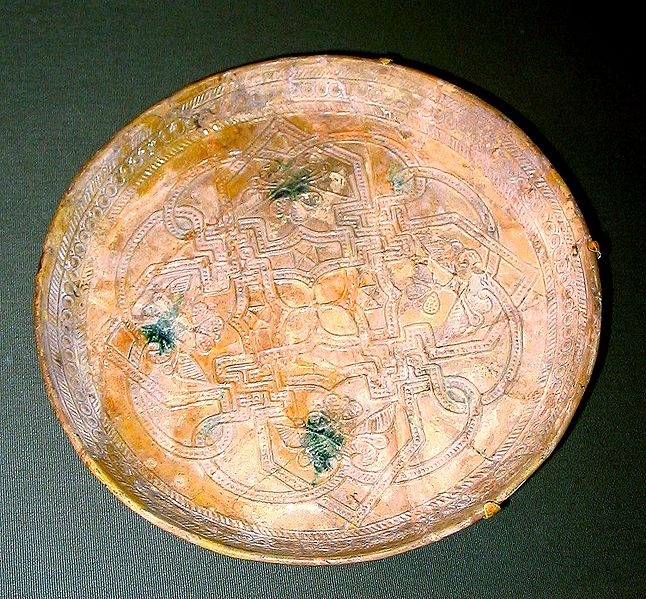
Earthenware moulded dish with yellow glaze,
Iraq 9th century - source Freer Gallery
Smithsonian Washington
Some of this technology also passed to Chinese potters. When Middle Eastern potters emigrated to the west of the Arab Empire they took these technologies with them via North Africa and on to Arab (Moorish) Spain where it became known as Hispano-Moresque ware. In turn the Moors manufactured it and traded it via Mallorca to Italy where it became very popular and the Italians also started to produce it locally. Today any type of tin-glazed ceramic is likely to be called Majolica (pronounced Maiolica) because the Italians thought that was produced in Mallorca rather than just being trans-shipped from Spain. Alternatively it is, perhaps confusingly, also called faience.
From the 9th century AD Venice had taken over as the chief Mediterranean maritime trading nation, transporting significant quantities of pottery from the Islamic and Byzantine Empires to Western Europe. The whole of Europe became influenced by this technology as it travelled from Italy to Holland where it was called Delft, after the main production centre, and from there it spread throughout the rest of Europe. It is often referred to as Delft in the UK.
| Page: 229 of 418 Go To Page: | |
◁◁ First | ◁ Previous | Next ▷ | Last ▷▷ |
Author: Dr. Stan Jones © Copyright 2010 -