

9. Ceramic Development in the Middle East
| 977 Page: 230 of 418 Go To Page: |  |
◁◁ First | ◁ Previous | Next ▷ | Last ▷▷ |
The Abbasid Caliph built a palace at the new capital at Samarra in Iraq in 836 AD, as he had to get away from rioting Mamluks in Baghdad. The Capital was returned to Baghdad in 892 AD, but in the meanwhile its potters had produced the best ceramics of that period. Buff coloured, close-grained, soft earthenware called the “Samarra body” was found there, but possibly manufactured elsewhere. It was comparable to the body used later for Italian majolica. A blue/green glaze similar to Parthian was commonly used on it. A large number of lustre-decorated vessels have also been found at Samarra. The buff body was covered in a white tin-opacified glaze and lustre paint applied over this. There were also moulded reliefs with a green/yellow glaze, and sometimes a metallic “golden” lustre, although this often wore away. The Samarra body was also used for vessels covered with an opaque cream glaze decorated with foliage and/or Arabic inscriptions in dark blue (or sometimes green); and thinly potted polychrome vessels in purple, lavender, dark green and yellow. They imitated celadon vessels so well that an analysis of the body is needed to differentiate them from Chinese porcelain, although imported Chinese stoneware and porcelain was also found in Samarra. A large number of wall tiles were also produced there.
Muslim pottery produced during the Abbasid Period travelled widely and has been found from Portugal to Thailand and from Turkmenistan to Mozambique.
Summarising, Muslim potters during the Umayyad and Abbasid Periods were responsible for some important technical innovations and improvement of previous technologies leading to remarkably sophisticated forms of pottery. The most influential of these was the rediscovery of opaque white tin glaze in the 8th century AD. The Muslims also developed lustre painting on earthenware vessels probably also in the 8th century AD. Incised ware on a frit body was first developed in Egypt in the early 11th century, possibly related to imports of Song wares. After incision the vessel was covered in a hybrid lead-alkali glaze. Later Syrian and Iranian versions used an alkali glaze. Sgraffito ware became common throughout the Middle East and was particularly popular in Syria and Egypt in the 13th century. The body was often red/pink with a white or buff slip, covered in a high lead glaze. Related to it is ‘slip carving”, where the body is covered in thick slip that is carved out with a knife. This technique, often called Champlevé, leaves a raised design of slip material. It was probably first developed in Iraq in the 8th century AD. A good example is a shallow bowl with a black raised bird on green ground in a museum in Istanbul.
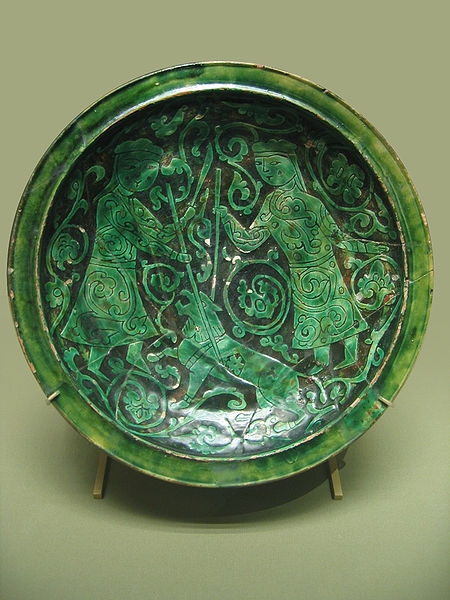
Green glazed plate depicting hunters,
12-13 centuries AD - source
Louvre Museum
In the 10th and 11th century a Persian example of this ware, known as Guebri, had a red body covered with a white slip, covered with a transparent green or yellow lead glaze. Typical motifs were flowers, animals, including humans, and bold inscriptions. “Lakabi” wares were also developed in the Middle East. In this method, clay threads were used to outline the design, separating the different coloured glazes, similar to the cloisonné technique. It was not used for long as the colour separation was not as good as with cloisonné.
When life for the Abbasid potters got difficult towards the end of the 10th century AD, some moved to Egypt, causing a stagnation of the technology in Iraq. However, lustreware as well as tin glazing became particularly popular in Egypt during the rule of the Islamic Fatimid Dynasty. The lustre ware had a buff or pink clay or a fritware body and tin-opacified glaze. In the 11th century lustre was coloured gold, orange and brown depicting subjects such as people playing instruments and animals. Some wares had the pattern incised under the glaze. It seems likely that in turn some of the Egyptian potters moved to Iran on the fall of the Fatimids.
| Page: 230 of 418 Go To Page: | |
◁◁ First | ◁ Previous | Next ▷ | Last ▷▷ |
Author: Dr. Stan Jones © Copyright 2010 -