

9. Ceramic Development in the Middle East
| 978 Page: 231 of 418 Go To Page: |  |
◁◁ First | ◁ Previous | Next ▷ | Last ▷▷ |
Islamic water jugs often had delicate pottery filters, but possibly the strangest objects were pottery hand grenades that could be decorated with underglaze green, blue and yellow.
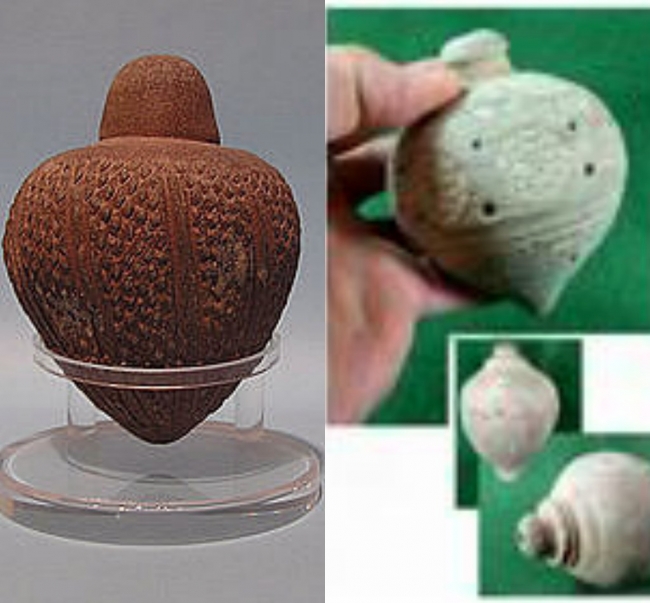
Islamic hand grenade 6-8 centuries AD -
courtesy Griffin Gallery and early
medieval example
Another important, but more basic, technology developed by the Moors is evidenced in Seville as they installed a terracotta-piped sewer system that is still functional some thousand years later and still represents over 10% of their present sewer system.
Many of the books containing the Greek and Roman technology the Muslims had translated, together with further Muslim advancements, found their way to Spain via North Africa, particularly to the library at Toledo in Southern Spain. When the European Christians (Castilians) recaptured Toledo in 1085 AD, all of this technology was translated yet again, this time into Latin, sometimes via Hebrew. This then passed to Christian Europe, which possibly catalysed the first phase of the European Renaissance in the 12th century; in the same way it had triggered the Arab Renaissance in the 8th century AD.
General unrest in the Middle East and Spain allowed further Berber tribes to take over in North Africa. Firstly the Almoravids from 1062 to 1150 AD and then a Berber Confederation, the Almohads, took over from them until 1269 AD. They created Islamic Empires in North Africa and Southern Spain. The Capital of the Almoravids was established at Marrakech in 1062 AD and the Almohads added Seville as a second Capital. The Moors of Southern Spain excelled in the use of beautiful patterned ceramics for buildings, from doorways to domes. Even after the Christians had driven them out in the north, Moorish artists were used to decorate buildings in the “Mudejar” style with glazed tiles. Both the Almoravids and the Almohads paid homage to the Abbasid Caliph. Rabat was an important cultural centre during the Almohad period, and was particularly noted for its polychrome pottery that almost reached the artistic level of Syria, Persia and Egypt.
Rioting and disruption became so bad in Baghdad by 1055 AD that the Abbasids had to commission the Seljuk Turks to take control of the capital on their behalf. In Egypt Salahuddin had taken control and set up the Ayyubid Dynasty in 1171 AD. He is noted for his battles with the Crusaders, wiping out their army at Hatim in 1187 AD and retaking Jerusalem in that year, and in particular his battles against Richard the Lionheart around 1191 AD. The Mamluks seized control of Egypt from the Ayyubid Dynasty around 1250 AD and the first Mamluk ruler, Aybak, married the Ayyubid Sultana, but she had him murdered a few years later. The Mongols sacked Baghdad in 1258 AD crushing the Abbasids. A relative of the Abbasid Caliph escaped to Cairo where he was made Caliph. The Mamluk army finally stopped the Mongol invasion by defeating its army in Palestine, and later they also finally drove the Crusaders out of Palestine around 1291 AD. In the 14th century the Mamluk potters imitated Persian Sultanabad ware, and imitated Chinese wares in the 15th century. The Mamluk regime survived until after the Ottoman conquest in 1517 AD and they were still powerful under Ottoman rule until Napoleon’s conquest of Egypt in 1798 AD.
| Page: 231 of 418 Go To Page: | |
◁◁ First | ◁ Previous | Next ▷ | Last ▷▷ |
Author: Dr. Stan Jones © Copyright 2010 -