

10. European Pottery to the Fall of the Romans
| 994 Page: 243 of 418 Go To Page: |  |
◁◁ First | ◁ Previous | Next ▷ | Last ▷▷ |
The Greeks were farming fruit by 7,000 BC and the Iberians by 5,000 BC. The Neolithic period (6,800-3,500 BC) in mainland Europe is particularly characterised by its stone axes and the earliest evidence of the potter’s art being practiced, and this pottery technology appears to have entered via the Aegean. All the vessels were handmade and the better ones were highly polished. In Central Europe from around 5,700 to 5,000 BC the inhabitants produced pottery with linear incised decoration called Bandkeramic that spread quite widely.
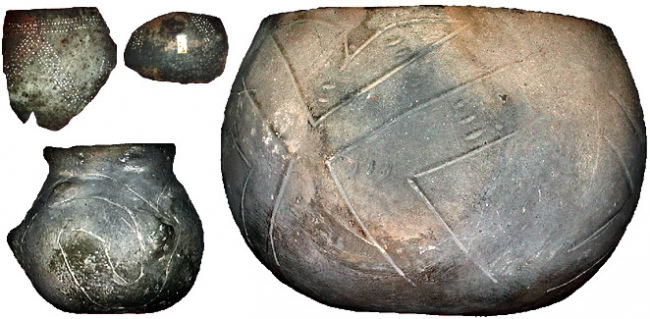
Bandkeramic Pottery - source Wikipedia
In the Early Neolithic period pottery vessels had round bottoms, but later they were made flat. Ceramic female figures have also been discovered.
In the Mediterranean region early farming was associated with “Cardium” pottery that was decorated with impressions of the cardium shell (a type of shellfish).
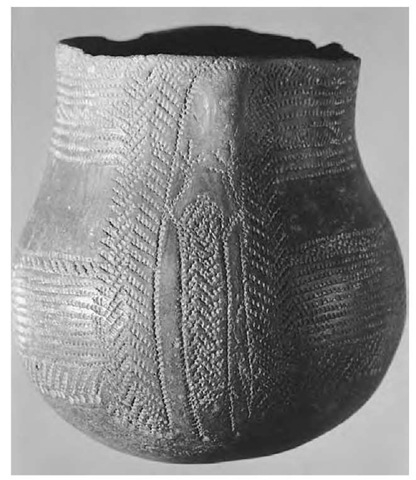
Cardium pot showing impressed decoration -
source Museu Arqueologic Municipal,
Arcoi, Spain
Most decoration of early pottery in Europe was incised or stamped, often to mimic baskets, but some in the South East, for example Italy and Sicily, was painted.
Early pastoral farming and pottery were in evidence in Britain by about 5,000 BC. Land clearance began there for grazing animals around 4,500 BC and pottery bowls were found in the long barrow at Fussel’s Lodge in South Britain dated to 4,000 BC. Pottery technology remained unusually backward in early Britain, with leather, wood and wicker vessels maintaining their roles until the 16th century AD. Coiling was used to make the pottery bodies, and shapes were mainly containers with round bottoms some with lugs, with firing temperatures between 600 and 700 degrees C. Decoration was corded, impressed (especially fingernails) and incised with little painting on pots, even though it was becoming common elsewhere in this period. There is no evidence of pottery figures being made during the British Neolithic.
The more developed technology of farming of cereals and animal breeding (the agricultural revolution) was spread by immigrant farmers from West Asia reaching the Balkans about 6,500 BC. It is thought that the people who brought this technology were the first wave of Indo-Europeans. It then moved at an estimated rate of 0.5 miles a year into Northern Europe along the river valleys, reaching the Danube by 5,000 BC and the Seine by 4,000 BC. Evidence of the simple furrow plough has been found near the Danube dated to 4,500 BC, and marks in the ground indicate it may have been used in Britain around 3,500 BC. Initially the plough would be made of wood and pulled by two people. The agricultural technology also spread along the Mediterranean coast and up the Atlantic coast. The indigenous population may have adopted the technology and become farmers themselves, coexisted in parallel as hunter-gatherers and/or interbred. However, it appears that in Britain most of the previous population remained in place absorbing the technology. Contrary to previous views, DNA analysis shows that some three quarters of the ancestors of British people were already in Britain before these first farmers arrived, and subsequent invasions have not had as much impact on the gene pool as might have been expected.
| Page: 243 of 418 Go To Page: | |
◁◁ First | ◁ Previous | Next ▷ | Last ▷▷ |
Author: Dr. Stan Jones © Copyright 2010 -