

10. European Pottery to the Fall of the Romans
| 995 Page: 244 of 418 Go To Page: |  |
◁◁ First | ◁ Previous | Next ▷ | Last ▷▷ |
Depending on the climate and soil conditions each European region would have raised the crops most appropriate to their situation. Some nomads that previously had been following wild herds eventually became adapted to living off domesticated animals such as goats and sheep (sheep were not as popular in Northern Europe as it was too damp). During this period (5,000 to 4,000 BC) villages were established based on farming crops and livestock, although there was still a significant dependency on hunting and gathering. They were likely to have been about 50 dwellings containing 2-300 people and food would have been stored throughout the year. As the soil was not looked after and deteriorated, forests had to be constantly cleared using stone axes to provide new ground. These first farmers also brought with them new styles of pottery called Funnel Beakers, found across North Central Europe, the earliest of which has been dated to around 4,500 BC found in a “long barrow” grave in Poland. A rounded pot with a crude human figure in relief dated to around 4,000 BC was found in Bavaria.
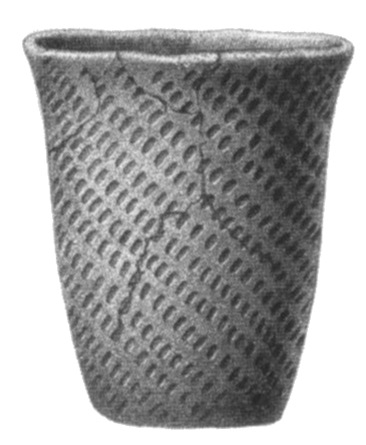
Norwegian impressed funnel beaker
- source Wikipedia
The villagers raised domesticated cattle and pigs, and used oxen as draft animals; the latter was illustrated on the handle of a pot. Some sheep were also raised and a ram figurine with cord impressions to depict its fleece has been discovered, again in Poland. Pottery spindle whorls have been found that would have been used to weave linen from the flax they grew. Very early traces of wagon tracks indicate the use of wheeled carts possibly not long after 3,500 BC. A vessel of the Funnel Beaker Culture found in South Poland, called the Bronocice Pot, has a depiction of a wheeled cart and is dated to 3500 to 3350 BC.
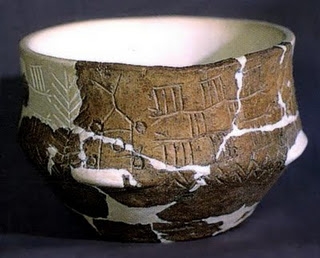
The Bronocice pot - source Geoff Carter Blog
Also during this period craftsmen might have started to specialise in trades such as pottery, leatherworking, weaving, tool making and matting, and they passed on the technology to the next generation. Trading grew in these commodities between villages and further afield. Within a settlement some assets would be personal property (e.g. tools, utility pottery); others would belong to the community (e.g. barns, animal enclosures and fortifications). Tribes would have expanded to contain up to 100,000 people made up of smaller clans. In 5,000 BC, the population of Europe was about 2 million, and by 3000 BC it had grown to around 10 million, due almost entirely to the increased availability of food. However, life expectation was low with half the males dying before 35 years old and 85% of women dying before 25!
By 3,000 BC farmers in Britain were also clearing relatively large areas of forest to cultivate cereals. Remarkably, stone houses have been found dated to around 3,000 BC in Skara Brae the Orkneys, North Scotland, having some of the oldest examples of stone drains and lavatories (comparable with the Indus Culture). As wood was in very short supply the extensive use of stone and the lack of subsequent development has preserved much of the detail. Some flat-based, grooved ware vessels were found at Skara Brae dated to approximately 3,200BC, which were probably more suited to their flat, stone work surfaces.
People made and amassed more and more goods, including pottery. This led to attacks on settlements by nomadic groups wanting to possess goods too, resulting in the building of defensive ditches and ramparts from about 3,800 BC. Tribal ritual became very important, leading to various types of burial. Stone multiple burial chambers or “Megalithic” Tombs (replicating caves) were used in Western Europe by 4,500 BC, and predated the building of the pyramids in Egypt by some 1,500 years. They were used for men, women and children and covered many generations. They comprised a burial chamber of wood or large stones, covered by a large mound encircled by upright stones.
| Page: 244 of 418 Go To Page: | |
◁◁ First | ◁ Previous | Next ▷ | Last ▷▷ |
Author: Dr. Stan Jones © Copyright 2010 -