

10. European Pottery to the Fall of the Romans
| 996 Page: 245 of 418 Go To Page: |  |
◁◁ First | ◁ Previous | Next ▷ | Last ▷▷ |
In the Neolithic Period tombs were characterised by long mounds also known as long barrows. In some regions cremation was also practiced with the ashes contained in pottery urns placed within tombs. Probably ancestors were considered important in their beliefs. Some of the stone monuments they built were very important in their rituals and social lives, being used for communal activities and events, for example Avebury and Stonehenge in Britain. The advent of agriculture made the building of huge monuments possible, as surplus food could be stored and there were seasons where little attention was required on the land.
There were other changes taking place in Europe. As the climate in Mediterranean Europe became more arid, the intensive farming of wheat, hardy trees, olives, vines, sheep and goats caused the soils on the hillsides to become further impoverished. In the dry grasslands and semi-desert areas further east mobility was essential, and the Steppe horse had become domesticated as early as 4,000 BC in Kazakhstan, giving the Steppe people this much needed mobility, meat and mare’s milk. Their population expanded greatly, both in number and geographically, introducing their different Culture to people living in regions to their west and south.
Around 3,000 BC another Culture found its way into the northern half of Europe called “Corded Ware” or “Battle Axe”. The associated dark to light brown pottery is decorated with horizontal lines impressed by string or cord often covering most of the pot. The cord would have been twisted round the wet clay, possibly to help shape the pot, and burned off in firing. In Britain similar pottery is known as Peterborough ware. Some “Corded Ware” pots are heavily decorated with the so-called “barbed wire” pattern that is a combination of horizontal lines and chevrons between. An example of a small, coiled-clay beaker with pierced lugs and “barbed wire” decoration dated to 3,000 BC was discovered in a long barrow in Holland.
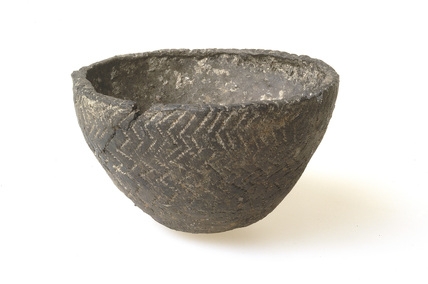
Peterborough ware bowl found in London,
notched impressions forming herringbone
pattern 3,500-2,750 BC - courtesy ©
Museum of London
Peterborough ware in Britain had oval indentations in the same way as in Sweden and Finland, and became more ornate with grooves and swirls. A variant in Wales was decorated with impressed bird bones.
There was little “grog” used as temper in Early to Middle Neolithic bowls or Peterborough ware, typical content was “calcined” flint 46%, shell 29% and sand 8%. An interesting jar from this culture found in Bucharest, Rumania was formed as a female figure dated to 3,000 BC.
Whereas previously the Neolithic farmers and semi-nomadic herdsmen lived in rough equality with a community orientation, the arrival of these Corded Ware immigrants with their battle-axes caused a major social change. They created a ruling class with an individual warrior chief or king and even more emphasis on possessions – the newcomers, although in the minority, were dominating the natives.
Another major change associated with this Culture was that the previous collective tombs started to be replaced by individual burials of the dead. This might have reflected the change from family groups to clans. Items such as pottery vessels shaped as squat, flared-mouth beakers or bulbous jars and stone battle-axes accompanied the dead. Pottery and battle-axes were traded throughout Europe and some battle-axes found in Britain were brought from as far as the Alps. This Culture spread wider than the Funnel Beaker one, particularly eastwards. Houses in the villages were made of wood and faced on to roads that were made of logs, and some early copper axes started to appear. The Corded Ware Culture declined around 2,400 BC.
| Page: 245 of 418 Go To Page: | |
◁◁ First | ◁ Previous | Next ▷ | Last ▷▷ |
Author: Dr. Stan Jones © Copyright 2010 -