

10. European Pottery to the Fall of the Romans
| 1000 Page: 249 of 418 Go To Page: |  |
◁◁ First | ◁ Previous | Next ▷ | Last ▷▷ |
Archaeologists have agreed that to a first approximation time periods of the major Civilisations in the Eastern Mediterranean could be considered synchronous. This allows much easier comparison between them. Minoan history can be broadly divided along the lines of the Egyptian, so that Early Dynasty/Old Kingdom, Middle Kingdom and New Kingdom became Early, Middle and Late Minoan corresponding approximately to the Bronze Age: Early (3,500-2,000 BC), Middle (2,000-1,600 BC) and Late (1,600-1,100 BC). On mainland Greece this also broadly corresponds to Early, Middle and Late Helladic, while for the Islands in the eastern Mediterranean it is known as Early, Middle and Late Cycladic. Historical records in Egypt and Babylonia are of particular assistance in dating Cretan artefacts, as Cretan written records have not yet been translated.
Tomb sites such as Vasiliki in Eastern Crete indicate the Minoans had developed a social hierarchy, and by 3,000 BC they had developed a remarkably advanced civilization containing sizeable townships with significant buildings, mostly by the seashore. Elite burials had become more widespread, not only giving details on the social classes but also the contents indicate contacts with overseas countries. Often bodies were squashed into large pottery storage jars for burial. Grave goods included pottery vessels.
Knossus was the main city that grew out of prosperous farming, metalworking, pottery craft and trading between the islands of the Mediterranean. Bronze technology reached Crete and the other islands from the East. It then spread to the Peloponnese and to Mainland Greece. By the middle of the 3rd millennium BC metals use and trade flourished throughout the Islands. Crete lacked indigenous metals so from the Early Bronze Age they were imported from the Cyclades, Greek Mainland and the Middle East. The economy was linked to the other civilisations in the Middle East and Egypt that also influenced the development of the Minoan Culture and vice versa. The Minoan Culture particularly influenced the Aegean Islands and Mainland Greece.
At the start of the Bronze Age, Cretan potters used slow, unpivoted wheels to ease manufacture and decoration. At this time there were several pottery styles, with an overlapping regional coverage, most of which were fairly thickly potted. “Pyrgos” ware had a black or brown body, was burnished and incised. It is possible that the decoration was to imitate wood. “Scored” ware was incised through the black ground to expose the pale body, with vertical, horizontal and herringbone patterns, sometimes enhanced with white chalky colourant. There was also a round-bottomed yellowish ware. Popular shapes were the bottle and low “pyxis” (round jars or boxes with lids for jewellery and trinkets). “Dark-on-light” ware had painted decoration using an iron-red slip, which came out red, brown or black, depending on the firing conditions. The decoration was linear, with diagonal parallel lines and cross-hatching. Popular shapes were two-handled cups, jugs and bowls. “Lebena” ware was painted in white over a red or black slipped ground. Popular shapes were shallow bowls, plates and platters.
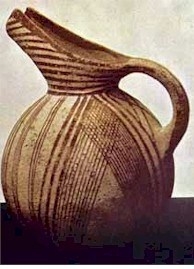
Minoan pitcher 2,500 BC - source
project-history blogspot
These were followed around 2,700 BC by Early Minoan pottery from Vasiliki. This relatively short-lived pottery, named after the village, had mottled red and black surface effects caused by irregular firing of the slip, probably deliberate experimentation with colour, as the decoration formed a regular pattern. The commonest shapes were flat-bottomed jugs with high semi-circular spouts, dishes, goblets and long spouted drinking jars resembling teapots. The shapes of Vasiliki pottery give an indication of later Minoan pottery elegance. Also at this time there was a “Fine Grey’ ware that had a very fine texture with a glossy finish and simple incised geometric patterns, dots, rings and semi-circles.
For most of the Early Bronze Age across the Aegean, the finest pottery had mainly been dark decoration on a pale ground. Around 2,400 BC on Crete, pottery decoration changed, with the pots covered in a dark shiny slip with white or light painted decoration. Motifs were geometric, lines, spirals and chequers.
| Page: 249 of 418 Go To Page: | |
◁◁ First | ◁ Previous | Next ▷ | Last ▷▷ |
Author: Dr. Stan Jones © Copyright 2010 -