

10. European Pottery to the Fall of the Romans
| 1012 Page: 250 of 418 Go To Page: |  |
◁◁ First | ◁ Previous | Next ▷ | Last ▷▷ |
Around 2,000 BC there was a hierarchy of cities and towns across the island, with well made roads and bridges. At this time they started to build the first palaces around a central courtyard. They had agricultural surpluses requiring large-scale storage that was provided within the palaces, and elite crafts such as potting were also centred there. The most magnificent palaces were subsequently built (and repaired after earthquakes) from 1,900 BC at the centres of the flourishing cities, with the most impressive at Knossus. These so-called palaces were large, complex buildings, with many rooms of various sizes – some identifiable as storerooms, workshops and archives. Large rooms were probably staterooms and others decorated as shrines. They also had fresh water supplies and a sewage system. Clearly they were far more than just the residences of the leaders, as they were also the centre of administration, politics, religion and the economy throughout the subsequent Minoan Period. They still contained workshops for craftsmen, including the potters. Important buildings in the regions could have been the residences of Governors, and in later times country houses were linked with the production of oil and wine and other agricultural products that was the basis of their economy.
Trade links expanded, with Minoan trading posts on several Aegean Islands as well as in the Levant, Egypt and Miletus on the West Coast of Anatolia (probably to access metals).
A further group of migrating Indo-Europeans had introduced a faster pivoted potter’s wheel to the Aegean around 2,000 BC, probably from the Levant, some using a ceramic wheel head, and the quality, symmetry and consistency of the vessels were considerably improved. A new iron based red slip became available at this time, but it required sophisticated kilns and careful firing to obtain the best results. One new ware known as Barbotine was very tactile, as it was decorated in relief with knobs, cones, ridges and waves. A thick slip could be used to provide this relief decoration, either dribbled onto the body or applied rather like icing on a cake, or separately moulded ornamentation could be applied (appliqué). It was used extensively on Pithoi (very large storage jars) that first appeared at this time and were large enough to hold up to 1,000 lbs of produce.
Crete reached its greatest influence from around 2,000 BC, at the same time that the most sophisticated pottery in the region started to be made there. Manufacture of the finest elite ware was restricted to the two royal capitals of Knossus and Phaistos, and the Kamares cave sanctuary that this pottery was named after. This beautiful rich polychrome “Kamares” ware was decorated in red, orange, brown, yellow and white slips over a dark, lustrous slip ground. Some of the vessels had delicate egg-shell-thin walls, copying metal ones, and some including moulded or impressed decoration. The painted designs were a careful balance of abstract linear, curved and spiral patterns and stylised versions of plant, flower and marine life such as octopi covering the entire pot, sometimes in bands.
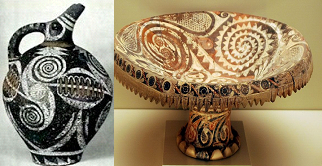
Minoan pitcher 1,800 BC - source
project-history blogspot, and Kamares
decorated ware source Hieraklion Museum
via Wikipedia George Groutas
The commonest shapes were very-thinly-walled carinated cups and small round spouted jars. Sometimes pottery shapes seem considerably more decorative than functional, and some vessels, such as small ones for cosmetics and ointments, were remarkably fine. Kamares ware is found in many sites around the Eastern Mediterranean, including in Syria, Cyprus, Egypt, mainland Greece and the Aegean Islands, although the numbers of pots is low compared with the later Mycenaean exports. Later, polychrome became less popular but was offset by more naturalistic forms of decoration. Also around 2,000 BC Cretan potters made figures of Cretan males dressed in their characteristic loincloths. Women were depicted with elaborate hairstyles and much jewellery. They wore small jackets and long skirts.
| Page: 250 of 418 Go To Page: | |
◁◁ First | ◁ Previous | Next ▷ | Last ▷▷ |
Author: Dr. Stan Jones © Copyright 2010 -