

10. European Pottery to the Fall of the Romans
| 1013 Page: 251 of 418 Go To Page: |  |
◁◁ First | ◁ Previous | Next ▷ | Last ▷▷ |
The Minoans were not a military society, but influenced others through trade via their merchant trading posts set up in many countries. They did have a formidable navy that protected their trade routes from pirates.
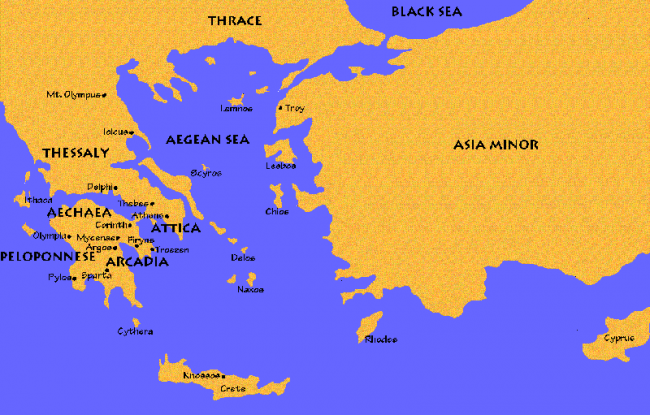
Map of Eastern Mediterranean showing Crete
and Greece - source Cedarville.edu
At the start of the Late Bronze Age, around 1,700 BC, the old palaces were destroyed by fire, but it is not known whether this was due to earthquakes or invasion. However, the palaces were rebuilt even greater than before, up to five storeys high. At Knossus they had terracotta water pipes and covered drains. Around 1,600 BC, Aegean Civilizations reached a new peak of prosperity. This was displayed in Crete by the luxurious life in these new Minoan palaces. A fantastic game table has been found made from many different materials used to play a game akin to draughts. Minoan art excelled and potters were greatly influenced by the spectacular artefacts made in gold and bronze that they adapted to pottery.
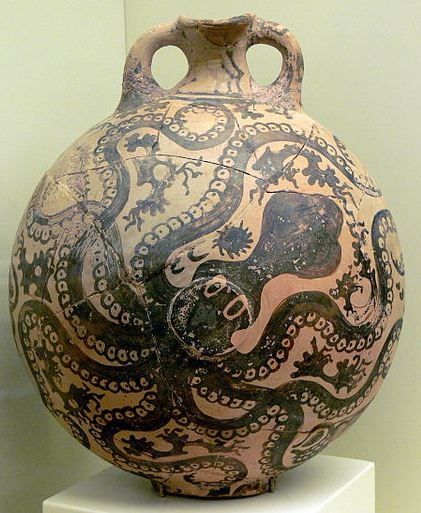
Minoan Palace ware octopus vase 1,500 BC -
source Hieraklion Museum via Wikipedia
Wolfgang Sauber
Some stone artefacts were also copied in ceramic such as the ceremonial conical Rhyton.
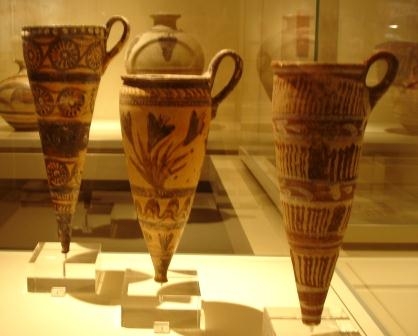
Minoan rhytons 1,600 BC - source
Archaeological Museum, Athens
The art of Crete manifested itself not only through this fine pottery, but also through fresco painting, small sculptures and plaques in faience (the technology probably imported from Egypt), bronze and ivory, and miniature work on seals and jewellery. A notable faience piece is the figure of the snake goddess dated to 1,600 BC found at Knossos. From 1,700 to 1,450 BC Cretan influence can be seen in Minoan-style frescos and tomb paintings of Cretans in Egypt, and designs on contemporary pottery all over Eastern Mediterranean countries. All this craftsmanship was widely exported and admired, for example an 18th century BC text from Mari (Syrian Mesopotamia) mentions Cretan weapons, textiles and sandals, as well as pottery. The Minoans also laid the foundation of Mycenaean art on mainland Greece, and Minoan art heavily influenced the designs on Mycenaean pottery from about 1,600 to 1,400 BC. Cretan vessels have also been found in the Cyclades where they were copied with local decoration including flowers, lilies and saffron crocus, swallows, wild goats, warriors and griffins in a lively, colourful style.
Much ceramic experimentation took place in the Aegean Region between 1,650 and 1,450 BC. The glossy black slip was continually improved by trial and error. Hollow glass objects, as opposed to previously only solid beads, were evident in Mycenae as well as Egypt and Mesopotamia in the 16th century BC. Cylinder seals found on Crete made of haematite dated to 1400 BC indicate the incipient Iron Age. The fast potters wheel was now pervasive throughout the Aegean. To increase the range of paint colours, fritting was used by the Minoans at this time to enable them to work with more volatile pigments.
Around 1,550 BC the Cretan potters changed their colour scheme back to dark-on-light decoration on a creamy yellow clay body. These were attractively decorated over the whole body, in reds or black on a white ground. The designs were mainly from nature with flowers, grasses and olive sprays drawn with charm and spontaneity, together with some abstract designs using spirals and ripples. After 1,500 BC “marine style” pottery with realistic marine animal decoration became popular, including starfish, argonauts, dolphins and octopi, with coral and seaweed, but no depictions of humans. This became stylised towards the end of the century, especially on the palace-style amphorae. These wares were very popular and exported in great numbers to the end of the Late Minoan period. The Minoan faience technology spilled over to pottery when they experimented with glazes, as did the Greeks subsequently, but they were not developed or utilised to any extent.
| Page: 251 of 418 Go To Page: | |
◁◁ First | ◁ Previous | Next ▷ | Last ▷▷ |
Author: Dr. Stan Jones © Copyright 2010 -