

10. European Pottery to the Fall of the Romans
| 1014 Page: 252 of 418 Go To Page: |  |
◁◁ First | ◁ Previous | Next ▷ | Last ▷▷ |
As mentioned earlier, from around 2,100 BC the Cretans were the first “Europeans” to have a written script, similar to the Egyptian pictorial Hieroglyphics representing objects. Some scratches on pots as early as 2,500 BC could have been an early version. It was used for short texts often impressed onto clay with seals and always local to the palaces. It has not yet been deciphered, and is not related to Semitic or Indo-European. It subsequently developed into a script called “Linear A”, a more regular alphabet of approximately 85 distinct signs or graphic characters, denoting whole syllables. It was read from left to right and was impressed on clay tablets with a stylus, although some form of ink also may have been used. It was more widespread than the hieroglyphic version; for example, some 168 tablets were found at the ancient town of Ayia Triadha. Very interesting clay discs containing spiral text have been found dated to 1,800 BC. Linear A has also not yet been translated or its origin agreed, so there are no understandable historic records available to us. Scribes used it in the king’s palace to record financial transactions, and potters decorated pots such as cups with inscriptions in Linear A. It was further developed in the late 15th century BC into Linear B by the Mycenaean Greeks.
The Minoan elite were buried in monumental graves with grave goods for the afterlife. Votive offerings at shrines were fine pottery and stone vessels, together with pottery and bronze figurines. Religious symbols included double axes and bull’s horns often stylised. Gods and ritual were depicted as decoration on pottery.
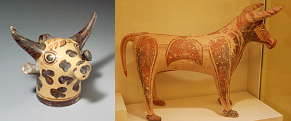
Minoan bulls, rhyton 1,450-1,400 BC -
source Metropolitan Museum and figure,
source Hieraklion Museum via George Goutas
The names of some gods occur on linear B texts at Knossos, dated to the Mycenaean Period, and some Cretan gods were referred to in mainland Mycenaean Greek and later writings.
Crete had survived several earthquakes between 1,800 and 1,500BC. Although there is considerable uncertainty about the date, around 1,600 BC, the volcanic island of Thera (Santorini) erupted with enormous force. It was preceded by an earthquake that caused great damage on Crete, followed by a huge tidal wave. All of this would have weakened the society, and towards the end of this period it started to go into decline. In about 1,450 BC Mycenaeans resided in the palace at Knossos, evidenced by Linear B inscriptions, about the time many sites suffered severe destruction. Knossos itself fell about 75 years later. It is possible but not certain that the Greeks invaded, however, one way or another the early Greek speaking Mycenaeans grew in power and took control of the society that provided them with so much of their Cultural background. The Mycenaeans displaced Cretan settlers on the islands such as Rhodes and on the coast of Anatolia, hence the Mycenaean pottery found at Troy. Hittite records refer to “interference” from Greece.
The island of Thera was covered in pumice from the eruption referred to above, and we are fortunate that this has preserved many artefacts, particularly its pottery that was decorated with swallows, dolphins, goats and saffron plants.
Subsequently, Cretan pottery became more “Mycenaean” in style, and vessel shapes favoured by mainland Greece were produced. The initiative in the art and technology of pottery moved to Mycenae, and there is evidence from the style of pots and decoration to suggest that potters from Crete moved to Mycenaean centres in mainland Greece. Similarly, administrative skills also transferred to Greece. Crete then became a flourishing part of the Mycenaean Empire. Greek mythology preserved many stories about Crete, particularly of the Minotaur, part man and part bull, said to have been imprisoned in the labyrinth at Knossos by mythical king Minos. Legend has it that Theseus of Athens was one of a group of young Greek people demanded as sacrifice to the Minotaur by King Minos, but Theseus killed it and found his way out of the labyrinth following a thread he had unwound behind him. Certainly bulls figure prominently in Minoan art, particularly of young athletes catching bulls by their horns and somersaulting over their backs. They and the Minotaur are depicted on many later examples of Greek decorated pottery. Around 1,200 BC the people in Crete moved to more rugged and defensible areas of the island, presumably because of the general threat from the sea at this time (the Sea People).
| Page: 252 of 418 Go To Page: | |
◁◁ First | ◁ Previous | Next ▷ | Last ▷▷ |
Author: Dr. Stan Jones © Copyright 2010 -