

10. European Pottery to the Fall of the Romans
| 1016 Page: 254 of 418 Go To Page: |  |
◁◁ First | ◁ Previous | Next ▷ | Last ▷▷ |
Around 3,000 BC the Peloponnese and Boeotia took the lead in pottery design from Thessaly. Typical wares were red-slipped and burnished hemispherical bowls and finer tableware, with linear inscribed or impressed decoration.
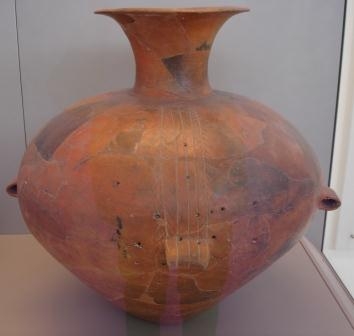
Large burnished pitcher from Boeotia, mid
3rd millennium BC - source Archaeological
Museum, Athens
Cooking ware had a dark surface with impressed decoration. They also developed a dark pigmented slip that, much improved by the Athenians, was used for the later, much admired, Attic black and red figured pottery. This ware developed into Korakou ware around 2,700 BC that came in two finishes, one coated in an unburnished, often mottled, red through to black slip, and the other with a burnished, mottled yellow, pink through to grey slip. Metalwork shapes were copied producing vessels with the appearance of “sauceboats” and high-spouted jugs and inscribed vases that were common throughout the Aegean.
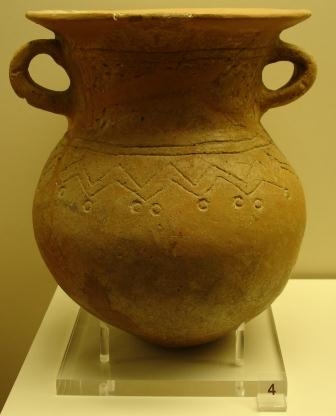
Inscribed Dalmation vase 2,300-2,100 BC -
source Olympia Museum
Other shapes included saucers, bowls, beaked jugs and spoons. Crude cylinder seals were used to decorate large pithoi and parts of ceramic hearths. Pithoi were often used for the burial of children. Figures of animals such as sheep and cattle were common, and occasionally applied animal heads were used to decorate vessels. At Lerna in the Peloponnese small terracotta tiles were used on the sloping roofs of two-storey houses – occasionally painted. Ceramic utility wares included loom weights, spools and spindles that assisted in the spinning of yarn by adding inertia to increase productivity and consistency. Wool was an important source of textiles in ancient Greece. By 2500 BC earthenware brush handles were being used.
The potter’s wheel arrived in Greece around 2,500 BC, prior to which coiling was generally used. In the eastern side of Greece around 2,400 to 2,200 BC they produced red and black burnished wares in a range of new shapes including wheel-made plates, bowls with incurved rims, two handled cups and incised pyxides. In Boeotia in addition they made petal rimmed (crinkled) tankards and vessels with shoulder handles and everted rims called “Bass bowls”. Many of these designs appear to have come via Euboea and the Cyclades.
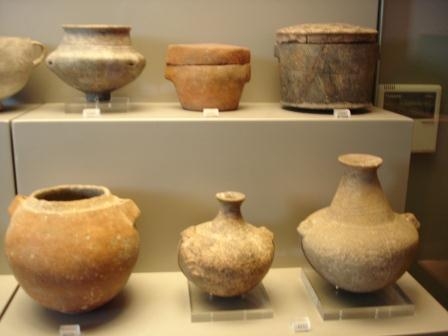
Early Cycladic period vessels, Naxos,
3,200-2,800 BC - source Archaeological
Museum, Athens
They are considered to have originated much earlier in Anatolia (Troy II/III) indicating a Cultural link that probably included the transfer of the technology of the faster wheel. Decoration included pictures of boats and spirals that may have represented waves. They had oared boats that were capable of reaching Egypt; the Cretan versions also had square sails.
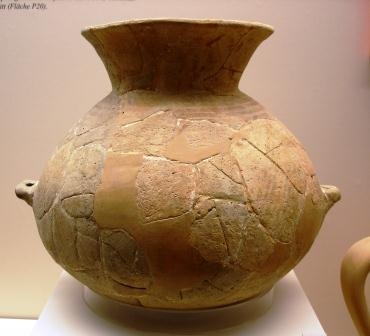
Vessel with fine line decoration (rhs
below neck), 2,250 BC - source Olympia
Museum
Around 2,200 to 2,000 BC there were two notable pattern-painted wares. In the Argolid region of the Peloponnese potters produced fine dark-on-light “Patterned” ware with cross-hatching and triangles. In Central Greece the potters produced a light-on-dark “Ayia Marina” ware. The dark paint on both is moderately lustrous and appears to descend from paint used in the Early Helladic period (2500 to 1900 BC). The use of this dark pigment spread throughout the Aegean. A lot of the more common wares are monochrome using the same dark slip as “Patterned” ware. Shapes common to both wares were two-handled tankards, rim-handled cups, Bass bowls, large jars and Askoi (oil containers). Shapes particular to “Patterned” ware included cylindrical vessels known as “ouzo” cups. Small items are burnished but larger ones are not and are often not well painted and have become known as ‘Smear” ware!
| Page: 254 of 418 Go To Page: | |
◁◁ First | ◁ Previous | Next ▷ | Last ▷▷ |
Author: Dr. Stan Jones © Copyright 2010 -