

10. European Pottery to the Fall of the Romans
| 1017 Page: 255 of 418 Go To Page: |  |
◁◁ First | ◁ Previous | Next ▷ | Last ▷▷ |
The origins of the present Greek people is not certain, but a major contribution seems to have come from an influx of wandering Indo-European tribes, originally from Asia Minor and Russia, but who then settled in the Danube region. They possibly called themselves Hellenes and filtered into Greece around 2,250 BC and again around 2,000 BC. These tribes had fairer hair and were heavier set than the natives. A characteristic of this time is that existing buildings were destroyed and replaced with less sophisticated ones. The newcomers settled with or conquered the indigenous people and mixed with them to become the ancestors of the present Greeks. They brought with them an early spoken Greek language (Indo-European), the flexibility of which contributed to Greece’s later success. It is likely that they also introduced horses. They are also thought to have brought with them their own pottery called “Minyan” ware that was fine burnished monochrome (grey, black, red and yellow depending somewhat on region), thrown on a wheel and well fired in a reducing kiln. There was also a light paint on dark body ware with similar decoration to Minyan ware but favouring the lower half of the vessel, and a dark-on-light ware using matt paint decoration. In the Peloponnese, although practically all other wares were handmade, early fine burnished “Grey” ware, related to Grey Minyan ware, began to be produced on a wheel.
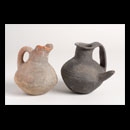
Minyan ware jugs
- source plutarcheio.gr
Around 2,000 BC the potter’s wheel had a wheelhead made of pottery, stone or wood, around 0.5 to 1m in diameter, fixed to the ground with a pivot. In the early centuries of the second millennium this faster wheel became increasingly popular. It was manually spun by an assistant giving rapid rhythmic impulses to it, allowing the potter to throw and draw up the body of the vessel symmetrically. Kick wheels were not in use until about the 2nd century BC. In the catacombs of Thebes there are drawings of the various processes used in the production of Greek pottery dated to 1,900 BC.
The surface of Grey Minyan ware was highly polished and felt soapy to the touch. There was a wide range of shapes and sizes not seen before in Greece, including carinated shapes possibly based on metalwork, particularly from silver cups, together with goblets (with tall ribbed feet) and Kantharos (drinking vessels with two loop handles extending well above the rim). However, sauceboats died out. Decoration was by inscribed grooving of upper portions, as well as parallel arcs and stamped concentric circles. Also at this time there were handmade wares with a white matt painted surface with patterns of lines in dull black and lilac. This style was first found in the Cycladic islands, but widely imitated on the mainland. The potters discovered that manganese-based slip produced a more controllable colour after firing than iron-based slip, so its use increased. The motifs used for decoration were later influenced by Minoan polychrome. Exported Minyan ware has been found on Crete and Anatolia. Larger Minyan ware vessels were sometimes used for the burial of infants.
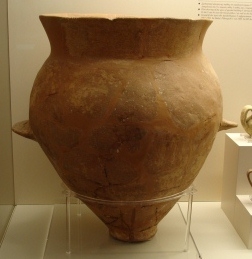
Infant burial urn, circa 2,000 BC - source
Olympia Museum
These immigrant Hellenic tribes were also warriors who had been travelling widely in search of riches to increase their wealth and power, and became dominant in the Aegean region. However, after about 1,700 BC those warrior chiefs in Greece, who were mainly of the Achaean tribe, settled, split Greece between them and ruled as local chiefs in city-states located in the plains between the mountains. The leaders based their power on the control of the distribution of food. They flourished on the Greek mainland from about 1,600 to 1,200 BC. The most influential were based at the site known as Mycenae, where the Culture was first discovered. Accordingly this period is known as the “Mycenaean Age”, and the Mycenaeans represented one of the greatest Bronze Age civilisations.
| Page: 255 of 418 Go To Page: | |
◁◁ First | ◁ Previous | Next ▷ | Last ▷▷ |
Author: Dr. Stan Jones © Copyright 2010 -