

10. European Pottery to the Fall of the Romans
| 1018 Page: 256 of 418 Go To Page: |  |
◁◁ First | ◁ Previous | Next ▷ | Last ▷▷ |
In the earliest phase, Mycenaeans had very rich burials in shaft graves, the contents of which were strongly Minoan in style and content. However, pottery also included local grey and yellow Minyan ware, matt ware and polychrome from the Cyclades. The local Mycenaean pots were black slipped decorated with spirals, ferns and double axes, and creamy yellow slipped with black and orange decoration, although the decorative area was sometimes quite small and not very imaginative.
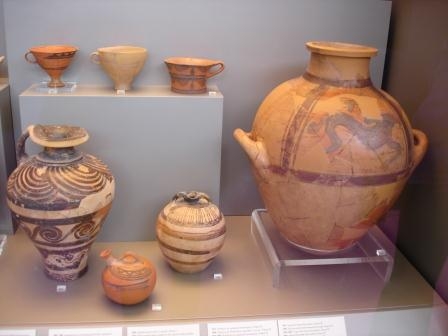
Mycenaean jug with concentric circles and ivy leaves
16th century BC - source Archaeological
Museum, Athens
Faience objects were also made, particularly for grave goods.
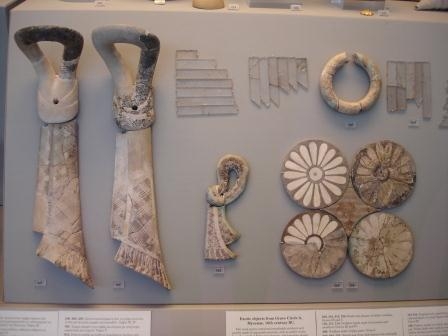
Mycenae grave goods, sacred knots and
rosettes 16th century BC - source
Archaeological Museum, Athens
Early Mycenaean Linear B tablets described a pantheon of gods. They already mentioned Zeus, Poseidon, Hera, Athena, Artemis and Aphrodite. Aphrodite was the Greek manifestation of the fertility goddess that had been worshipped for millennia, and had spread to all cultures and was represented by Venus for the Romans, Turan for the Etruscans and Ariadne in Crete. A group of large pottery figures, most with weapons, coloured dark brown were probably gods as they were found in a cult centre. Apparently the Mycenaeans also had a warrior goddess.
Throughout the period from 1,600 to 1,400 BC, the Mycenaeans were significantly influenced by the Minoan culture that reflected in their designs, technology and development. This is particularly seen in their pottery, reinforcing the likely presence of immigrant Minoan potters in Greece. However, the Mycenaeans soon developed their own superior technique, colour and style thanks to the synergy between the two cultures. This is seen in their increased abstraction of Minoan more natural decorative styles. The Mycenaean vessels were widely used as commercial containers for oil and have been found from Sardinia to coastal Syria. This is very helpful in dating archaeological excavations. Warlike scenes became common in decoration, indicating the difference in Cultures between the Minoans and Mycenaeans. They also produced unique standing female figurines. From around 1,600 to 1,450 BC fine painted pottery reverted to ‘dark on light’ style with cream background and their lustrous black and red paint. Common shapes were the Vapheio cup (cylindrical with single handle), a semi-spherical cup and the narrow alabastron for perfume. There was also a fine new ware that replaced Minyan. It was coloured from black to red, and was most common as a goblet. Patterns usually copy contemporary Minoan ones such as marine life and stylised flowers especially on the goblets.
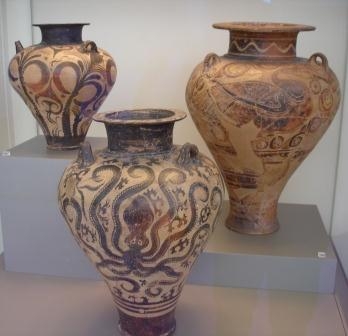
Mycenaean palace amphorae decorated
with octopus, palm trees and birds 15th
century BC - source
Archaeological Museum, Athens
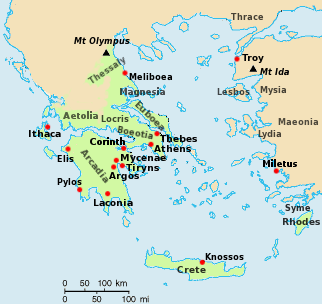
Map of Mycenaean Civilisation
circa 1400 BC - source Wikipedia
The Early Mycenaeans conducted extensive trade throughout Greece, North Aegean and the central Mediterranean, but as the Minoans dominated the Eastern Mediterranean, trade with the Middle East was more difficult. However, Linear B tablets at Knossus show the progressive increase in power and prosperity of the Mycenaeans, and their increase in influence on the Minoans, until by around 1,450 BC they were able to dominate Crete. With this decline of Minoan power the difficulty of Greek access to the Middle East was removed. The Mycenaeans were then free to absorb the Minoan sphere of influence abroad, and to trade more widely, for example with Egypt, the Middle East and Italy. Their control grew to cover a large part of the Aegean, but more as a powerful trader than an empire builder. After 1,450 BC, Mycenaean pottery styles started to flow in the opposite direction - into Crete. Typical patterns were blotchy stipple, ivy, lilies, nautili (large molluscs) and sometimes soldiers and horses. The goblet developed into the Mycenaean kylix, or open drink container, with a shallow bowl and longer stem, and the first stirrup jar appeared in quantity, decorated with spirals and fine stipple. A form of stirrup jar with a “false” spout, that is, to one side apart from the stirrup was particularly characteristic. The Mycenaeans also used pottery for a number of diverse applications including toys and jewellery.
| Page: 256 of 418 Go To Page: | |
◁◁ First | ◁ Previous | Next ▷ | Last ▷▷ |
Author: Dr. Stan Jones © Copyright 2010 -