

10. European Pottery to the Fall of the Romans
| 1019 Page: 257 of 418 Go To Page: |  |
◁◁ First | ◁ Previous | Next ▷ | Last ▷▷ |
In the 14th century BC the Mycenaeans built palaces similar to the Minoans, if a little smaller, and constructed huge fortified citadels with thick walls such as those at Mycenae. They also built the finest tombs, with commensurate fine pottery grave goods.
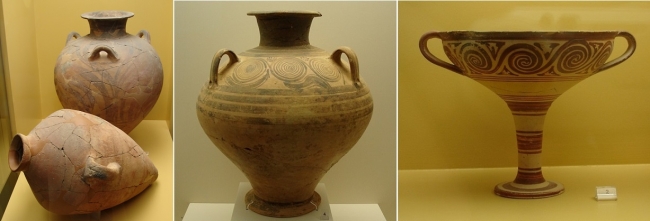
Mycenaean chamber tomb pottery; amphorae,
conical jar with spiral decoration and
stemmed kylix with spirals, 1,400-1,300 BC
- source Archaeological Museum, Athens
The Mycenaeans were centred on the Argive Plain, but similar palaces were found in the rest of the Peloponnese and Boeotia. A system of roads was built suitable for vehicular traffic to improve trade and communications. Such roads were not built again until the 5th century BC. They also had sophisticated water management schemes, including dams, which were built to improve the productivity of the land. The presumption that the Mycenaeans spoke an early form of Greek is based on Linear B scripts found on clay tablets in the palaces that are considered to represent a very archaic form of the language.
Mycenaean pottery was made from levigated clay rather than tempered. After shaping the body, separately made handles, feet and mouths were luted (attached) using slip. Many vases were thrown in sections, base, middle, shoulder and neck. Large pithoi were made by building up successive bands on top of each other. The vessel would then be coated in slip, polished with a wooden, bone or metal tool, dried for many hours in the shade and then decorated with their black or brown slip, before being fired in a high temperature kiln. The striking black or brown surface with a metallic sheen they achieved after firing was due to the slip being self-glazing, as it was an “Illitic” clay, high in iron oxides and hydroxides and very low in calcium oxide. This was very different in composition to the clay of the body that had high calcium oxide content. It is likely that some soda or potash was added to the original red/brown levigated clay to reduce its melting point.
The pottery production process is important to be able to understand the Mycenaean and subsequent Greek decoration, so is described in some detail. The kiln was a two level structure made of bricks and broken pots. There was a chamber dug into the ground with a stoking tunnel, and a circular domed structure where the pots were stacked. A perforated clay floor separated the two chambers, so the flames could rise up between the pots. There was an opening in the roof to release the smoke and let in air, which could be blocked with a slab. There would have been a large opening for loading the unfired pots that was bricked up when the kiln was full and reopened when firing was complete, causing a significant rebuilding of the kiln each time it was used. Later there may have been one or two small spy-holes that could be easily blocked, allowing the potter to check the temperature from the colour of the flames, and the progress of the firing by inspecting test pieces that he removed from the chamber. It took a lot of experience and luck to achieve good results, hence the use of good-luck symbols hanging outside the firing chamber to ward off evil spirits.
The vases were put in the kiln once, but the firing took place in three stages. This method was originally discovered experimentally in the middle of the second millennium BC. By continually feeding the fire for eight or nine hours, a temperature of about 850 degrees C was reached. The vases became incandescent and turned bright red as a result of the oxidation of the iron oxide in the clay to produce red haematite (Fe2O3). At this point in the firing, the source of the oxygen, the roof vent and the stoking tunnel, were blocked, after the fire had been fed with fresh branches to create smoke. The firing continued and at a temperature of about 950 degrees C, with the carbon monoxide making the atmosphere reducing, it produced black magnetite (Fe3O4), turning the vases completely black and at the same time the black slip melted, producing a glassy layer. The potter opened the roof vent and the stoking tunnel again allowing air to circulate cooling the kiln. The oxygen re-oxidised the clay surface where it was not covered by the black slip, restoring the red colour. However, the black slip retained its lustrous black colour as it had melted sufficiently at around 950 degrees C to trap the black iron oxide and seal the vase surface preventing the oxygen from penetrating.
| Page: 257 of 418 Go To Page: | |
◁◁ First | ◁ Previous | Next ▷ | Last ▷▷ |
Author: Dr. Stan Jones © Copyright 2010 -