

10. European Pottery to the Fall of the Romans
| 1020 Page: 258 of 418 Go To Page: |  |
◁◁ First | ◁ Previous | Next ▷ | Last ▷▷ |
The ancient Greek potters did not use specific separate glazes, that is, transparent alkali silicate or lead glazes that completely melt over the surface of the pot. However, the Greeks clearly would have been familiar with the existence of alkali glazes in Mesopotamia. It is likely that a further or different glaze would have spoilt the definition the Greeks could achieve using their own technology; furthermore, they were probably not keen to adopt a foreign technology. Glazes were not introduced until the Byzantine period.
As mentioned before, one of the earliest methods of shaping clay was by moulding. The method the Greeks adopted and improved was to use moulds of fired clay. Simple moulds became more complex as seen in the ones used for the manufacture of the unglazed earthenware figures of central Greece. They went from whole body moulds to components – heads, arms legs and torsos – moulded separately. They were made interchangeable so fewer moulds could make many different figures. This method of manufacturing figures is still used today.
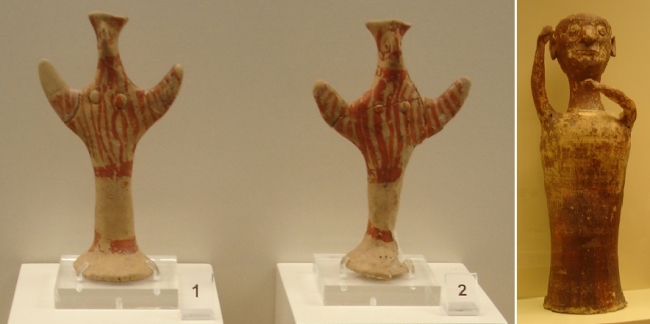
Helladic female figures 1,400-1,200 BC and
anthropomorphic figure 1,250-1,180 BC -
source Olympia and Mycenaean Museums
The Mycenaeans founded trading settlements abroad, for example at Miletus on the West Coast of Anatolia. These sometimes led to colonization, such as with the island of Rhodes. At Tel el-Amarna in Egypt (the Egyptian Capital from 1,352 to 1,336 BC) there was evidence of the presence of Mycenaean mercenaries on a painted papyrus depicting a battle between Egyptians and Libyans, with the Mycenaeans on the Egyptian side. In the 14th and 13th century BC, much of the trade was exporting exceptionally beautiful, pictorial, Mycenaean pottery that became coveted throughout the Middle East, and as far afield as Italy, Sicily, Cyprus (much in burial chambers), Phoenicia, Egypt, Anatolia, Malta and occasionally Spain. Typical examples are bowls and kraters decorated with large motifs, using the whole vessel area as a canvas, with bulls, octopi, egrets and chariots in brown and black on a white or cream ground.
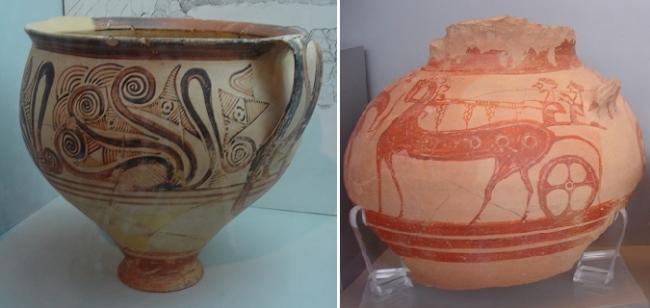
Mycenaean vessels; vase found in Anatolia
1,400 BC and pot decorated with a chariot
14-12th century BC - source Ephesus Museum
and Archaeological Museum, Athens
Many other countries produced pottery that was handmade, heavily tempered with an incised and/or burnished surface, so the fine painted Mycenaean pottery was highly desirable. A significant range of Mycenaean pottery of around 1,350 BC was found in Tell el-Amarna, Egypt.
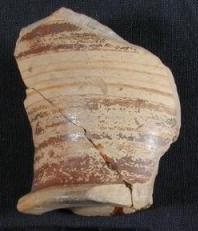
Mycenaean sherd found in
el-Amarna UC734 -
Copyright of the Petrie Museum
of Egyptian Archaeology, UCL
It was essential for the Mycenaeans to export high value products such as fine pottery as they needed the funds to pay for their extensive imports. Even in these early times economics was a powerful force and the elite, who controlled the acquisition and circulation of materials, organised import substitution that for Greece included pottery in exchange for precious metals. As Mycenaean pottery was such an important commercial commodity, it was produced in quantity not only on mainland Greece but also in their colonies on Rhodes and Cyprus, permitting export volumes to increase greatly, with evidence of mass production.
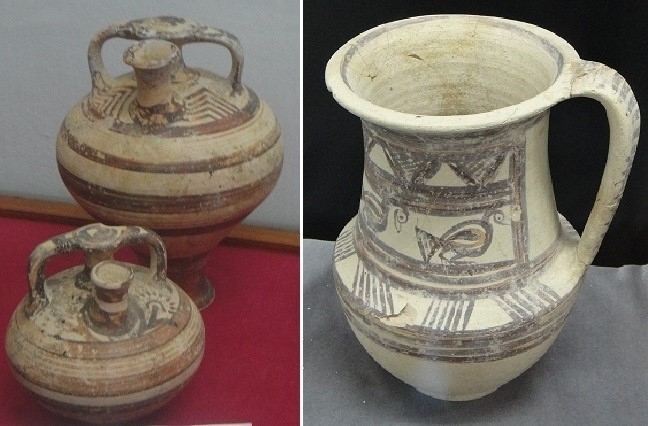
Mycenaean style stirrup jars made in
Cyprus 1,450-1,225 BC and Mycenaean ware
beaker found in Cyprus 1,400-1,190 BC -
sources Guzelyurt and St Barnabas Museums
Items found in a tomb in Cyprus demonstrate the diversity of trade in this period. It contained local Cypriot pottery, faience scarabs from Egypt, cylinder seals from Syria, together with pottery vases and a pottery chariot group from Mycenae. In such Cypriot tombs, Royalty would have fine imported Greek vessels; the lower ranking tombs would have local imitations while small commoner tombs would have neither. There are also illustrations in Egyptian tombs of Aegeans bringing gifts to Pharaohs. Other evidence was from sunken ships discovered off Anatolia and dated to about 1,300 BC again demonstrating the richness and variety of Mediterranean trade at this time, usually carried out by Phoenician and Cypriot ships. Mycenaean decorated metal cups and jewellery reached as far as Wessex and Scotland. There was also trade in glass ingots, some coloured blue with cobalt oxide.
| Page: 258 of 418 Go To Page: | |
◁◁ First | ◁ Previous | Next ▷ | Last ▷▷ |
Author: Dr. Stan Jones © Copyright 2010 -