

10. European Pottery to the Fall of the Romans
| 1021 Page: 259 of 418 Go To Page: |  |
◁◁ First | ◁ Previous | Next ▷ | Last ▷▷ |
After the fall of Knossos in 1,375 BC Mycenaean pottery became even more dominant in the region than Minoan had been. From this date to 1,250 BC Mycenaean pottery is described as “common” or “shared” as it was so uniform, technically and stylistically, whether made in Sicily, Cyprus or the Levant, that it is virtually impossible to determine where it was produced. The kylix became the most common shape in settlements and the stirrup jar and alabastron in tombs. Popular decoration motifs were stylised whorl shells and flowers. Some vessels were imported mainly for their contents such as oil, and medical salves, but others such as the tall-stemmed goblets were valued for their quality of form. The deep painted bowl became popular. Although the technical standards were high, the design of decoration was less inspired and over time became increasingly stylised, so octopi became wavy lines and flowers chevrons. Subsequently there was a move to a single pictorial area on a vessel, rather than whole body decoration, a style that was to last.
Around 1,300 BC people from the Hellenic Doric Tribes in the north started to move southwards into Thessaly. Some 50 years later they moved south again, into the Peloponnese, at a time when there was warring between the smaller-scale palace states, together with damaging earthquakes. At the same time there was a southward move of people from Thrace, overwhelming Euboea and the Cycladian island of Naxos and making life difficult for Attica. It was probably around the middle of the 13th century BC that the Mycenaean Kings sought a common purpose (and enemy) and so got together to mount an expedition against Troy.
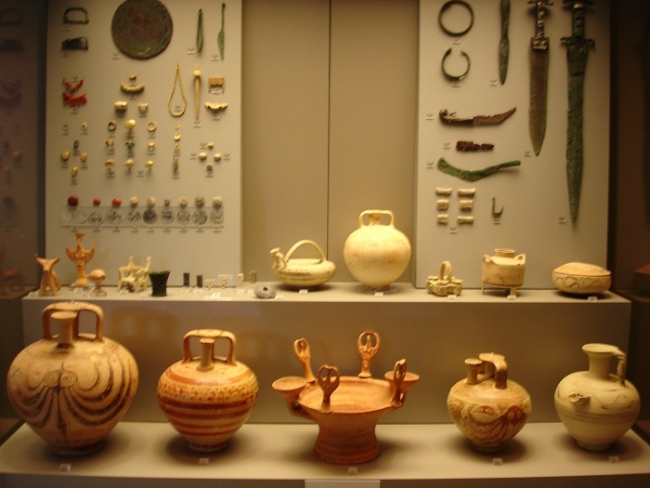
Finds from the Perati cemetery, Greece,
late 13th to 12th centuries BC - source
Archaeological Museum, Athens
This was immortalised by Homer in his epic poem “Iliad” written in 850 BC that, together with the existence of Troy itself, was originally considered to be invented. Now, with the discovery of Troy and its contents, it is thought to be based on the truth. However, it is much more likely to have been caused by Troy restricting trade for the Mycenaeans, so they found an excuse to attack it. Legend blames the war on Helen’s abduction, and relates how Agamemnon, the Mycenaean leader, sacrificed one of his daughters as an offering to the gods because of unfavourable winds! His wife was not too happy about this and on his victorious return she and her lover killed Agamemnon. Although the Mycenaeans won that war, and subsequently Mycenae and other cities had their defences reinforced between 1,250 and 1,240 BC, Mycenae itself was violently destroyed and the palace burnt in 1,220 BC, presumably by an invader, but little data exists.The Spartan capital was also abandoned. After about 1,250 BC, pottery regionalisation grew and exports from the Peloponnese to Cyprus declined dramatically as international trade broke down (the concurrent battles between the Hittites and Egyptians in the Levant would also have seriously disrupted trade). Around 1,190 BC some non-Mycenaean burnished wares appeared that were thought to have originated near the Danube, and possibly brought by the immigrants/invaders.
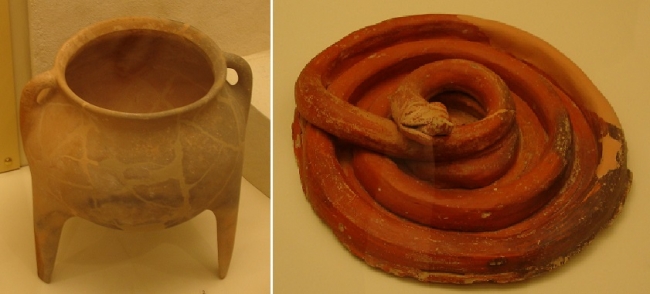
Tripod cooking pot and snake figure,
1,250-1,180 BC - source Mycenaean Museum
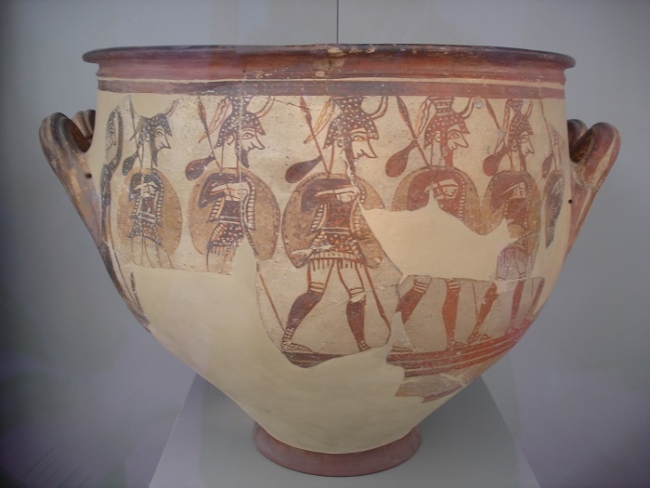
Krater decorated with warriors, 12th century BC
- source Archaeological Museum, Athens
The Mycenaean Civilization came to an end around 1,150 BC and most of Greece, but not all, slid into their “Dark Ages” until around 1,000 to 900 BC, depending on the region. Much of Greece returned to a village economy with a greatly reduced range of pottery shapes and decoration. Although various developments continued, and the term Dark Ages might be a misnomer, the problem is that their Linear B written script was little used for historic records, so written history of this period is minimal and we are reliant on written sources in Egypt and the Middle East.
| Page: 259 of 418 Go To Page: | |
◁◁ First | ◁ Previous | Next ▷ | Last ▷▷ |
Author: Dr. Stan Jones © Copyright 2010 -