

10. European Pottery to the Fall of the Romans
| 1022 Page: 260 of 418 Go To Page: |  |
◁◁ First | ◁ Previous | Next ▷ | Last ▷▷ |
Records of most historical events were left to traditional stories handed on by word-of-mouth, and these were the source of the later, sometimes embroidered, Epic Poetry. Perhaps surprisingly during this period the Greeks abandoned Linear B script and took on the Phoenician alphabet. The Greeks had to add vowels to this alphabet as Semitic languages could be represented without them, but Indo-European originated Greek could not. This ancient Greek writing was used mainly for private communication from around 900 BC, but quite widely from the 8th century BC until the Hellenistic Period.
The four major tribes in Greece and its nearby islands around 1,000 BC were the Achaeans, Aeolians, Ionians and Dorians. During these dark ages the Dorians, who had brought iron swords to Greece, took control of many of the Aegean Islands including Rhodes. They did not believe in a monarchy so destroyed palaces and the more sophisticated Mycenaean artefacts. The Dorians also drove Ionians out of the Peloponnese, some into Athens causing considerable population pressure. At this time the kings of Athens took advantage of the collapse of the Hittites and of Troy and shipped these Ionians over to the West Coast of Anatolia to a relatively small area that became known as “Ionia”, and other Ionians followed. This was about the same time that the Phrygians invaded Central Anatolia. The Ionians grew as maritime traders and flourished, becoming independent, with a confederation of 12 cities, even sending colonists to other parts of the Mediterranean coast. Ionia’s importance is reflected in its sons, as it was the reputed home of Homer in about the 8th, Pythagoras in the 6th and Herodotus in the 5th centuries BC. More generally over the period from 1,200 to 800 BC many Greeks migrated and settled in the Eastern Mediterranean particularly on the coast of Anatolia as well as the Aegean Islands.
In Greece during the dark ages the influx of people from the northern races increased, and over time came to combine their vigour with the culture of the indigenous inhabitants of the Eastern Mediterranean. People started to get together to form new settlements, villages became towns and the military leaders became the landowning aristocracy, and the development of the Greek Nation was underway. In particular Dorians rebuilt Sparta and Corinth, and their different Culture is reflected in their future way of life and their relationship with Athens.
Although from the start of the Dark Ages in Greece the general quality of art had declined markedly, utilitarian pottery items were still produced including jewellery and toys.
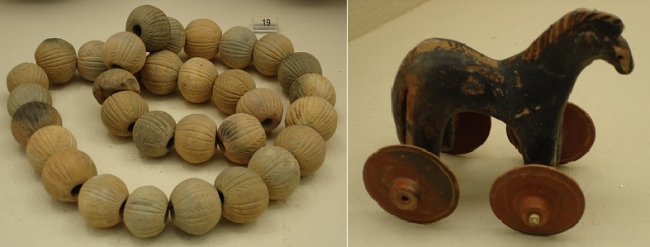
Necklace of pottery beads and
child’s toy wheeled horse, 950-900 BC
- source Kerameikos Museum, Athens
However, pottery was the first craft to recover its standards. After the demise of the Mycenaeans, many clearly defined regional styles of pottery developed in the Greek early Iron Age. Athens had managed to escape much of the troubles, although early in the Dark Ages the last Athenian king was replaced by a Triumvirate made up of a head of the military, chief civil magistrate and head of state – a structure becoming the forerunner to the Republic. Also in the dark ages Athens became the centre for ceramic development. The potter’s clay shaped readily on their wheels, although it produced rather coarse earthenware. Initially, rather crude, stylised Mycenaean motifs appeared (sub-Mycenaean ware), but now they were used to decorate a greater range of sizes and shapes of pots. The pottery of other Regions also recovered and very rich graves containing imported and local pottery have been found in Lefkandi, Euboea, dated to 1,000 BC, and Euboean pottery of this time has been found as widely as Italy and Anatolia.
| Page: 260 of 418 Go To Page: | |
◁◁ First | ◁ Previous | Next ▷ | Last ▷▷ |
Author: Dr. Stan Jones © Copyright 2010 -